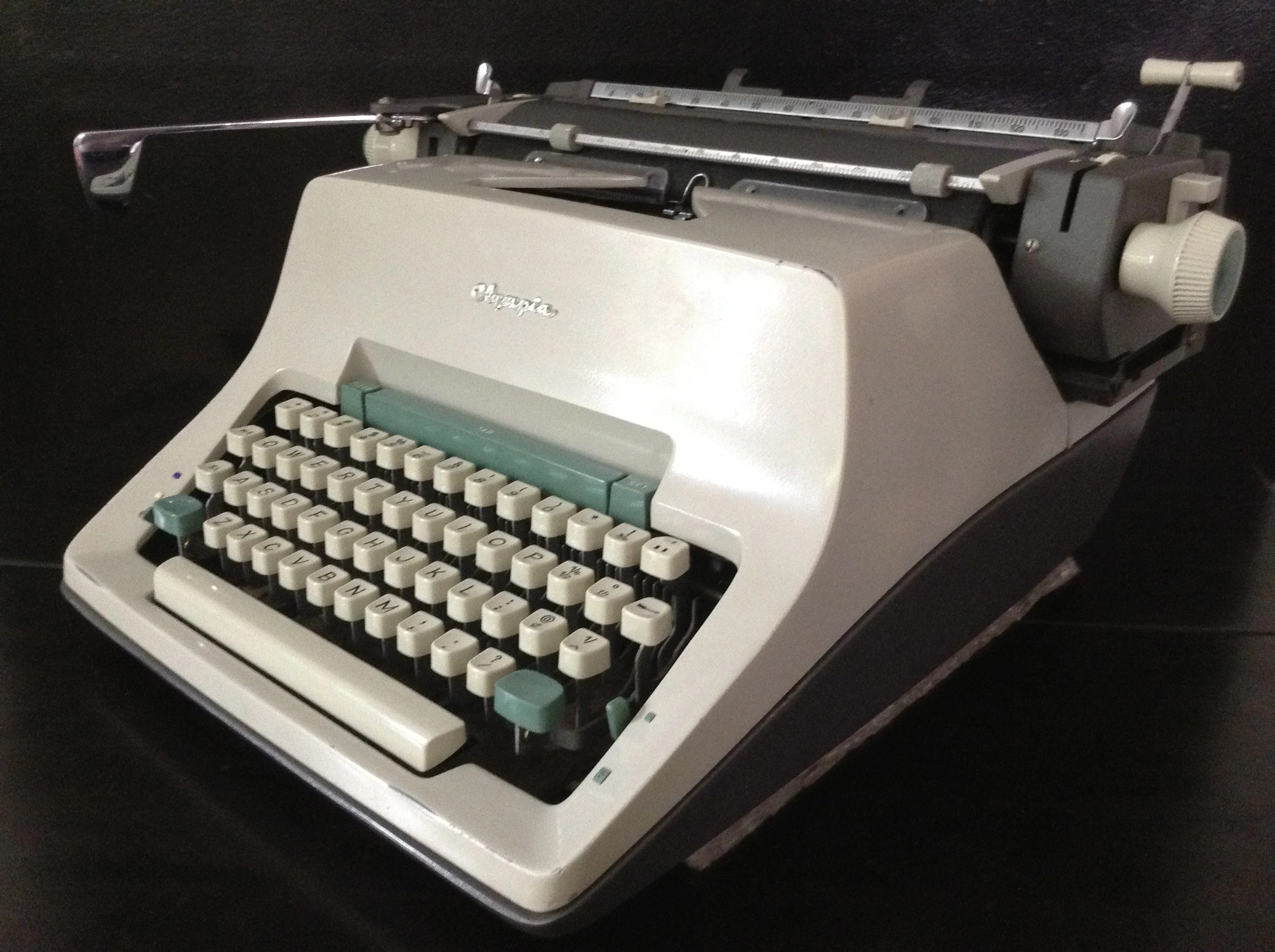
I finished up the Olympia SG1 project and patted myself on the back. Nailed it! Job well done! I fed some paper through it and started some long-form typing—a letter to RRTM—and that’s when the SG1’s residual issues became apparent. There would be no kicking back and cracking a celebratory brewski (ein bier) yet. I saw more work to be done.
1. Ribbon problems
While I typed, I watched the ribbon behaving badly. Out of the corner of my eye, I saw spontaneous stopping, tightening, and reversing while I typed. It drove me batty. I started cussing in grawlix.

There is nothing, I mean NOTHING, I hate more than ribbon problems. The ribbon feed is a fiddly mechanism that can make a perfectly nice typewriter completely unusable. It’s usually a teeny spring that’s missing or detached or loose. Or perhaps a subtly bent part or…
My ribbon problem came from the little flat springs on both reversing arms slipping out out their notches, causing intermittent ribbon reversal and stoppage.
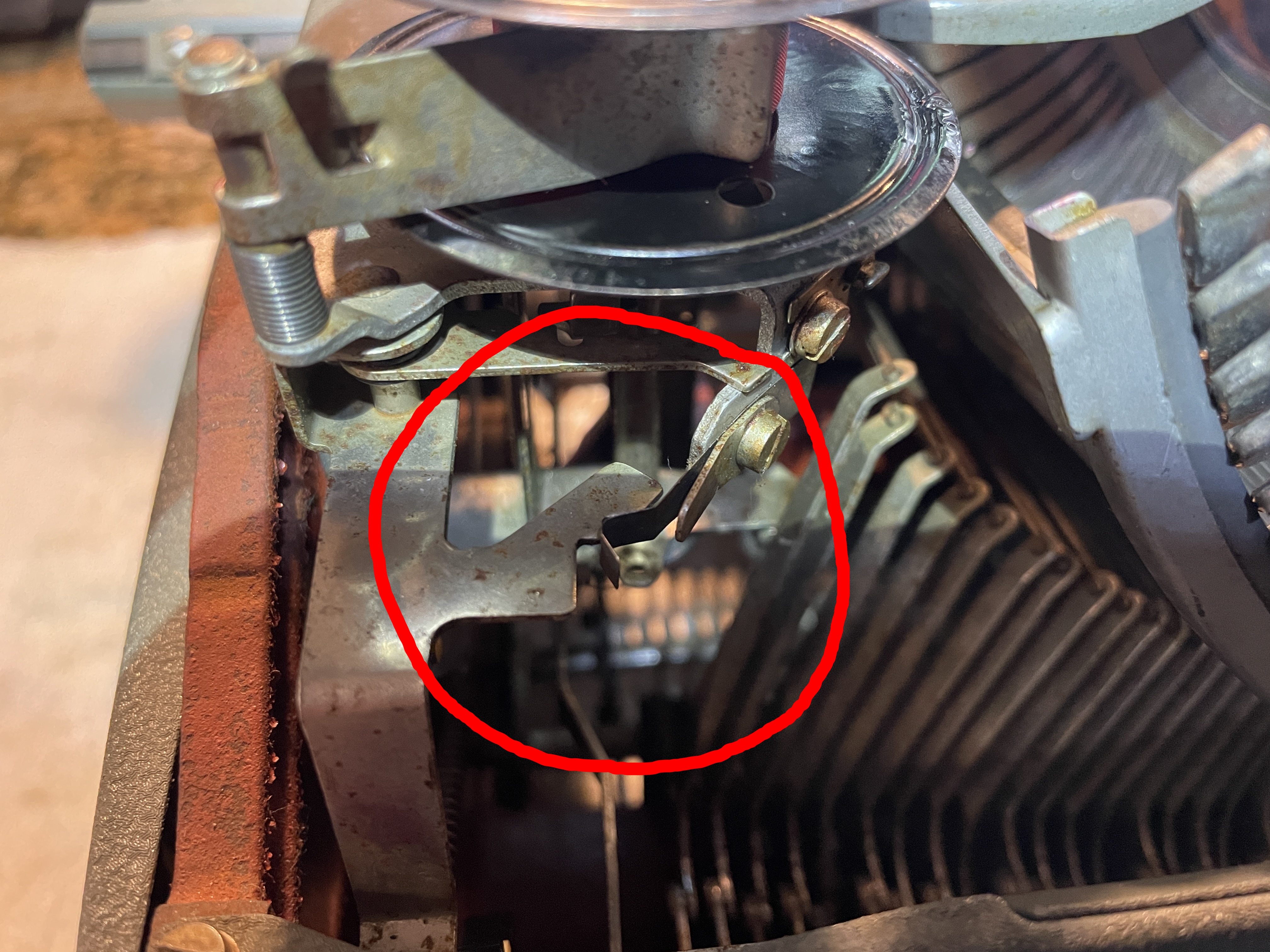
I read the SG1 manual and loosened the adjustment screw that lengthened the linkage between the reversing arms so that the flat springs in the reversing arms stayed put in their notches.
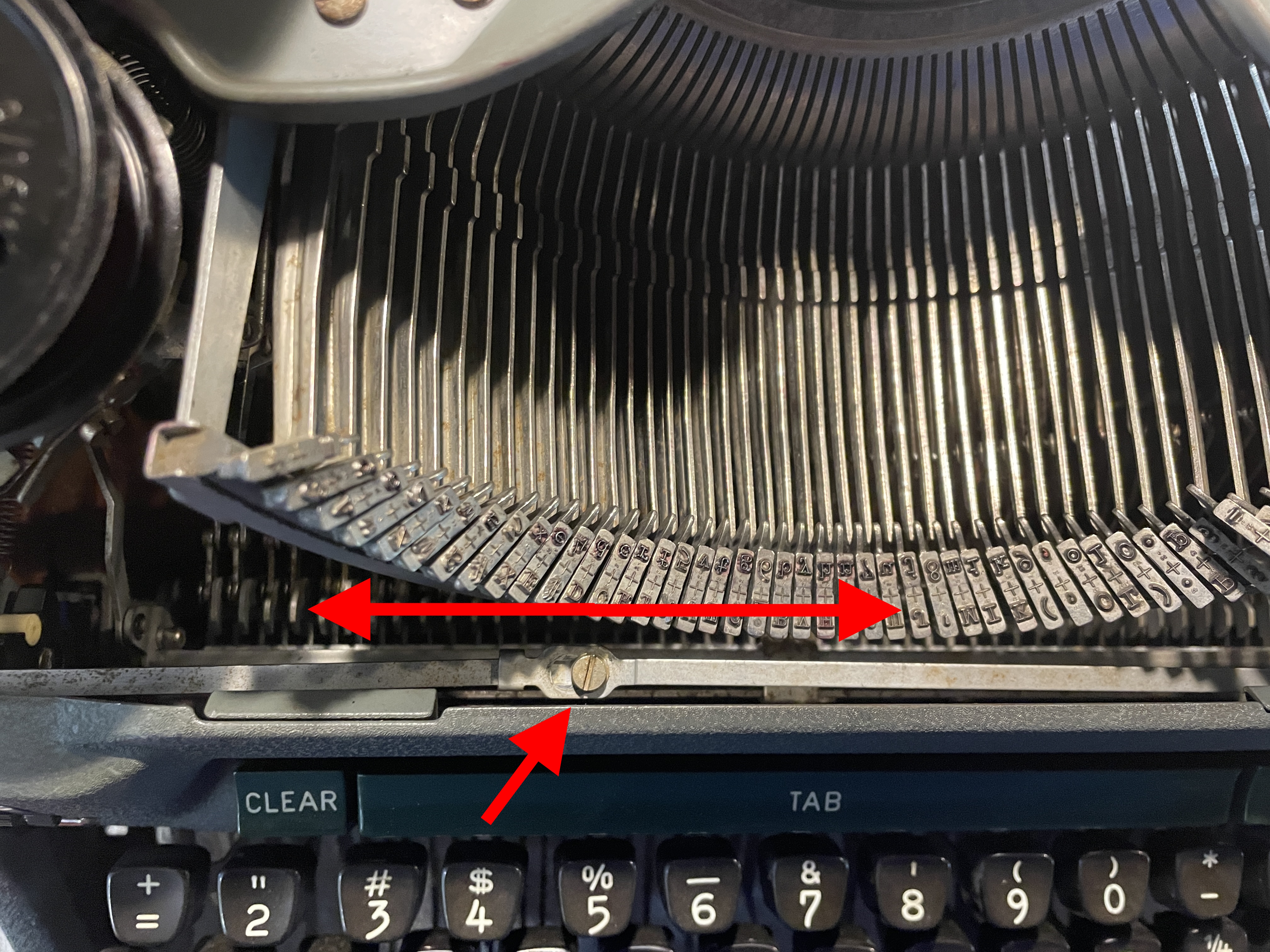
The ribbon is behaving itself now.
2. Stiff letter “E/e”
The key for “E/e” felt just so much stiffer than the other keys. I cleaned and cleaned the segment and sublever segment, but it still felt stiff.
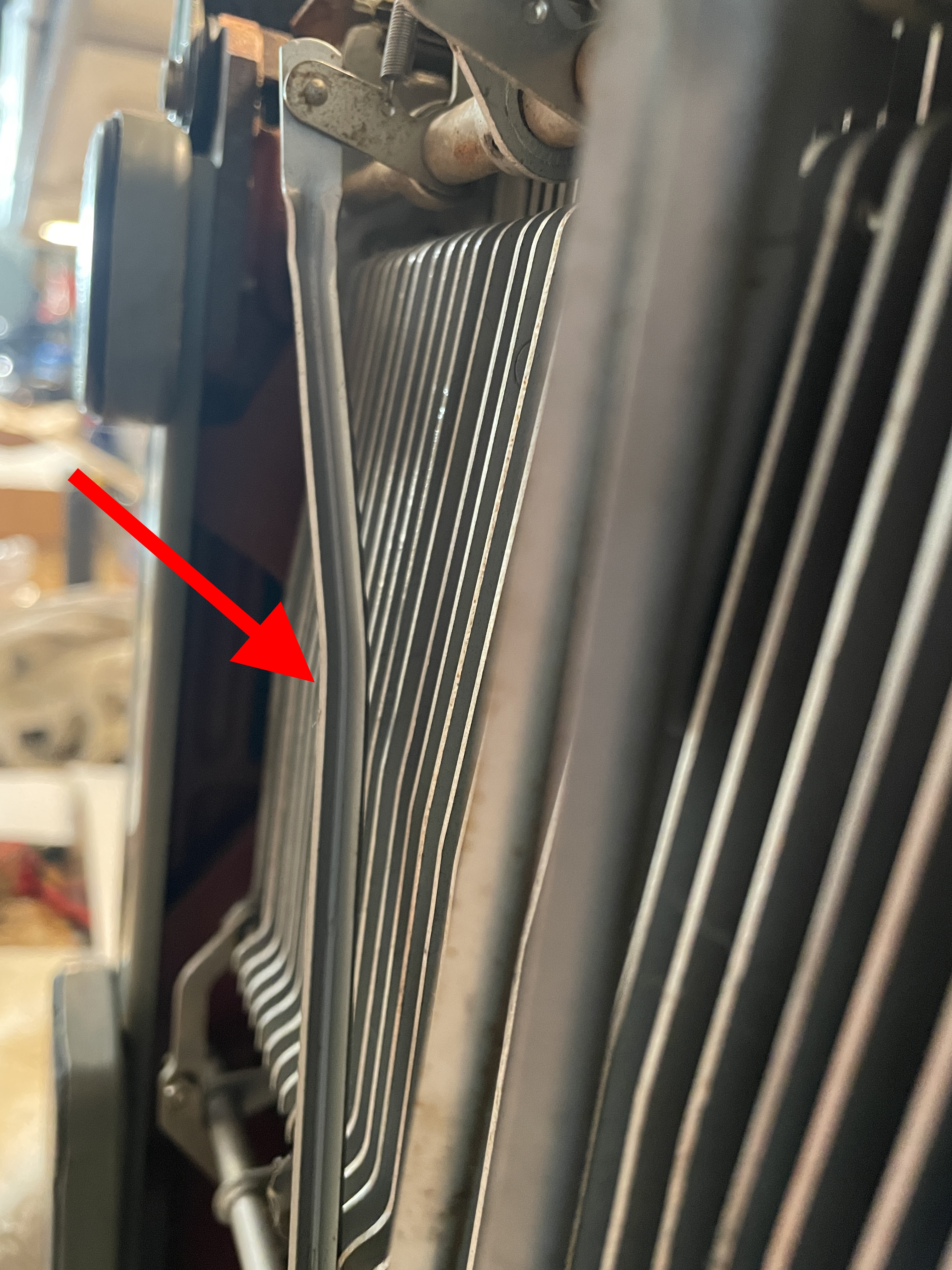
It almost felt like it was hitting something. Hmm. I tipped the SG1’s massive body up, and what do you know? The tab “CLEAR” linkage was bent and obstructing the “E/e” sublever. I straightened it out, and the key was able to move freely.
3. Tabbing causing typing stiffness
While I typed my letter, I found that it took great effort to lay down the first characters of a paragraph—the slugs barely made it to platen. After a word or too, the machine would loosen up and type normally. I determined that the problem only occurred after hitting the tab bar.
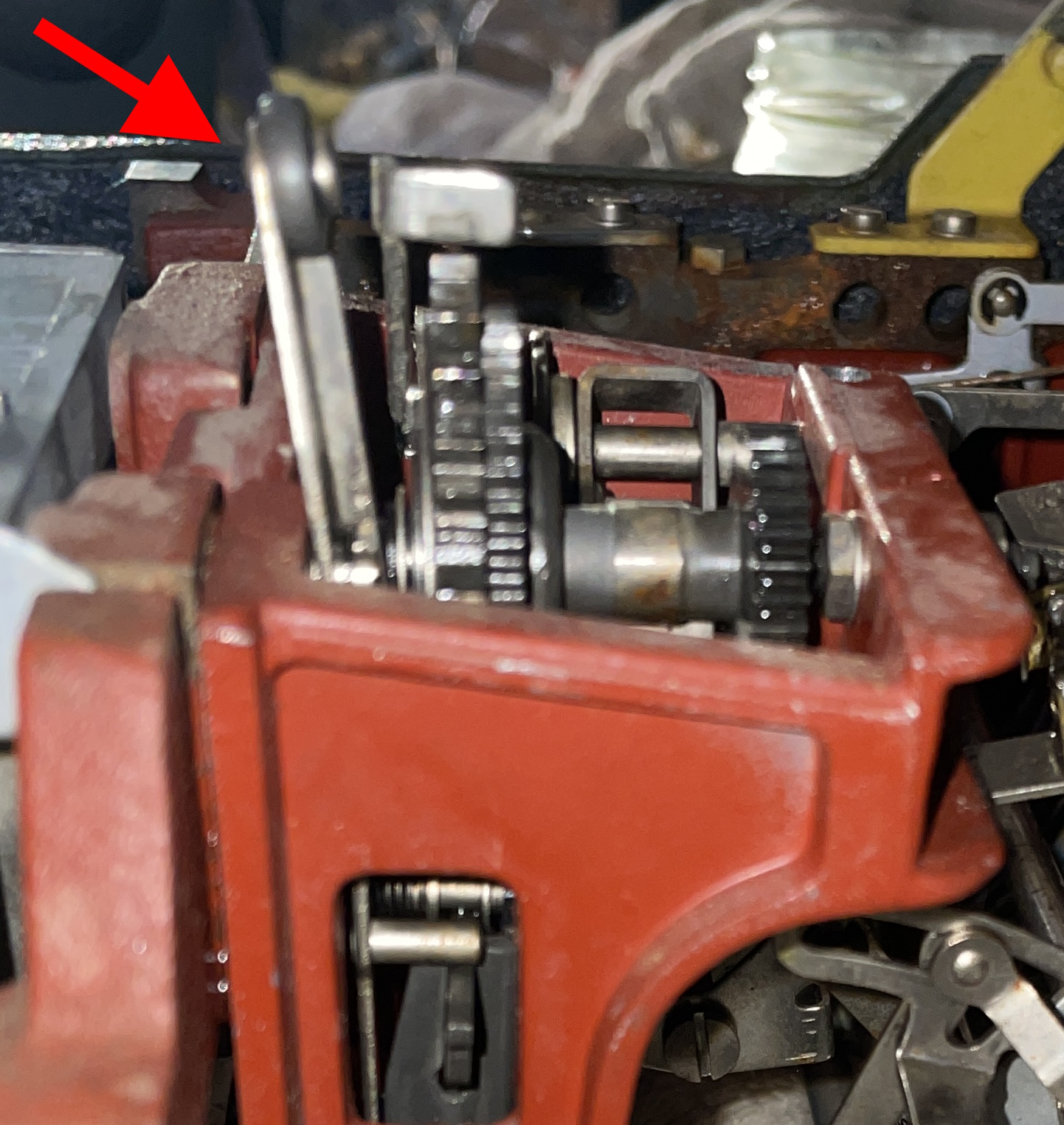
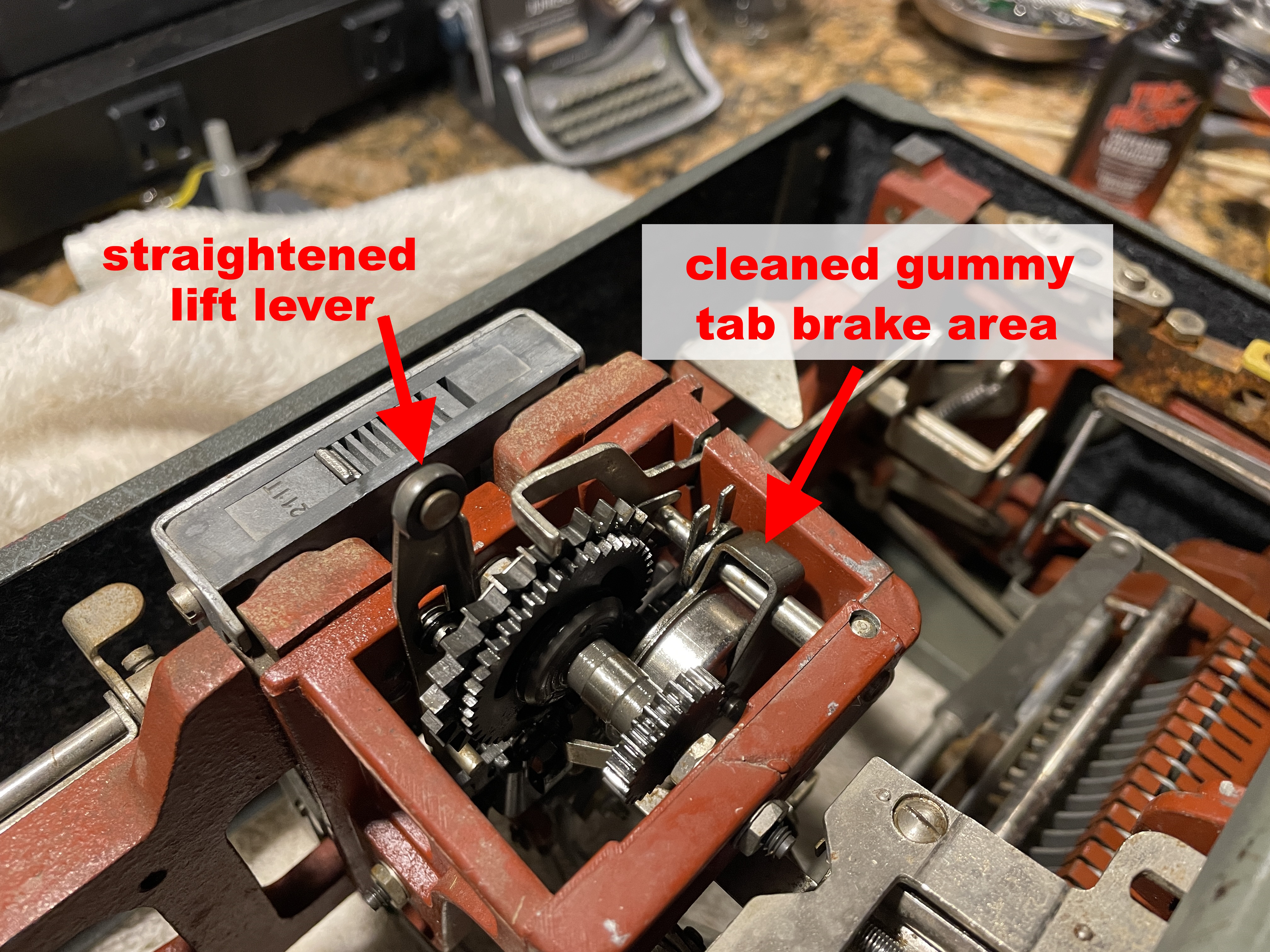
I removed the carriage and followed the tab mechanism through the machine. It ends in the escapement area.
I saw that the “tabulator lift lever with roller” was bent backwards, limiting smooth movement up and down. Also, the tab brake area was gummy, and it wasn’t popping back into position after tab key release. After straightening and cleaning, the tabbing mechanism operated smoothly, and I no longer felt the stiffness after tabbing.
4. Missing paper support
The missing paper support was beginning to bother me. This plastic piece is often damaged or missing on SGs. Heavy machines, fragile extensions—what could go wrong?

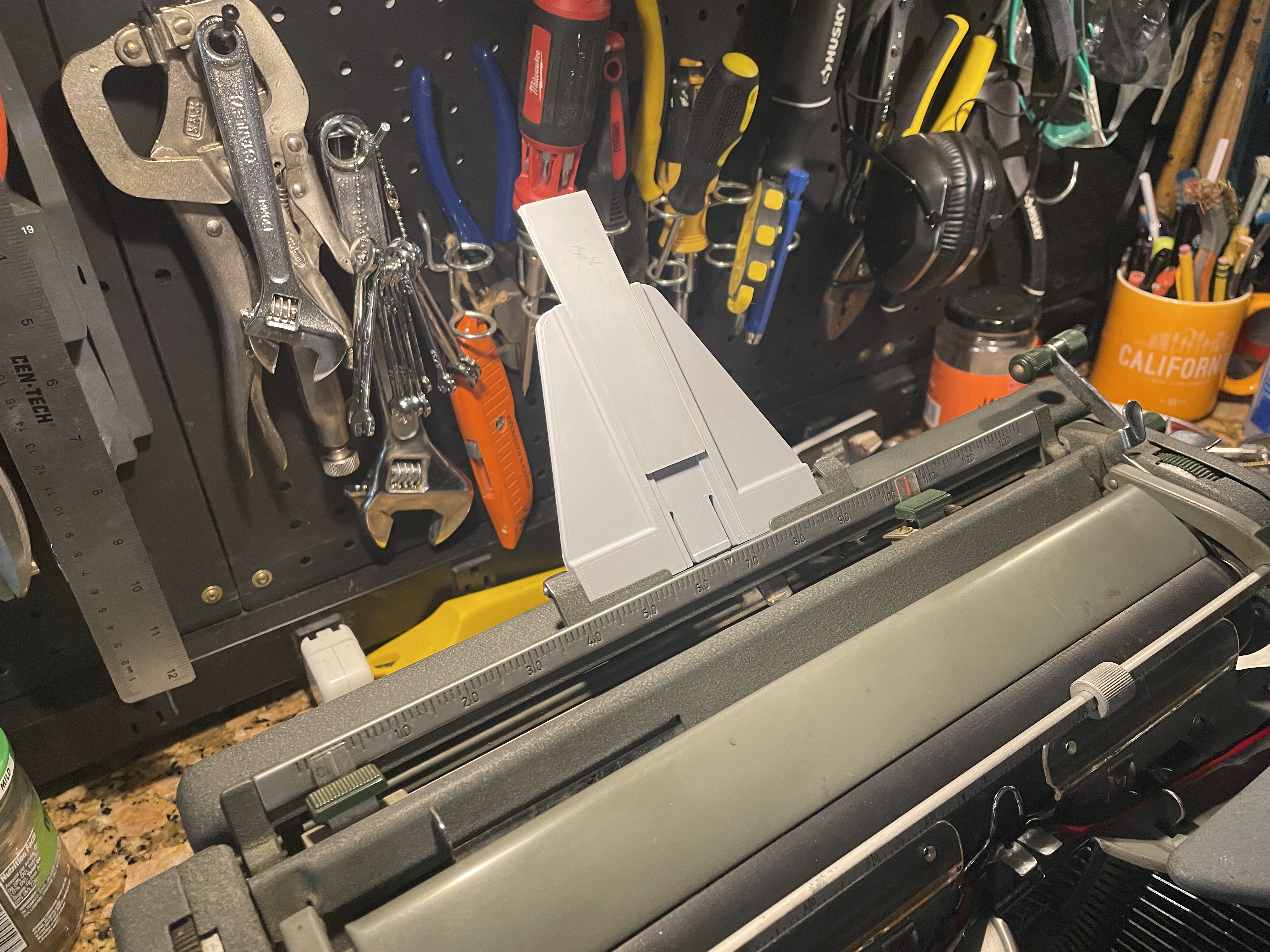
I went to Thingiverse and found that a user has created a 3D print file for the SG paper support.
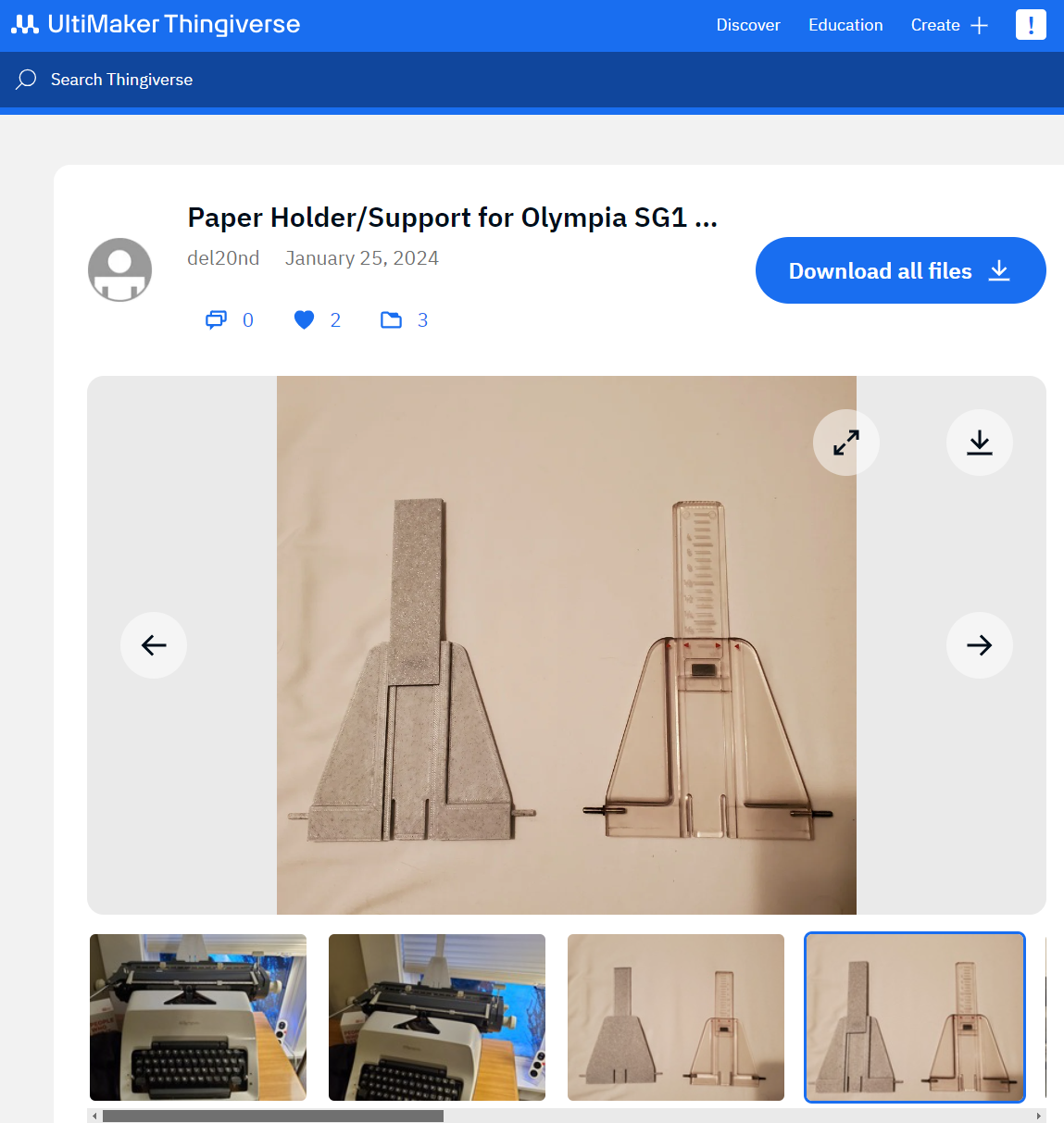
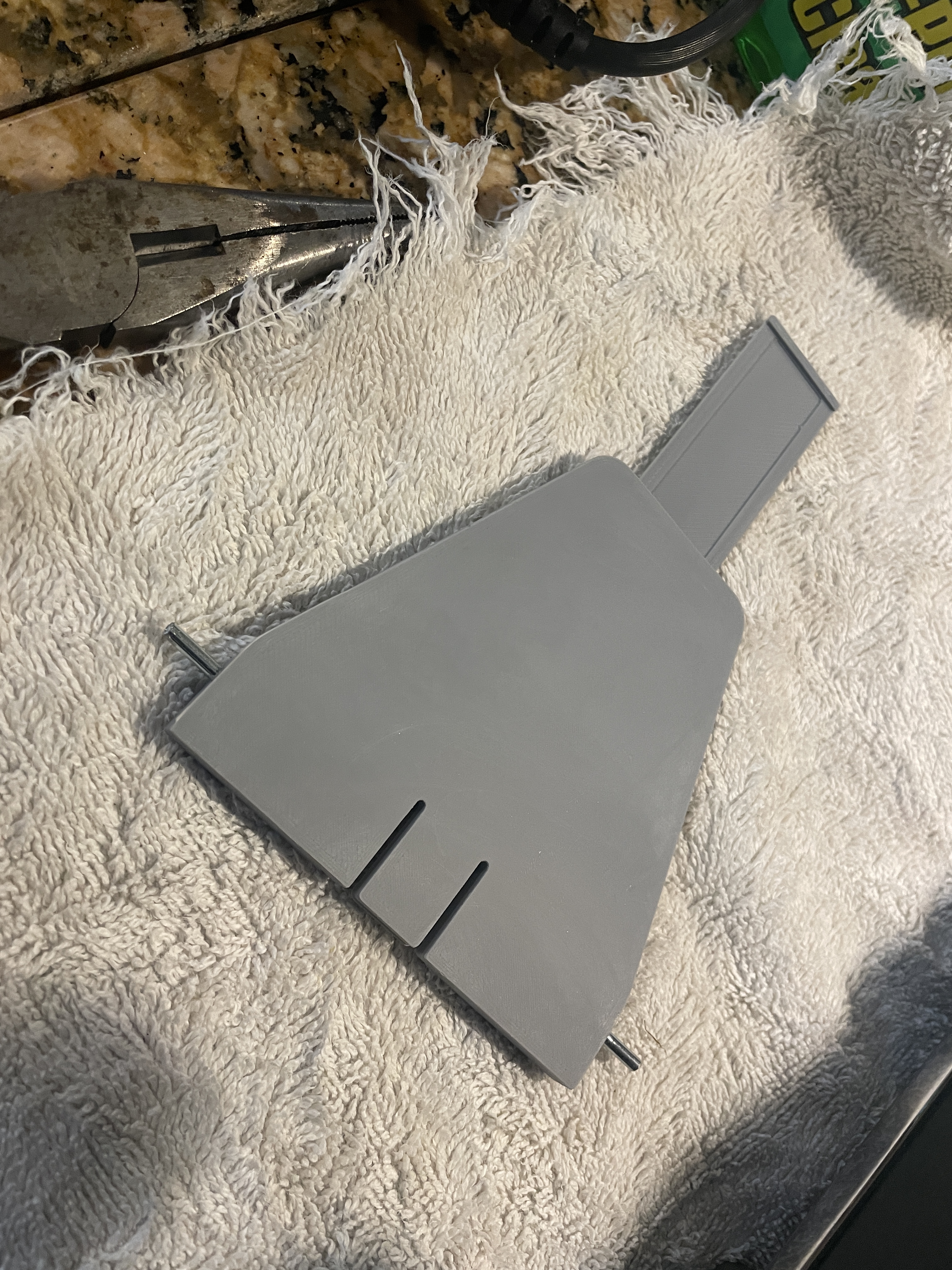
I download the .stl file and submitted a 3D print request to the local public library. For under $2.00, the library printed out the two pieces. It’s pretty great. I cut the heads off a couple nails and glued them in to act as pivot rods.
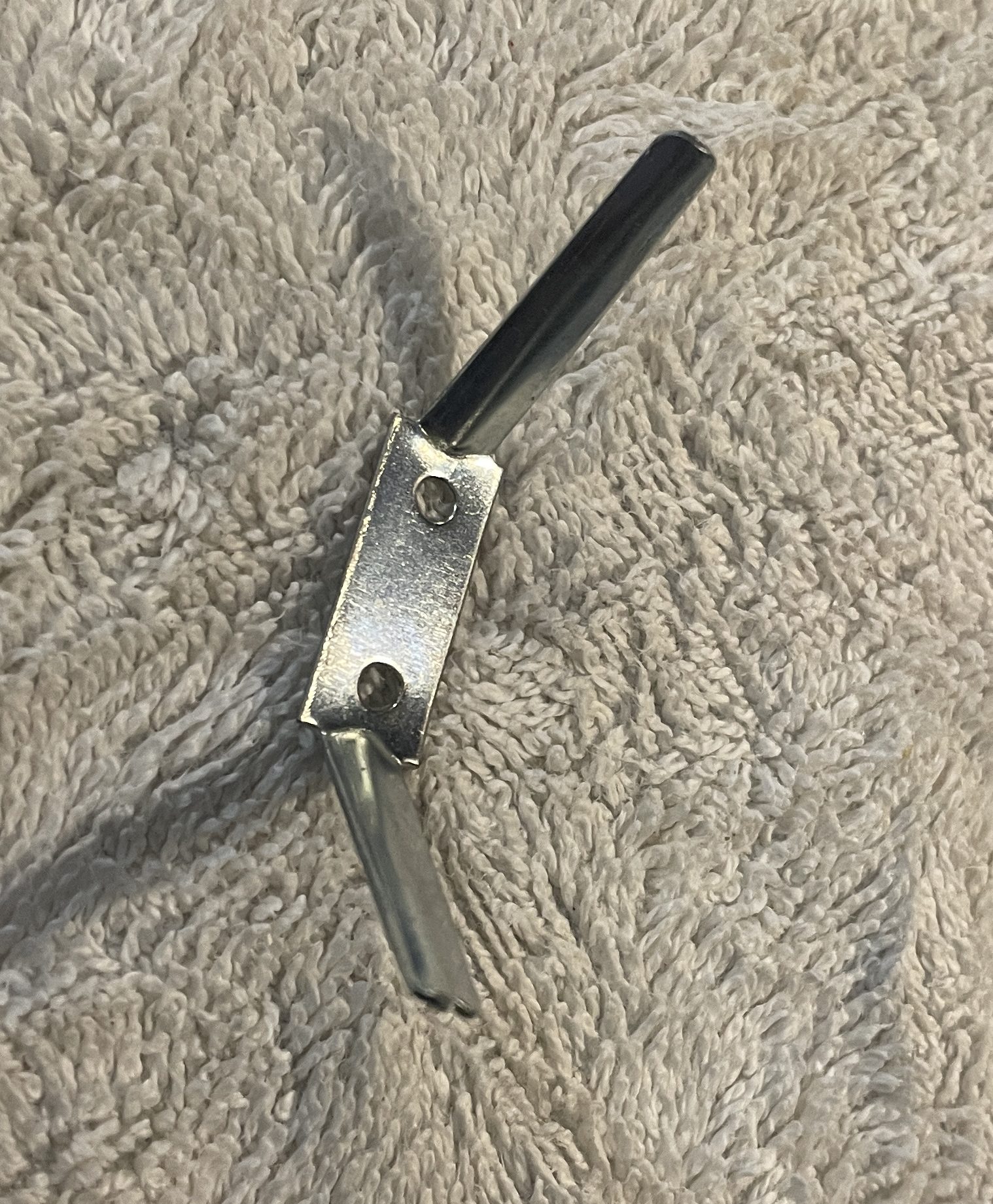
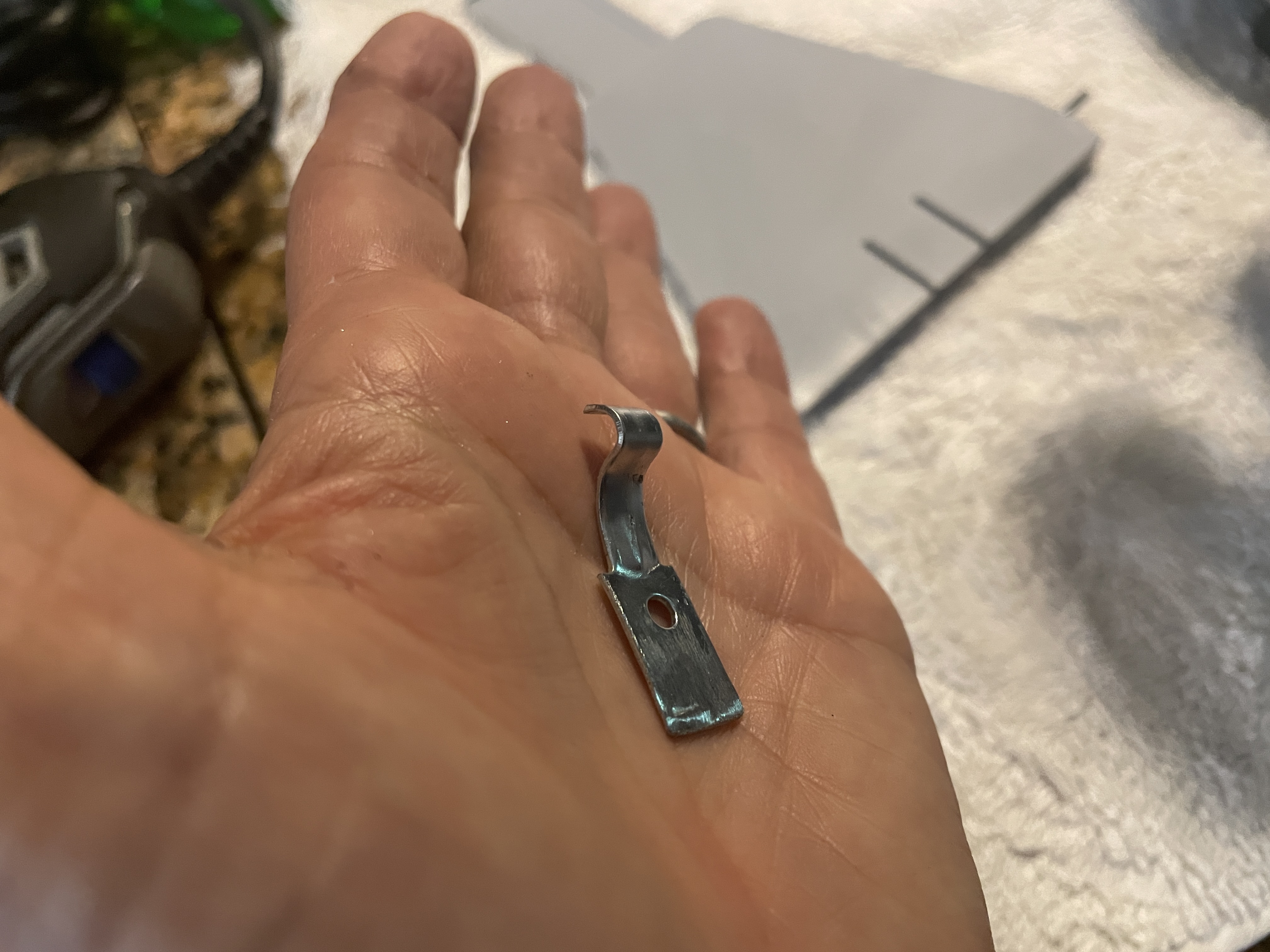
On one side of the Olympia’s carriage, the retaining clip for the paper support had been sheared off.
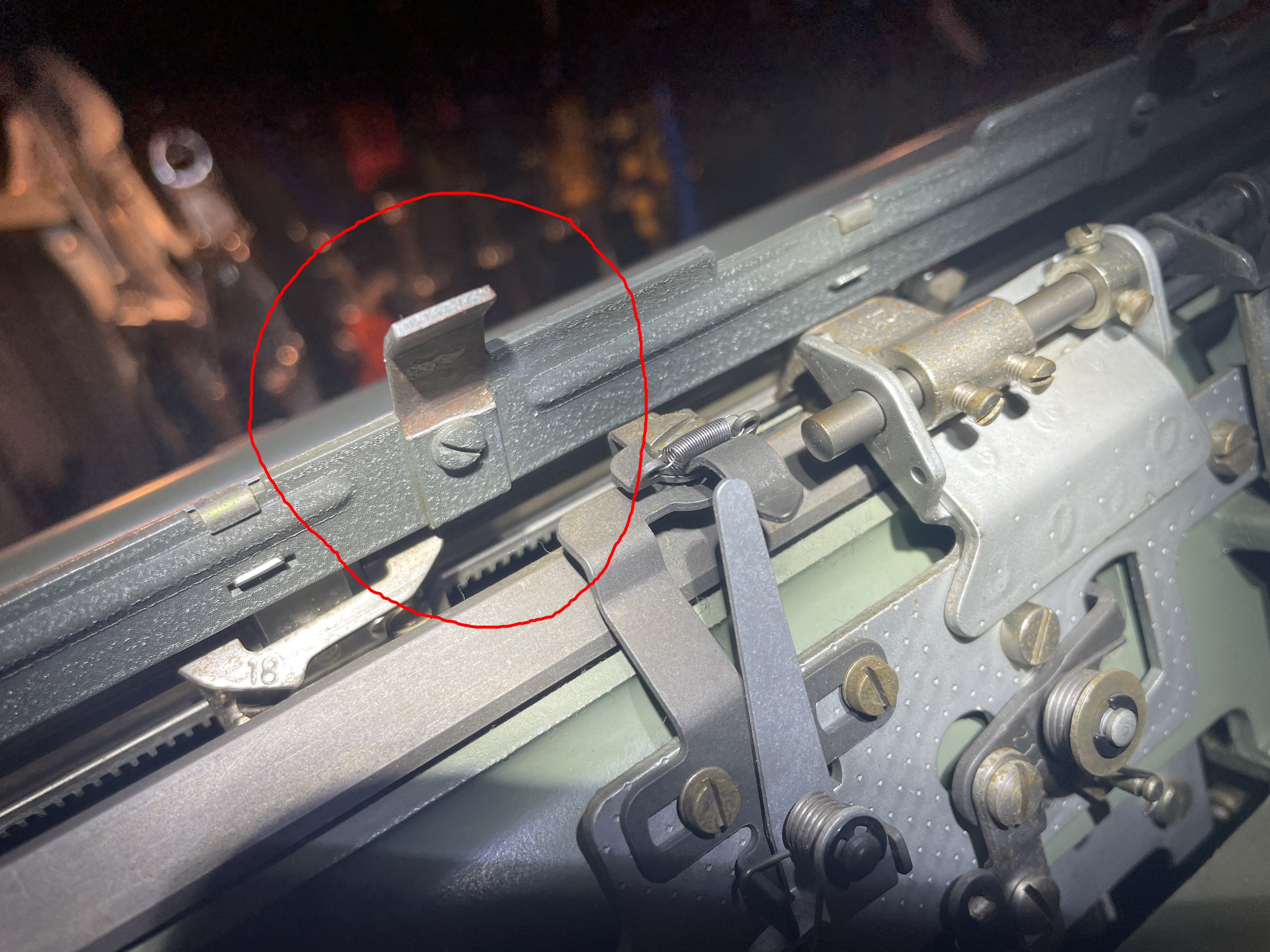
I fashioned a new clip out of a part from my miscellaneous hardware drawer—a window blind tie down anchor.
Looking good, SG1! I prefer the paper support oriented with the insert in front. The creator of the 3D file intends that it should slip in from the back.
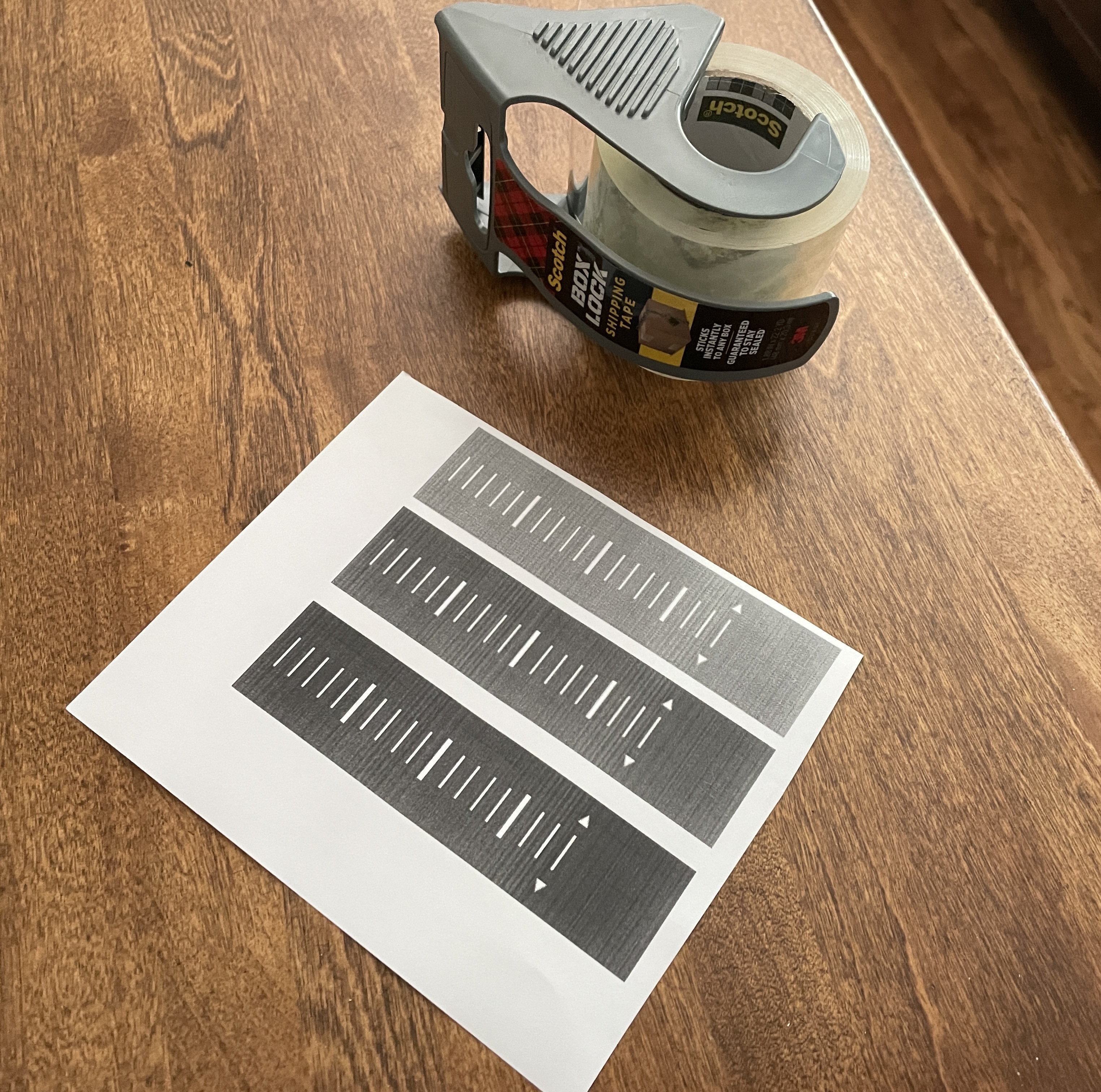
I printed out a scale and “laminated” it with packing tape and then glued it to my paper support insert.
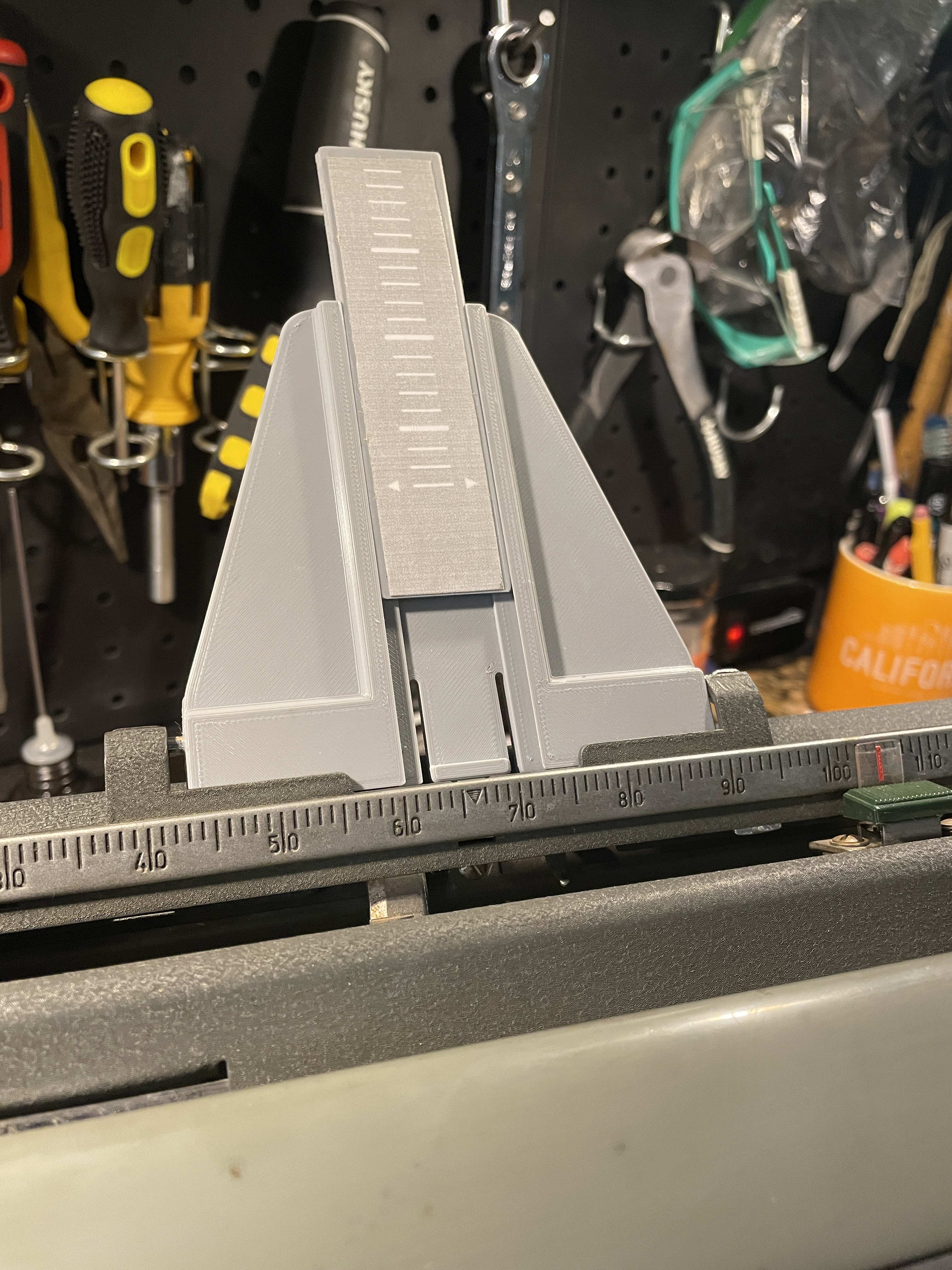

I really love how this first draft turned out, but I am still tweaking the original design. Michael (the owner of the SG1) is going to lend me a vintage paper support from one of his many other SG1s so I can see what a “real” one looks like. I’m toying with the idea of creating a silicone mold and casting a paper support in transparent resin.
When I began working on the SG1, Michael had suggested that I check out the Olympia SG1 Typewriters Facebook group. I joined. It’s a fun niche interest group for fans of these big machines. All SG1 content, all the time.
I am now going to mention something that I dare not utter in the SG1 FB group. Group members love their machines. Me, I haven’t been won over by the SG1—yet.
Most critically, it’s big and heavy. There’s a lot of unironic discussion online about how MASSIVE this person’s or that person’s SG1 is. For me, that’s a significant disadvantage in a typewriter. I can’t move this SG1 without taking off the carriage.
I have recently developed a repetitive stress injury from cradling my newborn grandson’s huge floppy head in the crook of my arm for a month. It’s called Golfer’s Elbow (medial epicondylitis) and I refer to it as Baby Head Elbow. It’s slowly healing, but this SG1 is causing a flareup. Every carriage return (indeed, every keystroke), I can feel the massive machine and its dense mechanics pulling through its functions.
Though it’s certainly high quality, it feels plodding to me. There, I said it. It’s an unpopular opinion, but I’m a girl who just wants to have fun and this particular SG1 is cramping my wild style. Keep in mind that this is the only SG1 I have encountered. I need clean, functional SG1s for comparison before I make any blanket statements. I should have Michael bring one or two of his very best from his stable of SG1s (he has seven or eight or nine—!) so I can evaluate properly.
I experimented with the touch selector adjustment. It does feel lighter set at “1”, but it’s certainly not frisky.
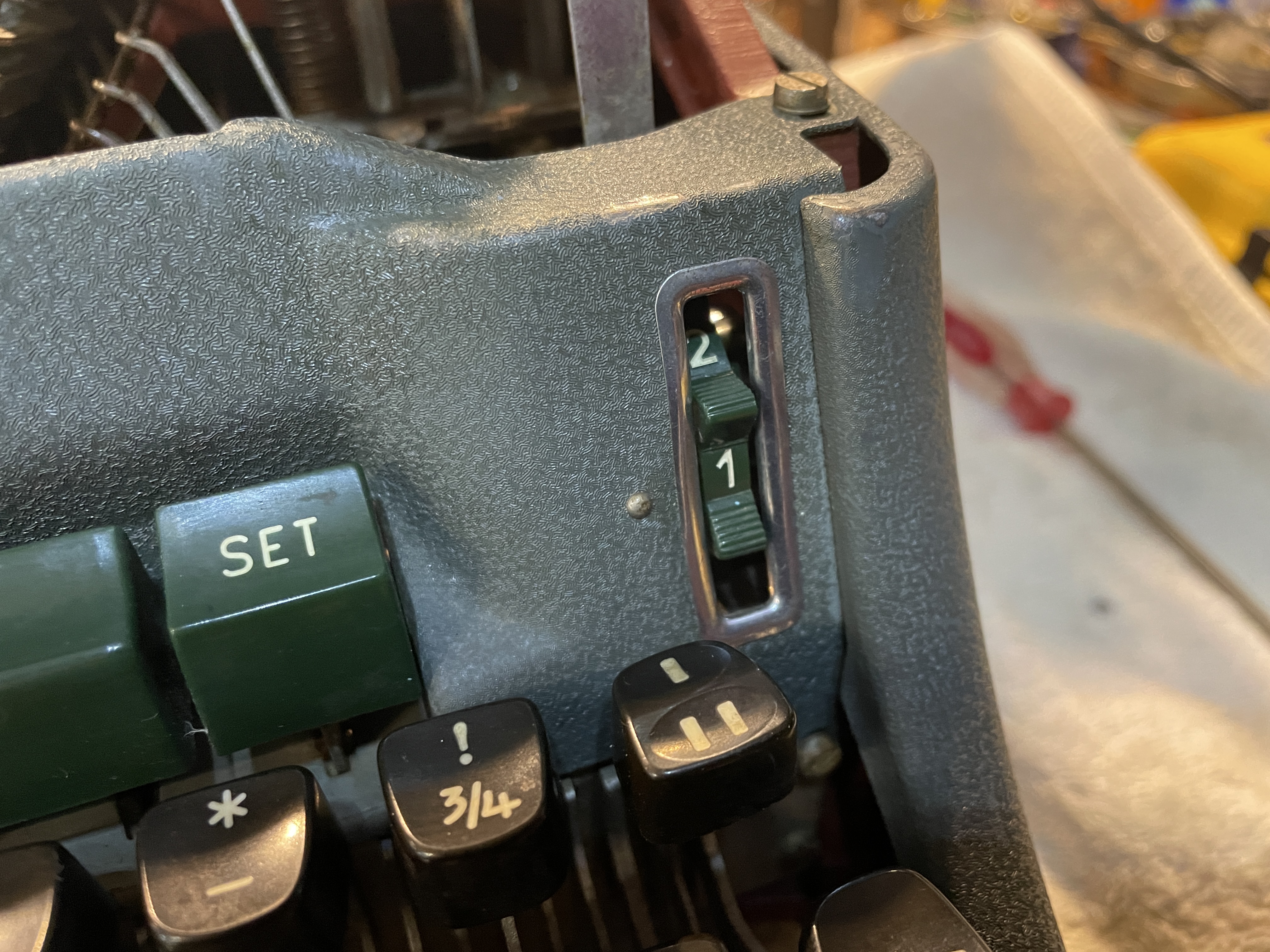
Have I not cleaned enough? I think I flushed it out pretty well, but there may be rust/oxidation/gumminess at any of the zillion pivot points inside this machine that prevents snappy action. The spring loaded key tops should reduce my finger fatigue, but I don’t feel relief.
I admit that it has a controlled, precise feel. It’s not going to let me crowd letters or skip spaces when I type. It will hold me back a bit when I get a little wild-eyed and think faster than I can properly type.
Personally, I like typewriters that let me get a little crazy, that will nimbly follow me down any ill-considered path. Take this KHM. It will skip and crowd, but it allows me freedom to mess up. I have never even cleaned it. It’s still fresh out of the (rotting cardboard) box, but it dances under my fingers.

Or this Underwood 6. It was dirty and full of game pieces, but after cleaning, it was fun and agile, a real pleasure to type on.

So: this SG1 may still be dirty/gummy/rusted/oxidized. It could be out of adjustment, and there may be something I could do to make it feel a little lighter on its feet. The rock hard platen sounds like machine gun and punches holes despite double sheets. Would it rattle me less with a softer platen?
Operator error may be involved. I’m not a touch typist. Maybe this is supposed to feel good and sound good to someone who doesn’t slam the keys like I do.
Operator weakness and frailty certainly play parts as well. If I wasn’t nursing a case of Baby Head Elbow, maybe I wouldn’t feel so worn out using this machine. I worry that I’m also risking hernia or lumbago just removing the carriage. I wrote Ted Munk that I may not be man enough for this SG1.
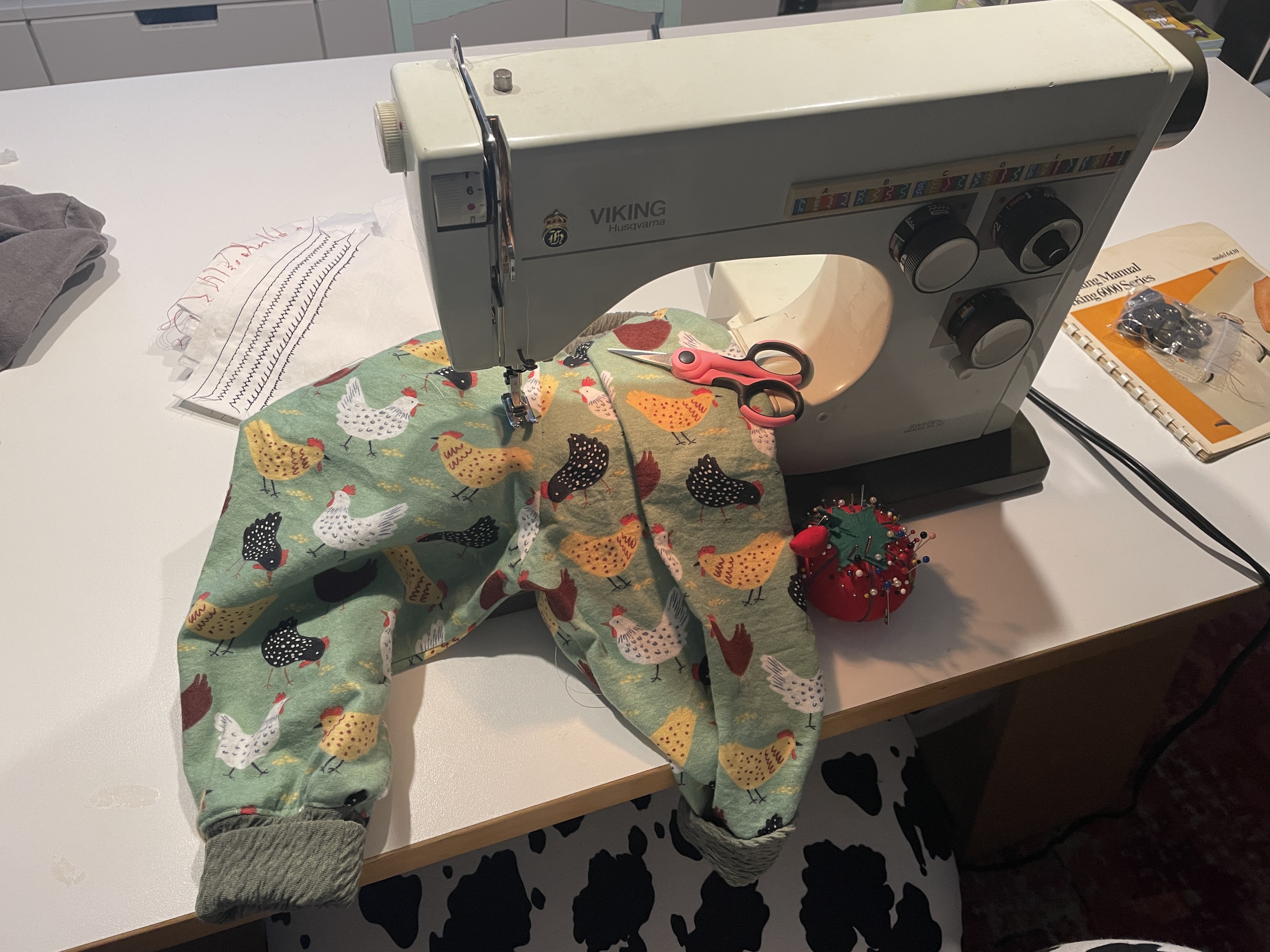
Please don’t report me to the SG1 group. It’s probably a “me problem” and not an “it problem”. I am still forming my opinions. I will carefully operate and move this machine around without further injuring myself. Right now I need to be in peak physical condition, for I am heading out to California this week to see my grandson. He is getting wigglier and closer to crawling, so I made him a pair of chicken pants on my brand new 1974 Husqvarna 6430.
Regarding sewing machines, I am pleased to read that Rev. Munk edges closer and closer to sewing machines and may eventually succumb to temptation. I foresee others falling under their dark spell.
While I am in California, I am going to reacquaint myself with my cool looking 1965 Olympia SG3 (which I wrote about nine years ago) and figure out what feels different between it and the SG1. Though it’s large, I don’t recall it seeming too heavy and lumbering. I will report back.


I enjoy your detailed accounts very much! I love my SG3’s ability to allow my tumbled-thoughts typing without jamming up. I’d always thought SG1’s would be similar. I am “set” as far as standards go so this helps me not hold space for an SG1! I can’t remember where you go in CA., but if at all near Sacramento, a visit w Ole Kehlet would be fun!
LikeLiked by 1 person
This was a fun article! Great job on troubleshooting those problems. I had an SG3 but didn’t like the heavy carriage, it always felt too heavy when doing a return. OTOH, my Royal KMM and Underwood 5 are the bee’s knees!
LikeLike
I owned a couple of SG1s and while they performed flawlessly and their output was perfect, they just never felt “right” to me either. I could never describe it well myself but your use of the word “plodding” was perfect. I sold both of them and later found a mid-1950’s Hermes Ambassador which foreshadows what typing in heaven will feel like.
LikeLike
Nice work on the SG-1. I almost smashed one of those in typing class. To me they are clunky as __________. There are very few Olympia typewriters that I like. Seldom do they compare to the gold standard: Underwood.
The SG-3 is a nicer machine all around. I had one for a while. gave it away at a Type-In.
Gotta watch those sewing machines. They will lead you down a worm hole bigger than typewriters.
LikeLike
Very cool story about making the paper support, I have planned to look into this myself, but wasn’t sure how to go about making a transparent one, which is really what we aesthetically want. I like the resin idea. There are likely places that would fabricate things like this for us, but also likely very pricey!
LikeLike
Yeah, having owned several SG1s and SG3s, none of them thrilled me like I had expected. I find that the typing experience on Olympias varies wildly as well, likely due to level of use, which doesn’t help. The worst part for me is just how heavy the carriage return is, even with smaller platen lengths. I suspect that weight is what makes it feel plodding, even when key feel is light.
But, I have issues with most desktop typewriters. The Olivetti Lexikon 80 has a similar feel, the Royals don’t type cleanly, the Smith-Coronas and Remingtons are uncomfortable. The only exceptions for me are some of the ~40s Underwoods and the Hermes Ambassador (I only had one, and it was 13cpi which just wasn’t happening, I need 10cpi. But what a machine!)
LikeLike
Portables 4-Evah! 😀
LikeLike
Great stuff with the 3D printed support!
Very solidly (stodgily?) built then, these SG1 machines. Could it be their ‘company culture’; even their first device, the Mignon, is imho ridiculously over-engineered for the index-typewriter that it is (that base could also work with several kilos less iron 😉
Always pleasure to read your write-ups!
LikeLike
Thanks Mary, for sharing with us another vintage typewriter restoration adventure 🙂 I’m sorry to hear that your “Baby Head Elbow” may be affecting the use of this newly restored 1957 SG1. Perhaps after taking a break with family and friends in California you’ll be able to compare it with an incredibly well preserved (and maintained), 1963 model that I was fortunate enough to obtain from the original owner. Safe travels!
LikeLike
Excellent work. I like that 3D-printed support!
I have had a couple of SG1s and found that they can feel different. The one I use now feels so good! It’s so snappy and easy that it almost feels electric. I don’t know what the explanation of this is, but don’t give up on all SG1s yet.
LikeLike
It’s been awhile since I typed on either My SG1 or SG3 but I think the word I wound up using to describe the SG1’s feel was “stolid”. Mine came from a well known Catholic prep school in NH, and I suspect since it was a for school use they wanted something built like a tank, and the SG1 certainly qualifies. It’s my only Double Gothic typewriter and in fine shape so even though a long distance move is in my future I will probably keep it, for those times I want to type something that looks like it belongs on a bulletin board! 😀 The SG3 is lighter in touch, but unremarkable. It’s hard for me to make a blanket statement on which of the different categories of typewriters – electric or manual, standard or portable – are my favorites, save for the portable electrics: my Hermes 101 is a real joy, I like to say it feels like a ‘power assisted manual’, not like the isolated feel of most electrics. But if pressed, I would say my favorite standard manuals are my Royal K’s, or for something more modern, my Olivetti Linea 98. The 98 is also a lot lighter than the others with its aluminum (I think, it’s a lightweight metal) main body.
LikeLike
Double Gothic is fun. You can make labels for all your mix tapes 😀 I’m currently evaluating another SG1. This one is a lot newer (a 1963), in much better condition, and it’s a bit lighter on its toes. However, the heavy carriage is still a deal breaker for me.
LikeLike
This was another great post, Mary. Thanks.
LikeLiked by 1 person
This is a great post. I’m sorry you didn’t find joy in the SG1. I’ve never used one myself, but do have an SG3 which is my favorite all-around machine at the moment. I’ve heard reports that the SG1 has a heavier feel than the SG3, and this seems to add to that echo.
Incidentally, I’m the person that designed the replacement SG1/3 paper holder and posted it up on thingiverse.
It was mostly an exercise in learning to use FreeCAD. I got a 3D printer for Christmas that year and was itching for projects. My SG3 has its original paper holder so I didn’t really need one myself, but it was something in the back of my mind to give a shot at designing; 90% of the reviews I read on SG1s or SG3s end on a sad note about how the paper holder is missing. I figured it would probably be useful to somebody someday, and this is the second post I’ve come across in the wild where somebody mentioned printing it, so that makes me happy.
LikeLike
Nick – so you are the mastermind behind the 3D deign for the paper holder! I (and the whole community of sad SG owners with broken paper holders) thank you from the bottom of our hearts. It is close to a perfect replacement. I’d like to try printing it in a transparent material and see how clear I can get the part with post-processing.
Thank you again for posting your design. You’ve helped a lot of people.
LikeLike
Thank you for the kind words! I’m glad it’s solving a problem for so many people.
It did have to be a little bit different from the original because of the limitations of 3d printers. I had to move the center post to the opposite side so that there was a big “flat side” for the printer bed, but otherwise I just copied the dimensions of the original. I did want to add detents for the lines, but honestly just didn’t know how.
I think a transparent green would be awesome for the SG1, maybe a turquoise green for the early SG3 with its accents, and then possibly a smoky transparent grey for the later SG3s. I’d like to see how it turns out using a straight up transparent filament, but you’d probably have to print it solid to avoid seeing the infill lines… unless you picked a cool gyroid or hexagonal infill pattern and showed that off on purpose, which might be cool!
LikeLike
I love the idea of printing in a transparent green or other color and a purposeful pattern infill is brilliant.
LikeLike
I’ve got a long work break coming and so many typewriters to tinker with. I so look forward to your fantastically helpful posts. I’m befuddled and not mechanically inclined, so written tutorials (and videos) are wonderful. Thanks in general!
LikeLike
I’m so happy to hear that my posts may be helpful to another person. I maintain this blog as a kind of mechanic’s personal notebook. I am constantly asking myself, “How did I do that?” and digging through old posts.
LikeLike