Some time ago, I was on the phone with one of my sisters, chatting about death—as one does—and the huge piles of accumulated STUFF people usually leave behind.
In our conversation, my sister directed my attention to the last will and testament of an ancestress who lived in San Antonio when it was a frontier town of colonial New Spain.

In Doña María’s will, the catalog of her worldly possessions is touchingly humble:

This spare list is a sobering inventory. Reading through this with some unease, I felt the weight of my own house full of possessions bearing down upon me. I would like to leave this world with two iron pots and not much else.
I emailed a scan of the original document to my brother-in-law who has a rare enthusiasm for old manuscripts. He picked with pleasure through the almost indecipherable Spanish cursive.
I saw my brother-in-law recently when the family gathered for the holidays, and before I could thank him for his help with the old document, he confessed to me that besides his two front teeth, what he really, really wanted for Christmas was an old Underwood typewriter.
Ah yes, a way for me to chip away at my mountain of possessions and get down to two iron pots. In my garage was DePiglio, a 1922 Underwood 5 who needed someone like my brother-in-law to love and appreciate him.
I got DePiglio from dear Mr E who gave it to me for parts. On arrival to my workbench, the machine had a cracked platen and dog food in its guts. Here’s some ruin porn for the weirdos:


I cleaned out the rust and dog food, recovered the platen and feed rollers with polyolefin heat shrink, and replaced the damaged paper scale with a scan of an Underwood 5 Pica paper scale from Ted Munk’s site.*


Though the decals have seen better days, this old Underwood types like a champ. 102 years old and durable as all get out.
For my brother-in-law, I printed out an Underwood manual from Machines of Loving Grace. Many thanks to MoLG and Richard Polt for his invaluable manuals archive.

DePiglio drank a shot of vodka to steady his nerves before being shipped out
My brother-in-law took DePiglio home with him. The Underwood 5 in its pink stripey bag fit right under the seat on the airplane.

It gives me a heady rush of satisfaction to see DePiglio back in action.

Yesterday, I got a thank-you card from my brother-in-law:
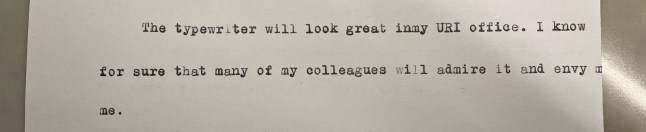
I should have given my brother-in-law a tutorial on Underwood 5 margin setting
The thought of Underwood envy among academics cracks me up.
*
Another typewriter came into my garage right before Christmas. Jean, a local typewriter enthusiast, mentioned to me that she would love to get her hands on two things: a typewriter table and an ultra portable typewriter. She had gifted her Lettera 22 to a friend and instantly regretted its loss. I knew of a super nice typewriter collector named Michael who might have both and bingo, I struck gold. Michael had an 1960s Olympia Socialite and a Hi-Lo typewriter stand:


The Socialite was missing a key top and several screws. It had been dropped at some point and needed straightening out, but was in otherwise good condition.
I looked at the pictures Michael sent. What a pretty little thing the Socialite is: creamy paint, tiny and trim with adorable light green accent keys and knobs. I wanted to eat it up.
I want one.
No, you don’t. Stop it.
I picked up both items from Michael. He included a printed scan of the Socialite instruction manual that he had bought from Antikey Chop’s eBay store.

After bringing everything home, I started with the typewriter table. It had a beautiful end-matched walnut veneer top, but there were some deep scratches:

I did a very careful sanding so I wouldn’t punch through the veneer. Once I got the scratches out, I applied four coats of a wipe-on satin polyurethane. Walnut is a beautiful wood and doesn’t need anything but a clear coat.

Next I considered the Socialite. I don’t know much about Olympia ultra portables, but I found a very interesting blog post about tearing apart an Olympia SF. This Socialite would not need such extreme interventions—just a deep clean, a few screws, some straightening, and a key top.

By serial number (95-747342), it is a 1963 Olympia Socialite.

For cleaning, I removed the bottom and side panels. The foam insulation inside had disintegrated to a sandy dust that coated the interior mechanics:

I dusted out the panels and made new felt inserts.
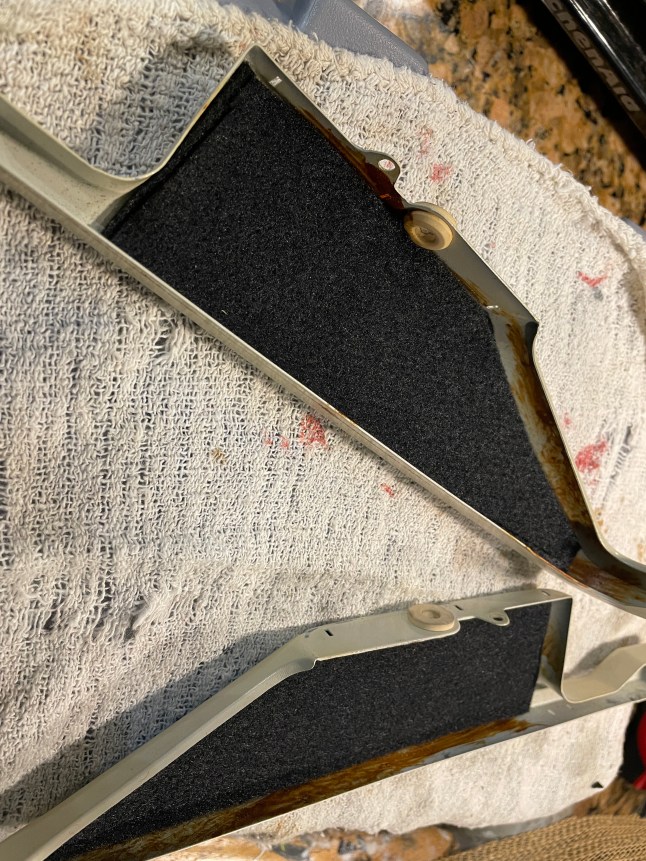
The Socialite had a few very sticky keys that were resistant to my usual light brushing with mineral spirits. In addition to the segment, I had to deep clean the key and sublever bearing frame and bring out the big guns (lacquer thinner and the air compressor) à la Phoenix Typewriter.
I often run into recalcitrant sticky keys on Olympias that require a lot of work to free. Could it be the syrupy residue of some mysterious 60 year-old West German lubricant or glue?
I noticed that on each side there were two stray springs with attached machine screws rattling around inside the machine. They were part of the shifting mechanism that brings the shifting arms back to rest.

I downloaded the Olympia SF Parts Manual from TWDB Operation OOPRAP and found out where the machine screws were supposed to attach.


The “tension adjusting plates” part #06/1840-001.1 were long gone, so I went to the hardware store and bought a couple M3 metric nuts and reattached the springs on each side. Knurled thumb nuts would look better, but hex nuts were what they had. I don’t know if attaching the springs affects the shift touch much, but it’s better than having the springs and screws roll around loose inside.

I also got some metric machine screws (M2.5 and M3) for missing ones. The margin rack was flopping around, interfering with the carriage movement. I had to use a clamp to hold parts together while I got the screws in because the casing was so bent.

After a thorough clean and getting it back together, I tested the typing. It works fine, but the typing touch is not really my style. I’m a slammer and the Socialite is loud and loose when I type. It doesn’t have that precise and expensive touch I feel when I’m on an Olympia SM. Perhaps the Socialite’s traumatic past has rattled it. That said, this Socialite would probably be good for a key massager, someone with a gentler, more refined typing style. Also, carriage shift. Not for me. ‘Nuff said.
The carriage shifting was even more uncomfortable than it should be because the shift key top on the left side was missing. I checked eBay, but I didn’t see any suitable replacements.

I used Tinkercad to create a design which I uploaded to Thingiverse. I then printed the key top in standard green PLA at the Arlington Public Library’s Makerspace.


It was a little rough, but I was very happy with the way it turned out. With some sanding to smooth out the edges, it began to look like a shift key. Even the color wasn’t too far off.

I attached the key top with J-B Weld.

So cute! While I worked on this, I again felt the familiar tug.
Adorable. Just adorable.
I should really get one of these.
No, to have worked on it and played with it a bit was enough. It is time to let it go and send it along to Jean.

Ready to roll out
I will always welcome typewriter visitors to my garage, but from here on out, it’s catch and release for me.
Addendum: I spoke to Michael (provider of the Socialite and Hi-Lo typewriter stand) and he mentioned he had another project typewriter for me: a script typeface Olympia SM9 he picked up on New Year’s Day at the Goodwill in Hampstead, MD for $14.99. The only problem with it is that it’s missing all its keylever springs. Hmmmm. Mysterious!
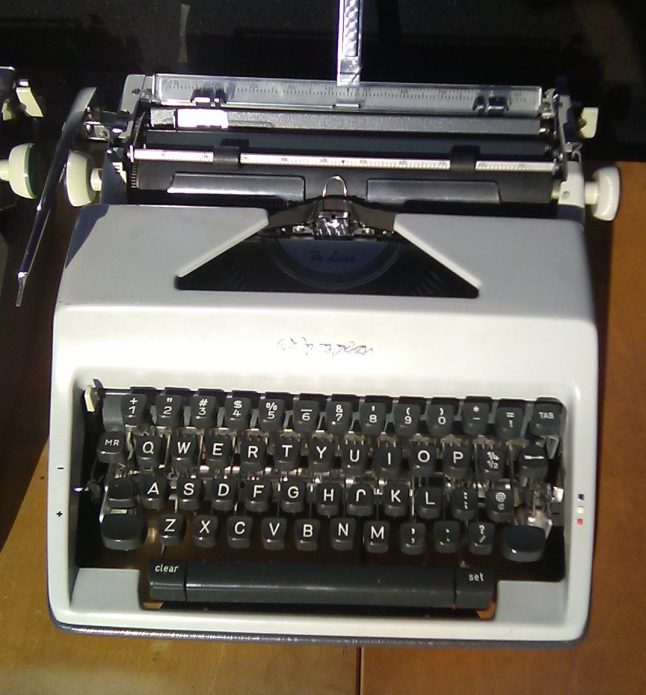
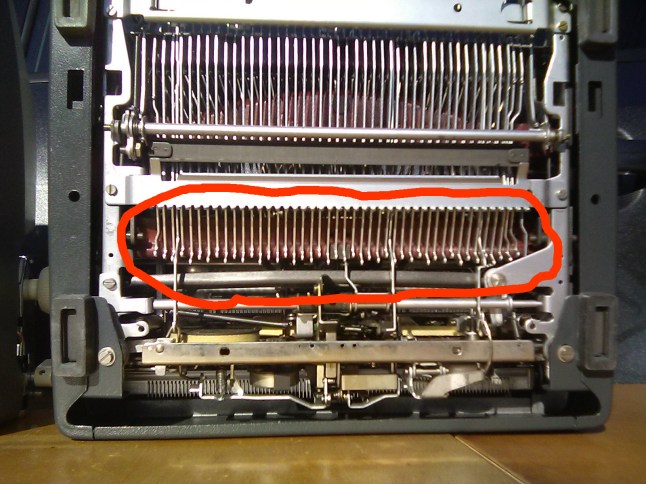
*Looks like Ted Munk did some Underwood 5 catch and release. I am happy to see that Drago is enjoying life in the Land of Enchantment now. [⇑ back ⇑]
 myoldtypewriter
Hello there and happy new years
Thank you for including me
LikeLiked by 1 person
I don’t click through. May I help you?
LikeLike
I’m not quite following you. Are you having problems with links in the post, or…?
LikeLike
All is well. keep typing..
LikeLike
Drago is one of my all-time favorites! Catch and release works!
LikeLike
Drago is such a distinctive creature – I love his color and the way the “w” peeks through the green paint.
LikeLike
Let’s see. The first comment did not work, even after I signed into WP…
Happy New Year.
Excellent work on the typewriters. The Underwood 5 is a fun typewriter to use.
I love those Hi-Lo typing tables. You made yours look great.
LikeLike
Happy 2024 to you! Glad to see that you are able to comment, and yes, those old Hi-Lo tables are quality works of art. I have a Hi-Lo that I move around the house. They really don’t make things the way they used to. The beautiful craftsmanship and attention to detail on something so utilitarian is striking.
LikeLiked by 1 person
What I failed to mention is that I have used heat shrink for years to repair damaged platens. None were as damaged as the one you did. That is amazingly nice work.
LikeLiked by 1 person
Happy New Year Mary, and thanks for sharing yet another great story! . . . and I hope that Jean loves using the Olympia Socialite as much as you did restoring it 🙂
LikeLike
Jean just picked up the the Socialite and the Hi-Lo table and she is beyond DELIGHTED. Thank you for making this happen.
LikeLiked by 1 person
Excellent work, as always. Typewriters do tend to multiply and create their own clutter of paraphernalia … I’ve got way too much of it.
LikeLiked by 1 person
As usual, this is inspiring work. I love the 3D-printed shift key!
LikeLiked by 1 person
I have a 1964 Remington Standard that had terrible disintegrating foam pads as on one of your machines. It’s a very basic question but I was wondering what you used to attach the new foam panels to the frame. I was thinking of using rubber cement, but maybe there’s something better.
LikeLike
I used basic craft glue, but in hindsight, I think rubber cement would have been a better choice since it can be easily reversed. Here’s a post by Ted Munk on the matter:
Soundproofing a JP-1 Typewriter
LikeLike
Thanks, very helpful–and I meant to write “felt” to the plastic side panels rather than “foam.” I’m not too worried about the sound, but, even so, I’d be nice to have things as close to what they once were as possible. In any case, I was able to find the original manual for the Remington by following a link on your blog–and I appreciate that. Best wishes.
LikeLike
Another great restoration Mary 🙂 and good luck with that “Goodwill find” Olympia SM 9!
LikeLike
After reading this I decided the perfect gift for my son’s birthday would be two 1967 machine from my collection: a Remington 24 and an Underwood Touchmaster Five. Perhaps not the fanciest or most treasured models, but both in fine shape and ready for new homes. He loves them. And underneath their “modern” exteriors are internals nearly identical to their 1940s (and earlier) forebears.
LikeLike
I enjoy spreading the wealth as well, knowing the typewriters are going to a good home.
LikeLiked by 1 person
Nice work on the 3-d printed shift key. I have a Socialite with a broken name badge, I wonder if you know how I might go about 3-d printing something like that? More intricate and probably much more difficult to model, I know. But maybe working from a picture it wouldn’t be so bad?
LikeLike
3D printing a broken name badge sounds like such an interesting project. If you start with a very clean, high-resolution image of a Socialite name badge, I think you could come out with something pretty good.
LikeLike