A local typewriter enthusiast named Ross has a stable full of Royal portables. These fine fillies are spirited creatures, but after 70 or 80 or 90 years of being ridden hard and put away wet, many need attention. I recently worked to fix some nagging issues on a 1950s QDL and a 1939 QDL, and he had another 1930s De Luxe that I looked at.
The 1938 Royal De Luxe had a number of things going on with it:
- Backspace not working
- Carriage return lever hitting the lid
- Touch Control lever jammed
- Capital letters hitting lower than lowercase
- Loose carriage
What a beauty—I almost hated to touch it. Serial number A732575.
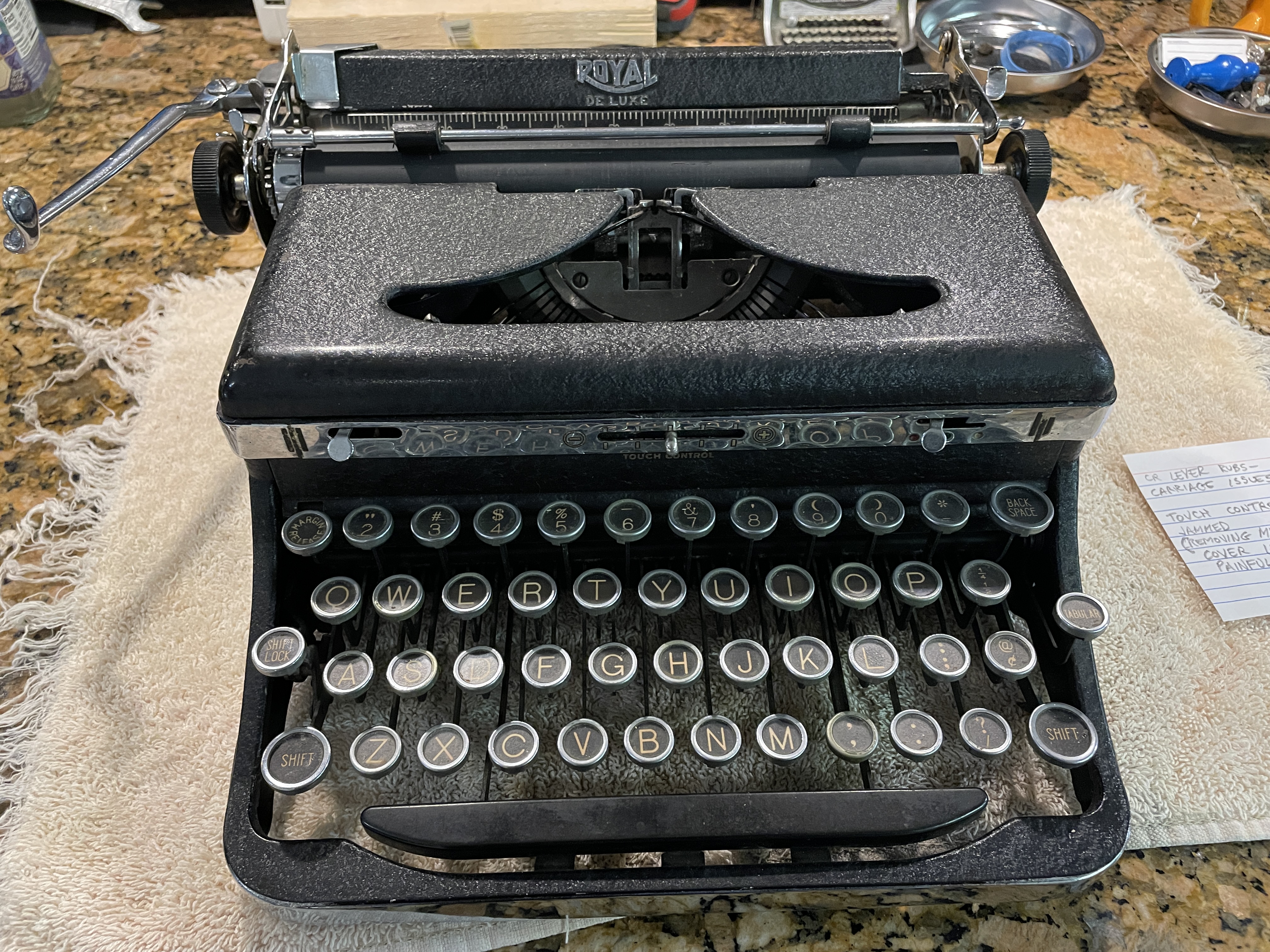
I wrangled it out of its case for a good cleaning. Removing and replacing the cover plates on Royal portables of this era are not easy tasks. Frankly, I would rather remove and replace the carriage (now that I have my Royal portable bearing guide / ball feeder tool, that is).
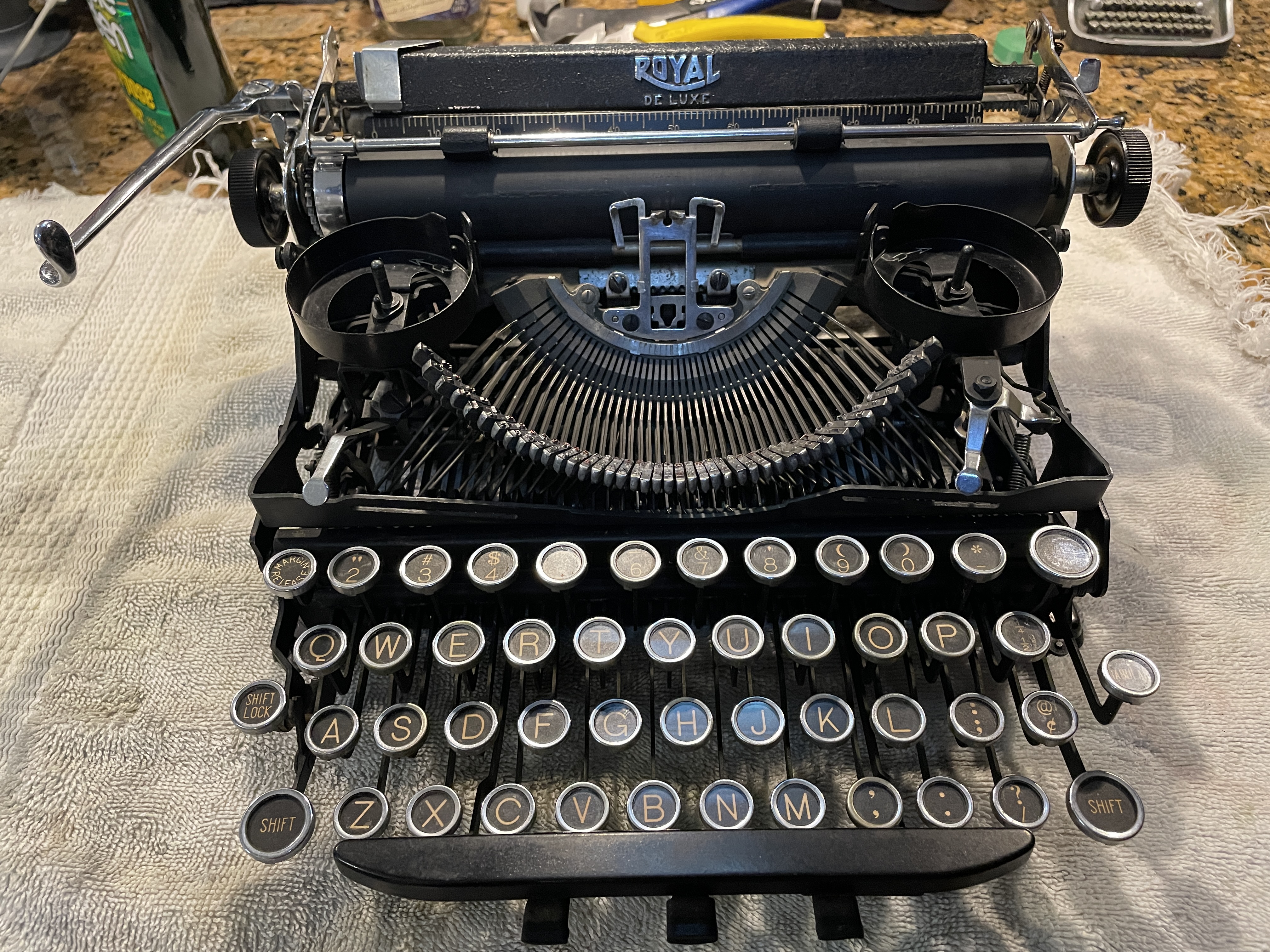
Backspace not working
Apparently backspace issues in Royal portables are quite common. Here is a video which clearly shows the backspace pawl missing the teeth of the escapement wheel:
As Typewriter Justice says in a comment on the video, forming the loose dog stop so that the backspace pawl engages with the escapement wheel will most often fix the problem. Here’s Phoenix Typewriter’s very good video on making this adjustment:
Per the OAMI service manual, this is the one of the first things you want to check:

In addition, the backspace arm itself where the pawl sits may be deformed and sitting too low to catch the escapement wheel. In an old Facebook post, Gerald Cha suggests “forming” the backspace lever with a screwdriver. Mark B. has blogged about the Gerald Cha solution.

Gerald Cha is a typewriter repair guru of near mythical status who runs a repair shop in Manila. The photo below is NOT Gerald Cha. Despite the name tag, that is Herman:

I adjusted the dog stop as recommended by Duane of Phoenix Typewriter, but since the backspace lever appeared to sit a bit low, I decided to try the Gerald Cha/Mark B. fix to raise the backspace pawl so that it could catch the escapement wheel. It seemed to do the trick and now the backspace is working consistently.
Carriage return lever hitting the lid
The carriage return lever was dinged and subtly bent down so it dragged over the ribbon cover. Fortunately Duane at Phoenix Typewriter has a video on how to form the carriage return lever.
I formed the lever with my bare hands and now it clears the cover.
Touch Control jammed
The Touch Control lever on the front of the Royal De Luxe was jammed and not moving.
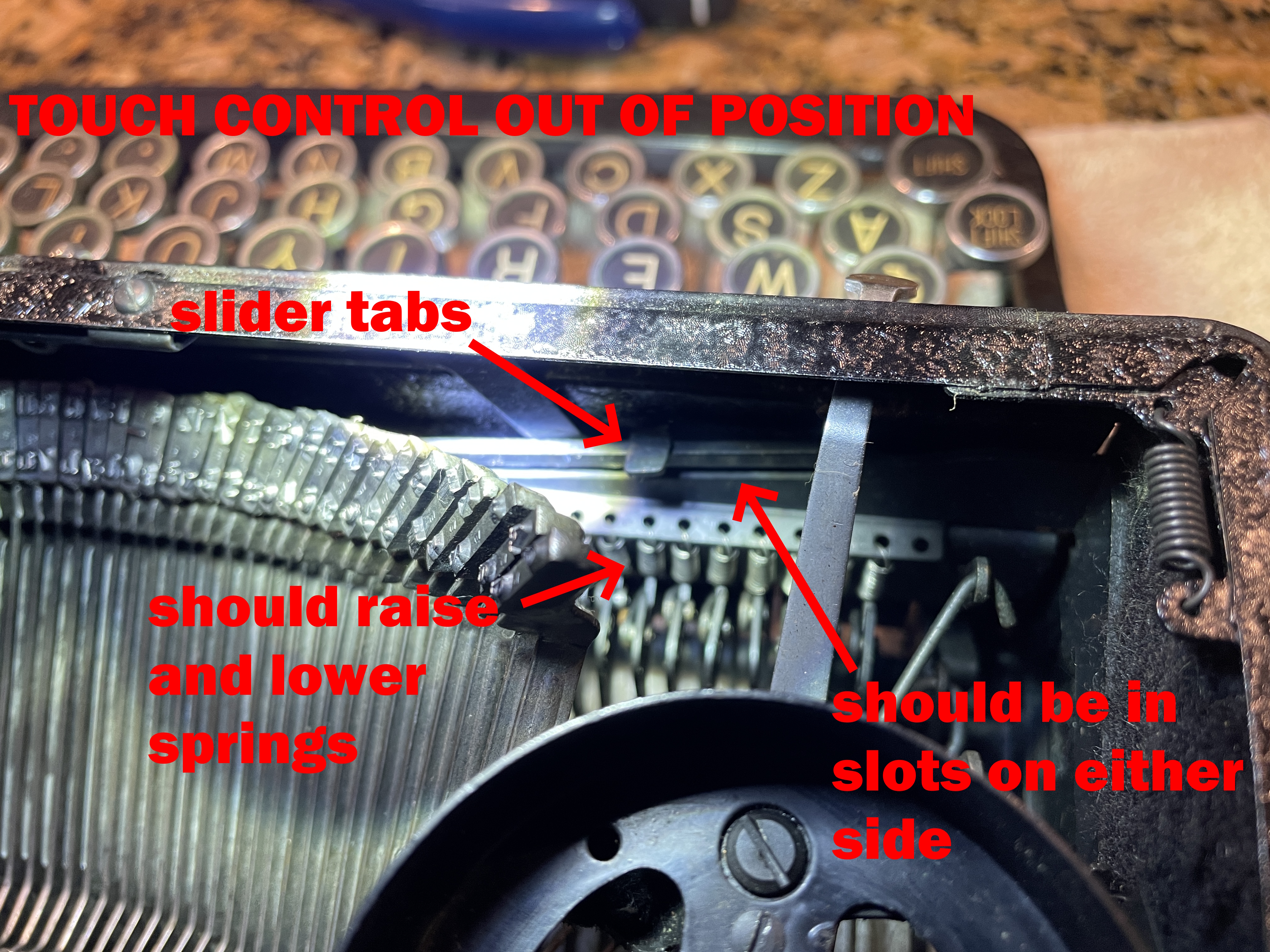
I never really understood the Royal portable Touch Control set up, but this is how I think it works: two tabs on the Touch Control slide through slots of a retainer behind the keyboard. The retainer raises and lowers springs on the key levers and that adjusts the “feel” of the keyboard.
When the Touch Control slide knob is to the far left (-), there’s no spring tension on the Touch Control slide retainer. When it’s slid to the right (+), the Touch Control slide retainer rises and puts tension on the key lever springs for a heavier touch.
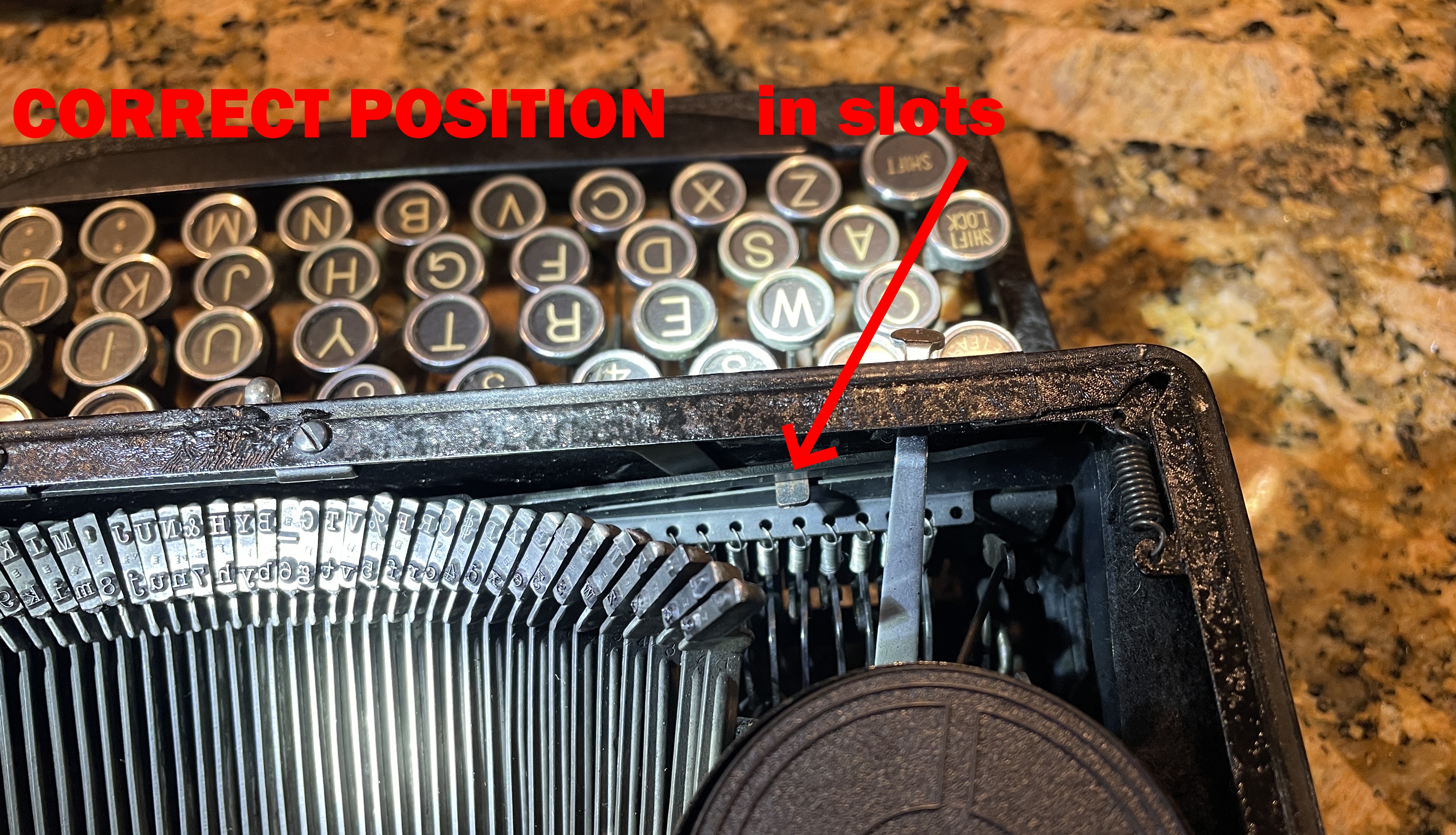
This typewriter’s Touch Control slide had wedged itself out of position, jamming itself outside the retainer. The Touch Control’s metal tabs should glide inside the slots of the retainer.
When I reassembled the De Luxe, I put the touch control slide back into the correct position:
I honestly don’t feel much of a difference, but this is a 90 year old machine, and I am not a subtle typist. I’m a slammer.
Capital letters hitting lower than lowercase letters
I noticed that the typewriter was printing capitals slightly lower than lowercase.

According to the 1946 OAMI service manual, I needed to make an “on-feet” adjustment:
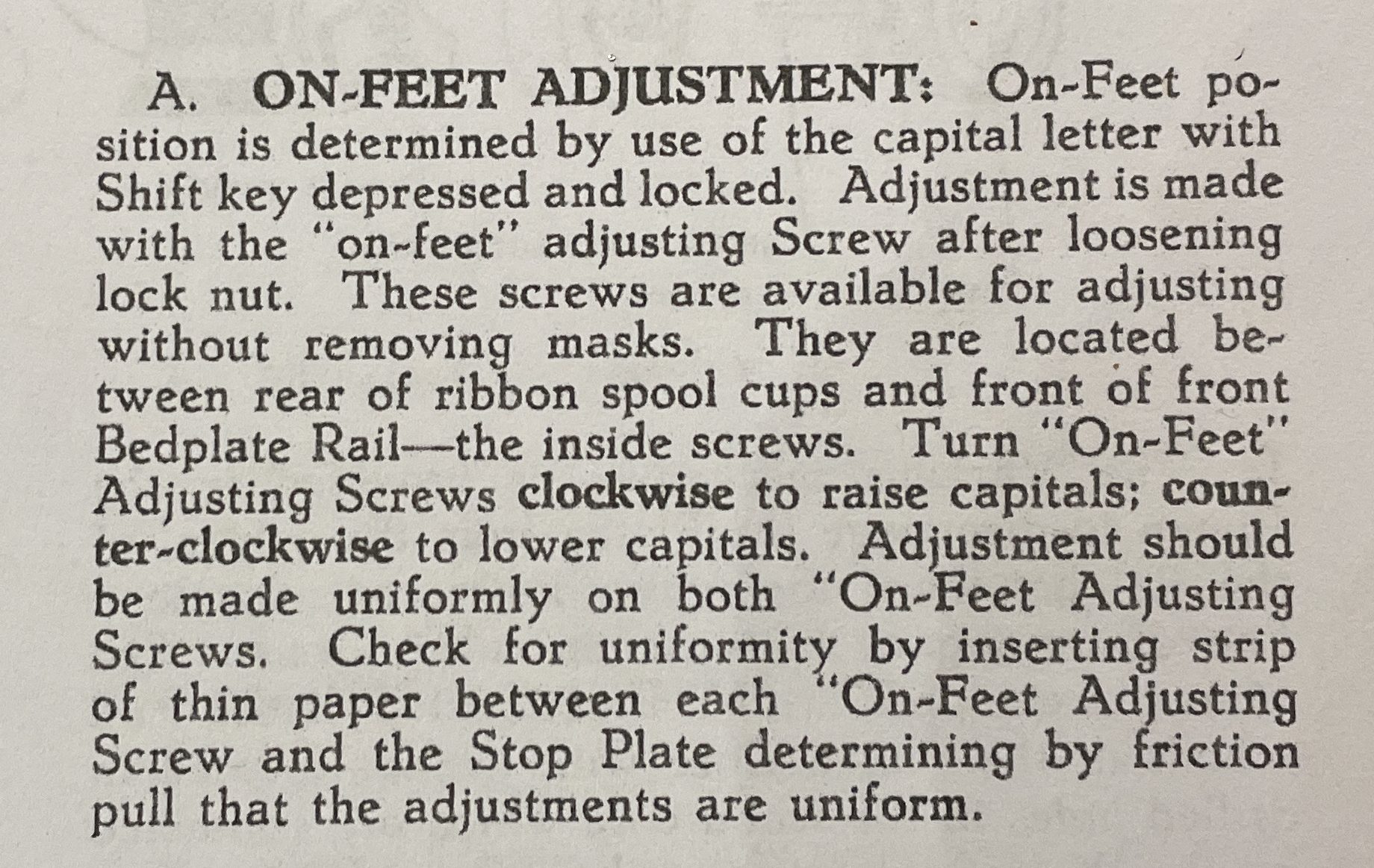
I loosened the lock nuts and turned the adjustment screws clockwise to raise the capitals. I did this on both sides of the machine.
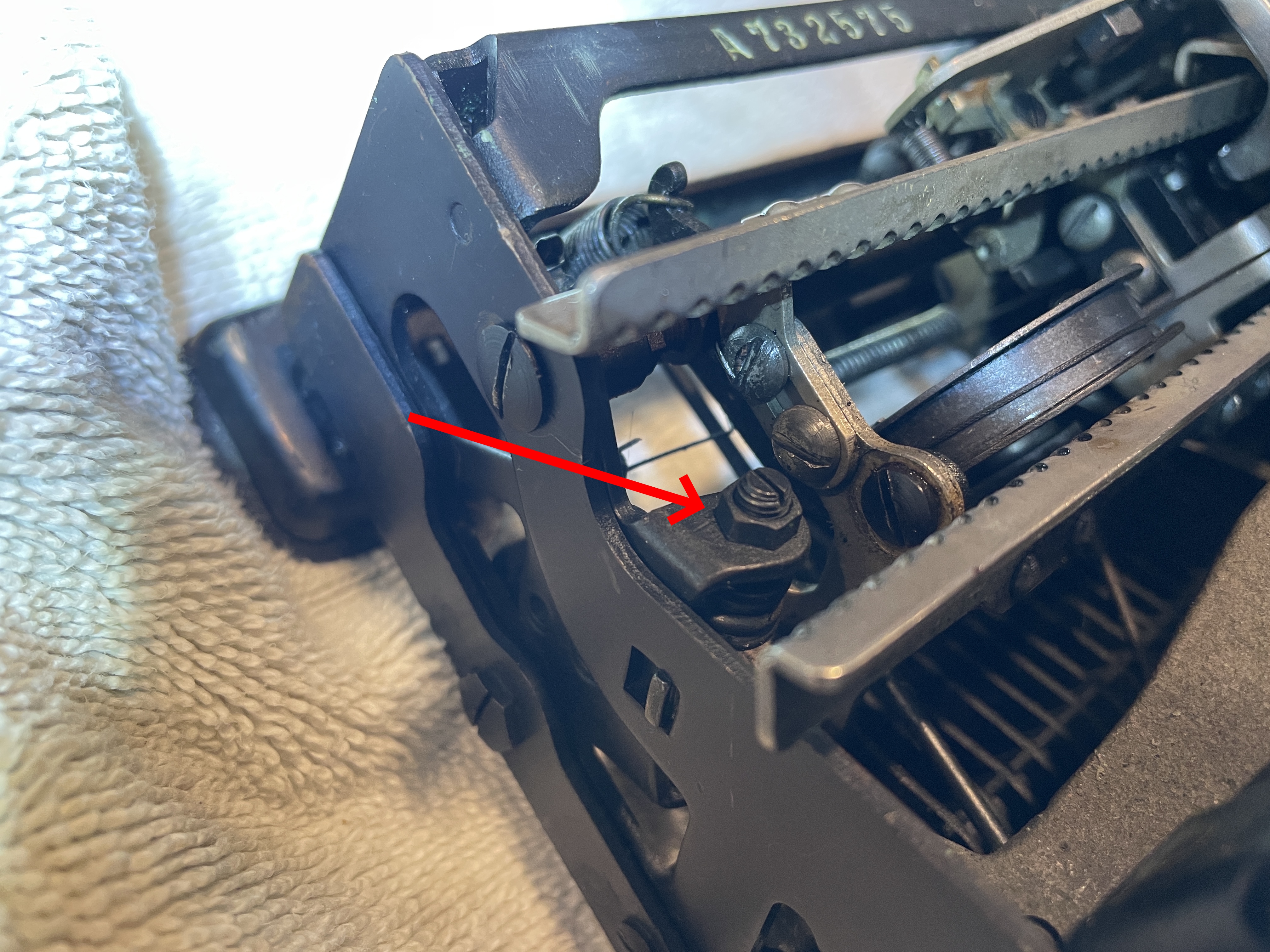
After adjusting to my satisfaction, I tightened down the lock nuts on either side.

The platen is in pretty bad shape. According to Ross, when he first got the De Luxe, the platen wouldn’t move because the feed rollers and the platen had fused together. He freed the platen, but there are damaged spots where the feed rollers had melded with the platen. The imprint of typed words when you hit those sections of the platen is pretty bad.
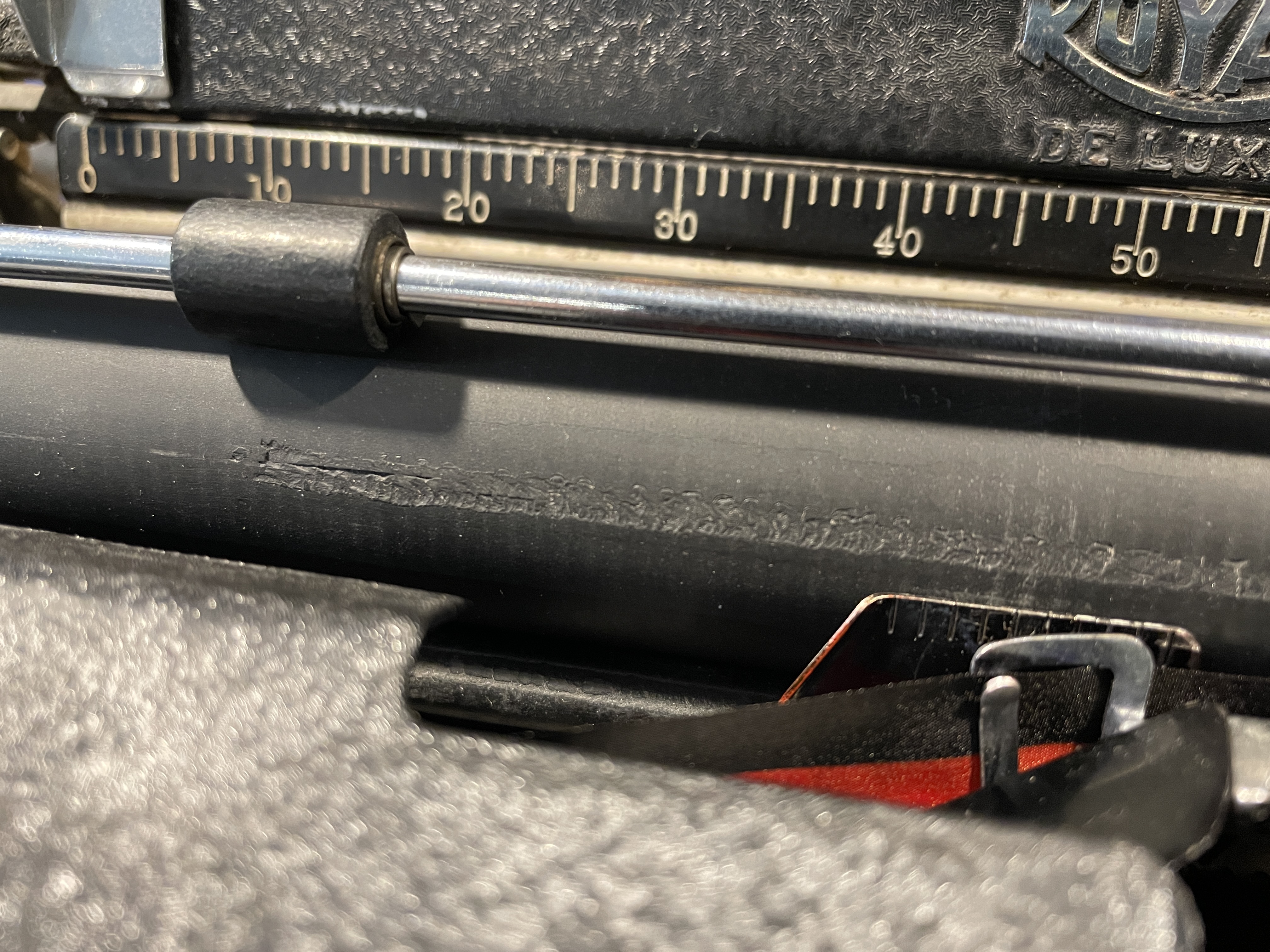
I wanted to swap in something better for this chewed up platen. Here is National Treasure Duane Jensen of Phoenix Typewriter swapping in a good platen for a damaged one:
The loose carriage
The carriage felt vaguely wobbly. I determined that all the carriage bearings were accounted for and in the correct positions on the carriage rails. I didn’t note any loose parts (rails, brackets) so I went to my OAMI service manual:

Per the manual, a loose carriage usually means that the carriage rails need spreading to get a tighter fit in the rails. You use a special tool, the bottom rail bender tool.
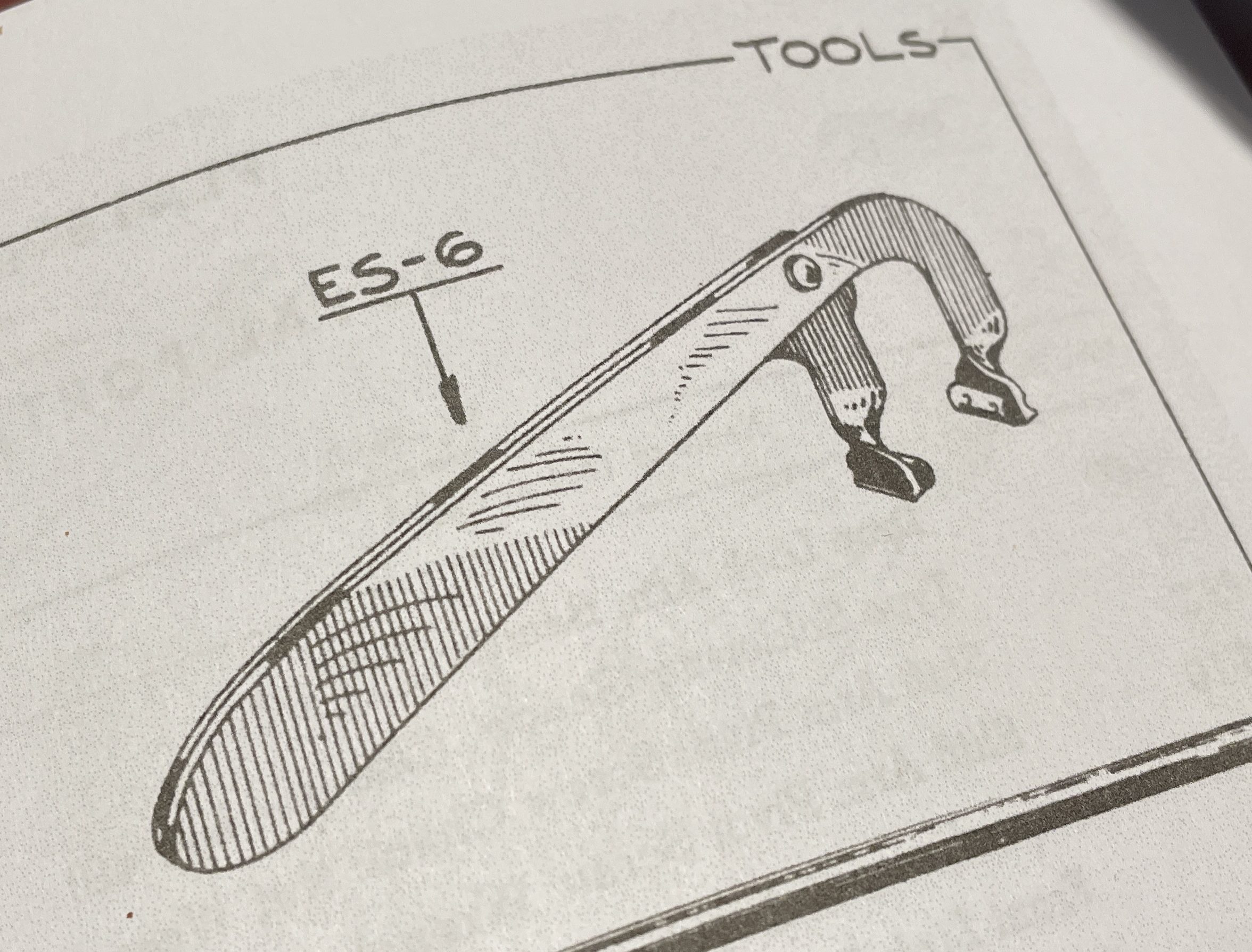
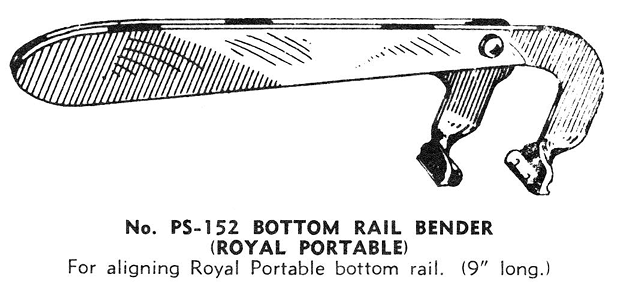
I don’t have an “ES-6” nor do I have a “PS-152”, and I don’t trust myself to mess freehand with these rails. I will let that sleeping dog and those bottom carriage rails lie.
Ross came over Saturday afternoon to retrieve his De Luxe and the QDL in which I had replaced the loose dog. He brought with him another couple problematic Royal portables, a Royal O with a wobbly carriage and a QDL with ribbon lift issues.
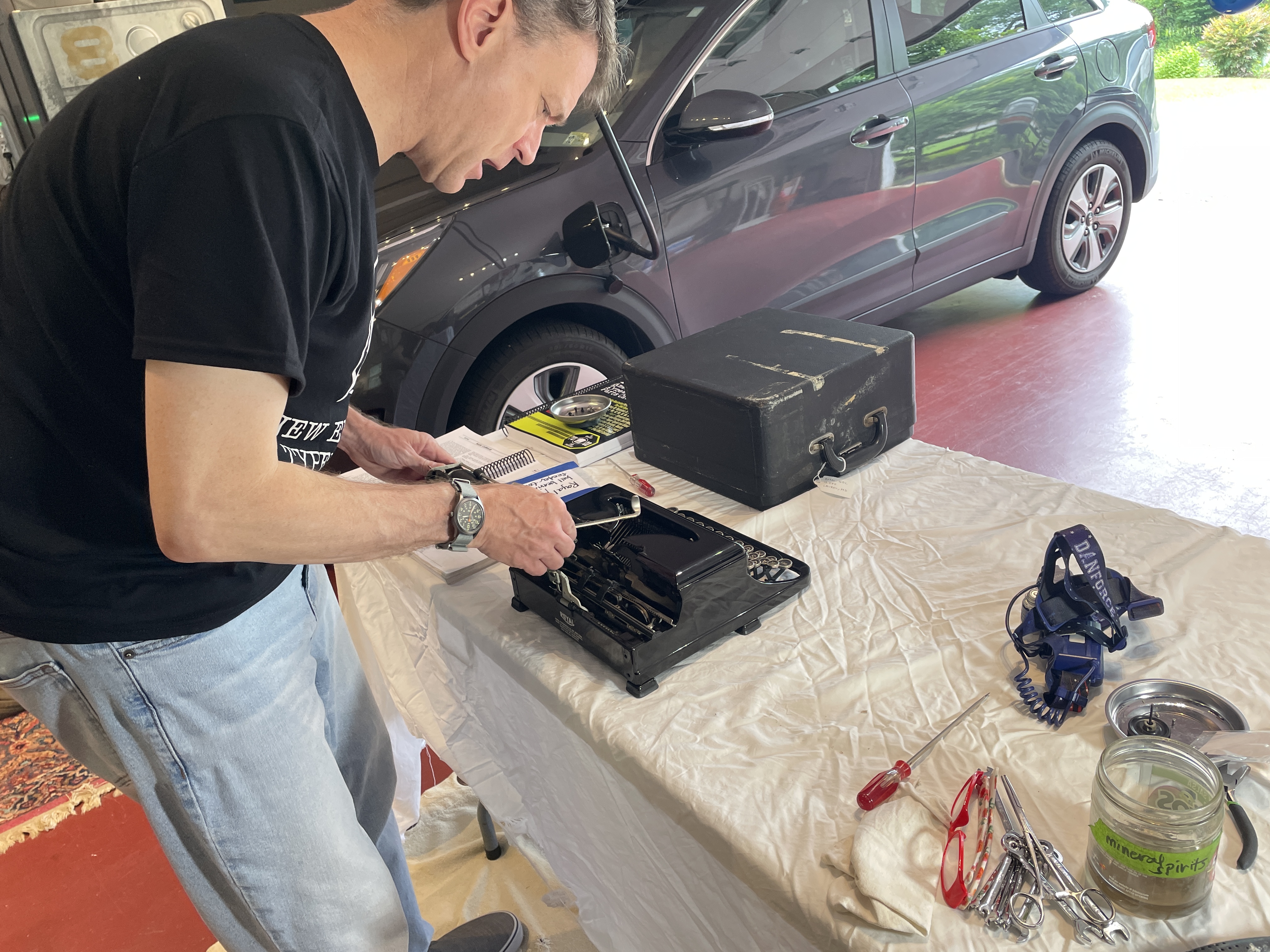
I set up an operating table in the garage and started work on the wobbly Royal O. Ross thought it may be missing a bearing set, but when we removed the carriage, all four were accounted for. We replaced the carriage, using the Royal portable bearing guide and ball feeder tool, and with properly positioned bearings, the carriage no longer wobbled.
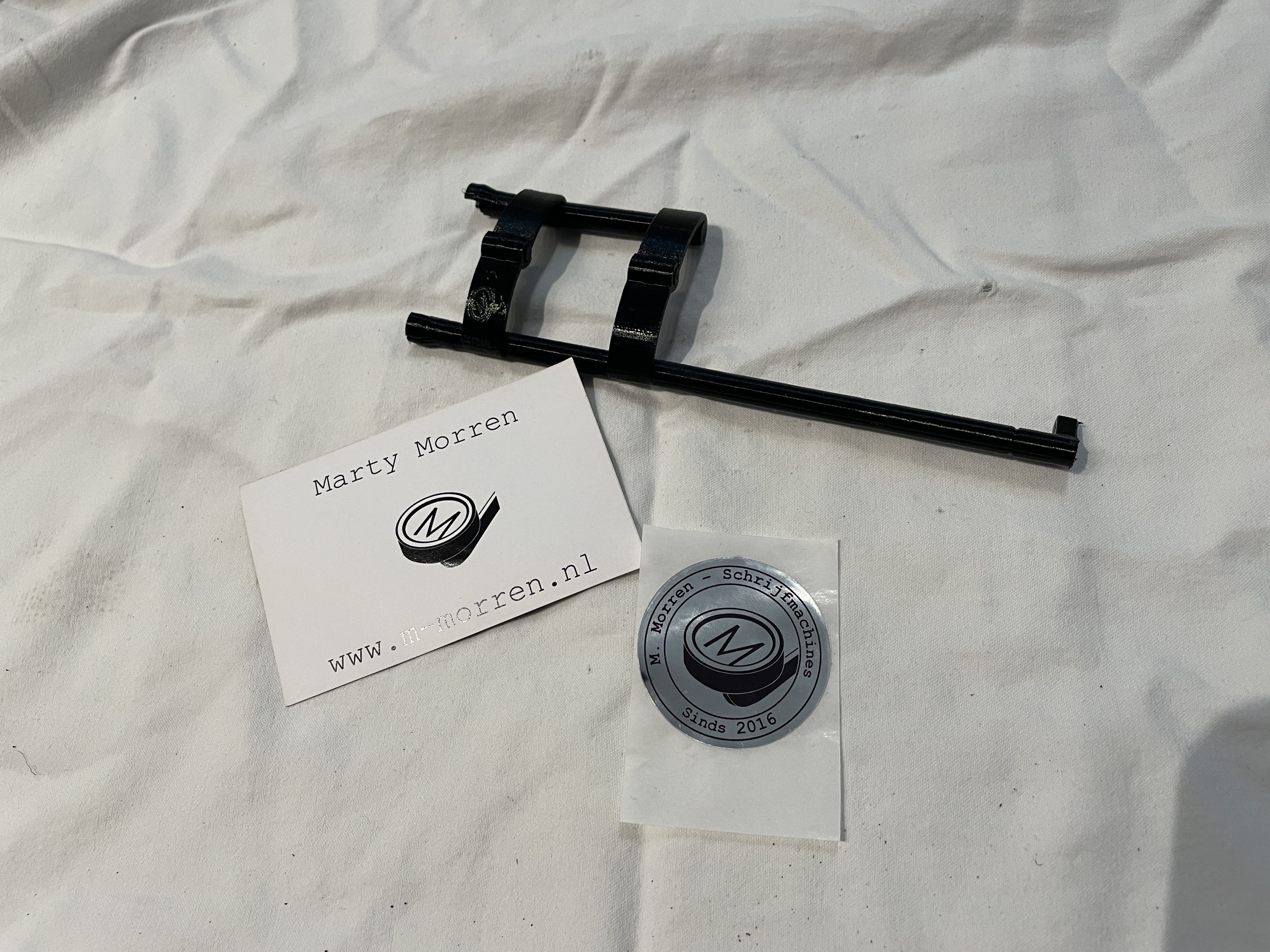
Marty Morren’s 3D-printed reproduction of the original tool has become an indispensable part of my toolkit. I no longer dread dealing with those fiddly little pinions and loose bearings.
Platen transplant
Ross and I spent a very enjoyable afternoon tinkering in the garage with Royal portables and trading repair tips. Before Ross left, I told him I wanted to see if the platen from my 1966 Royal Safari parts machine would work in his 1938 Royal De Luxe, the one with the crummy platen.
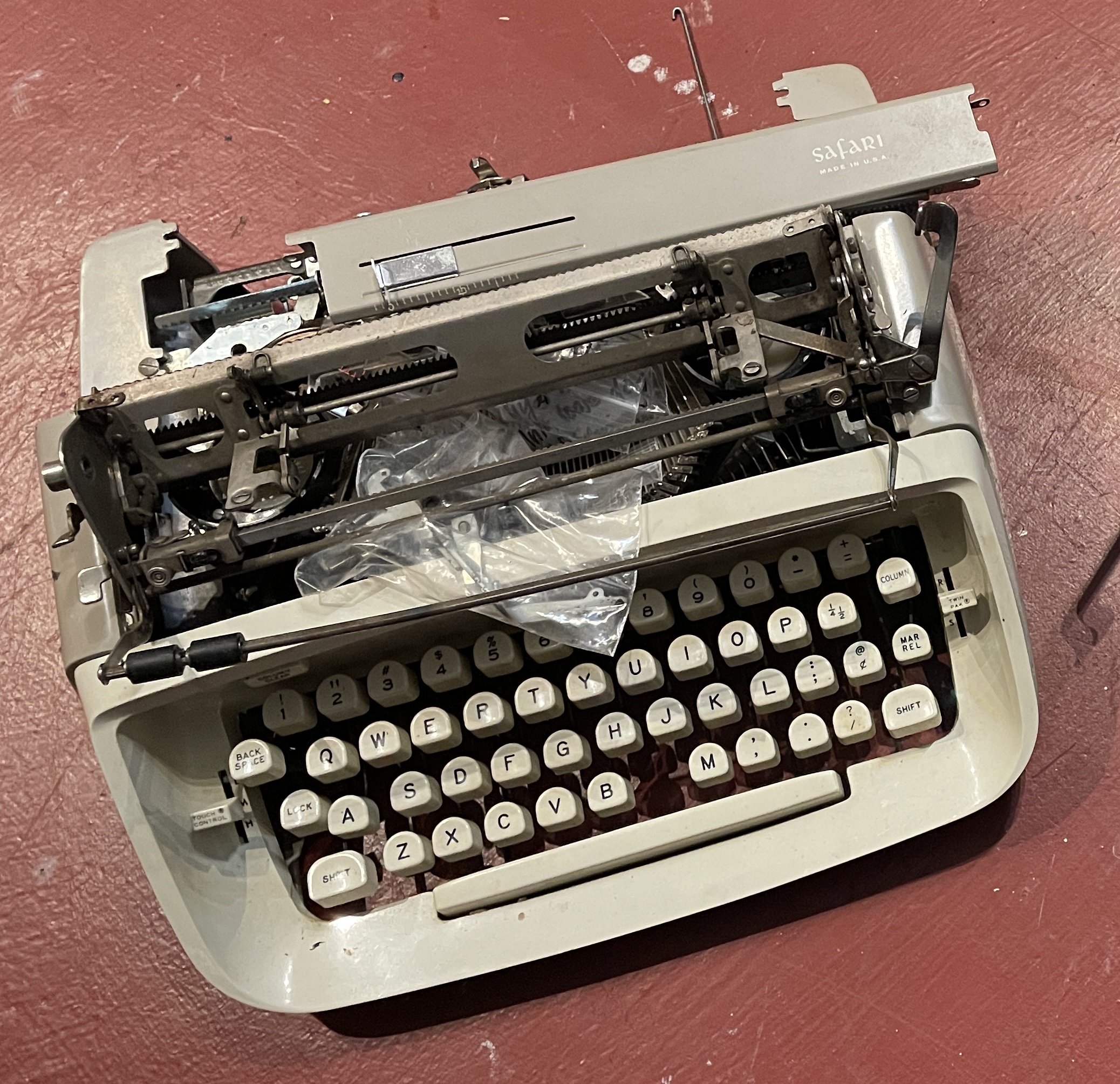
Would the platen from a Royal portable 30 years younger work in the old machine? Yes, indeed. It is the same length and diameter. The metal hub on the left of the Safari platen is a little beefier with a single big set screw, but it’s essentially the same platen.
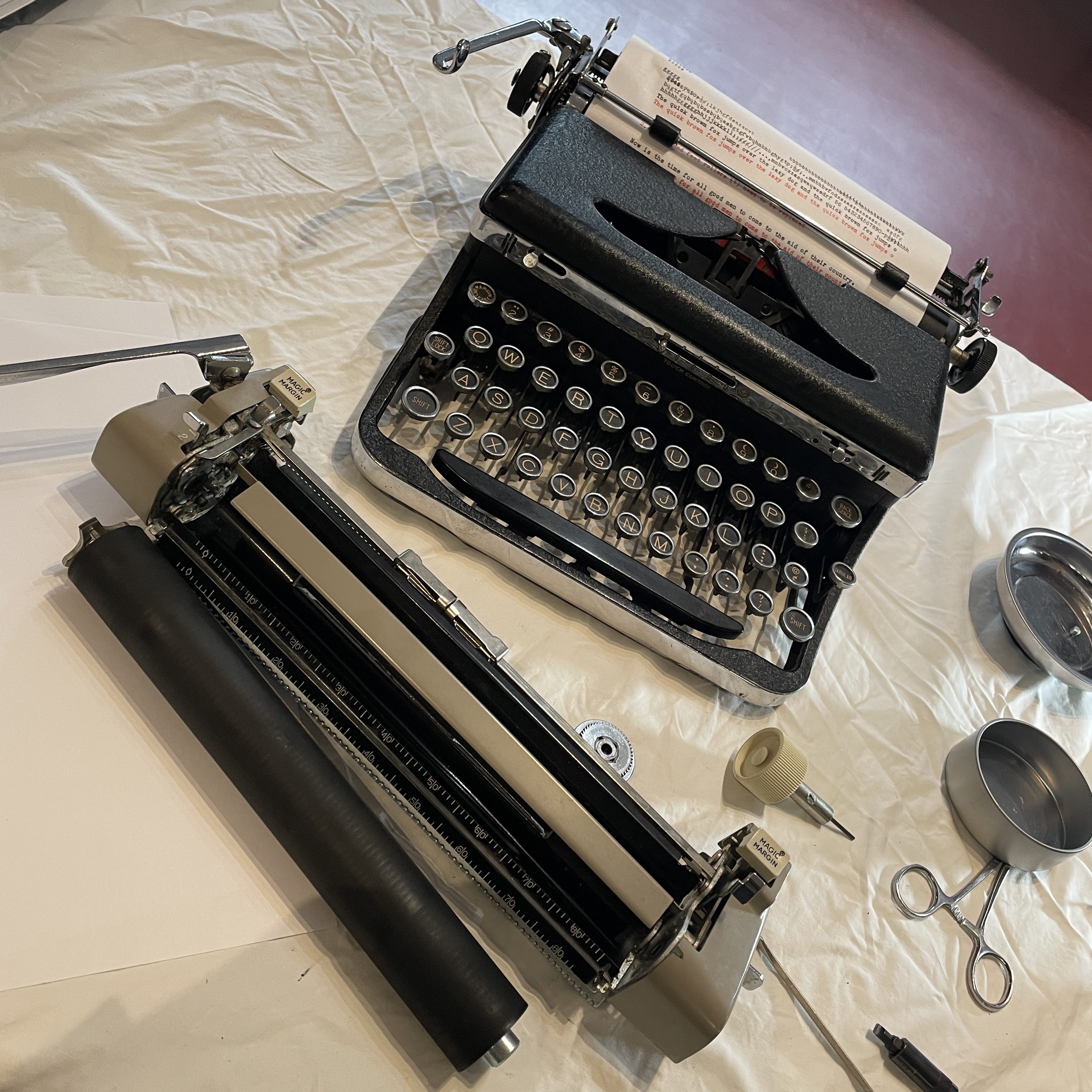
We popped it into the De Luxe, and now we have a younger, healthier platen in the old machine that works great.
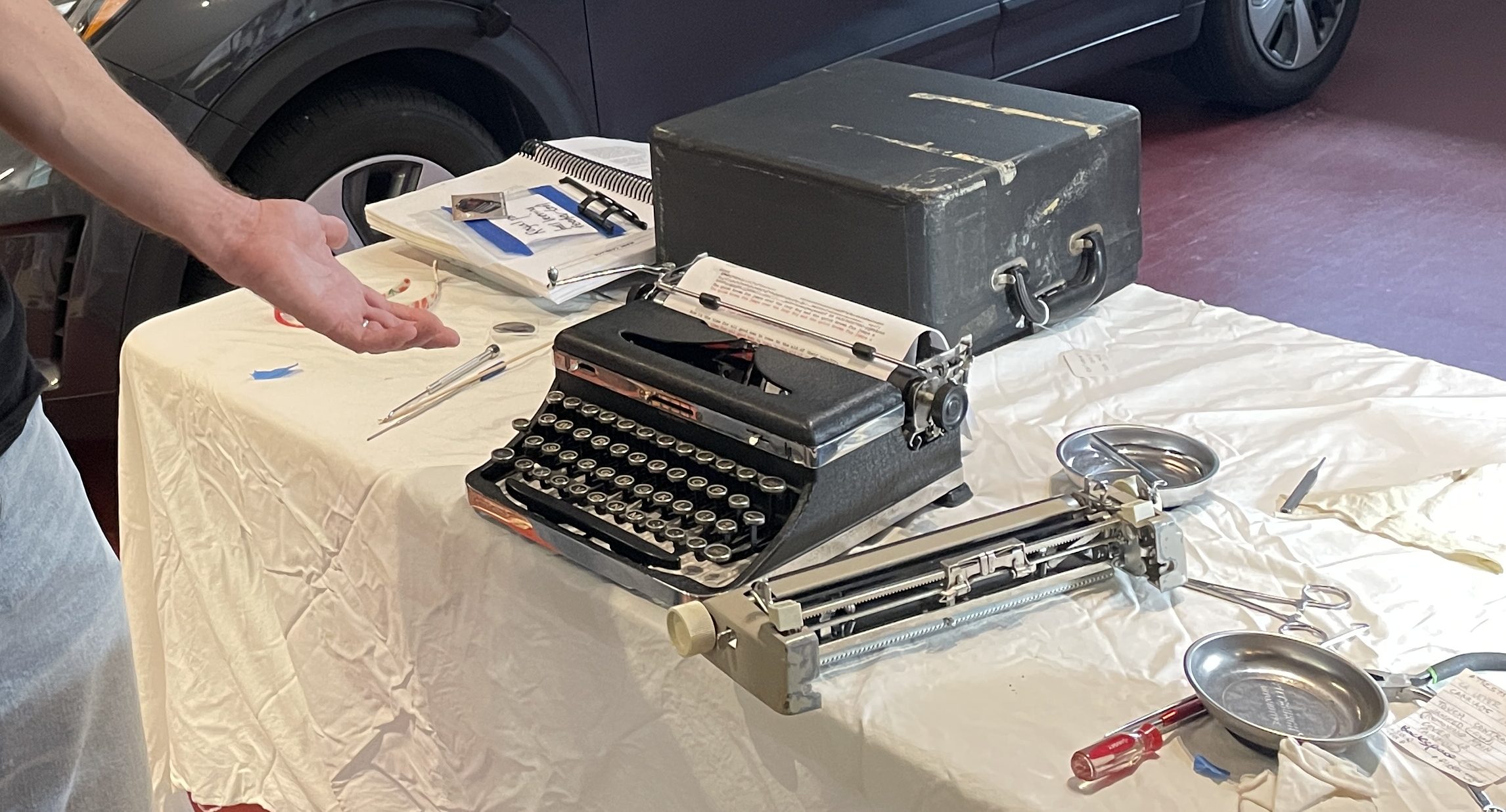
It was a successful afternoon all around, and as Ross packed up all his Royal portables, I told him he needed to find some more junkers. He agreed as he saddled up the Royal De Luxe—it was chomping at the bit. It is a gorgeous machine with a sprightly happy touch and now it sports 1960s rubber. It shook its mane and they galloped off for home.

I love my spiral-bound Manual Typewriter Repair Bible. It lays flat on my workbench.
Speaking of horses, I will leave you with this astonishingly heavy duty banger from the Osmond Brothers of Ogden, UT:
Apparently the whole album rocks hard.
 myoldtypewriter
Crazy Horses. Lots of good info here for Royal Portables
LikeLiked by 1 person
Giddyup!!
LikeLike
Another heckofa fun set of repairs. I wouldn’t have thought of using a 60’s platen in a 30’s machine – very clever! Royal portables are sure tricky to get around in (say, compared to a Smith-Corona) but it sure is satisfying to tweak something just a touch and have it work so well. Sensitive, but fun machines. (:
LikeLiked by 1 person
That 1966 Safari has been a generous parts machine, giving an escapement plate to a 1948 QDL, a loose dog to a 1939 QDL, and now a platen to this 1938 Royal De Luxe. I am grateful to the Royal Typewriter Company for sticking with a mechanical design that just worked. I have been working on a lot of Royal portables recently, and there are many, many more parts in that 1966 Safari that I will use.
LikeLike
congratulations on the fine repair.
LikeLike
I have one of those Royal DeLuxes, and in my opinion they are one of the most handsome, if not THE most handsome, black portables ever made. Just the right amount of chrome without getting gaudy. And they type well too, even though I prefer a segment to a carriage shift, the DeLuxe’s isn’t too heavy compared to, for example, an Olympia SM (though to be fair, the Deluxe itself weighs considerably less than the SM3 or SM4 does, period). Having just made a 12 hour move south to VA, I appreciate the weight of things more at the moment. I have an SG1 and some other beefy standards and electrics, boy howdy…
LikeLike
If you ever make it up to northern VA, you may want to come to a type-in hosted by members of the Mid-Atlantic Typewriter Collectors Group. It’s fun to connect with other fellow enthusiasts. I *think* there may be one planned for January or February – no details yet. The Facebook Group page will publicize events in advance:
https://www.facebook.com/groups/DCAreaTypewriterGroup
LikeLike
Thank you! I joined the Facebook group today, already met another typospherian from Williamsburg, not far away. Might be Tidewater (or vicinity, more or less) type ins in the future too!
LikeLike