I recently attended a type-in at a local public library. Two members of the Mid-Atlantic Typewriter Collectors Group, Monica and her husband Stephen, organized the event. They’ve done this a couple times in the past, and they always get a good crowd of local enthusiasts, library walk-ins, and kids.
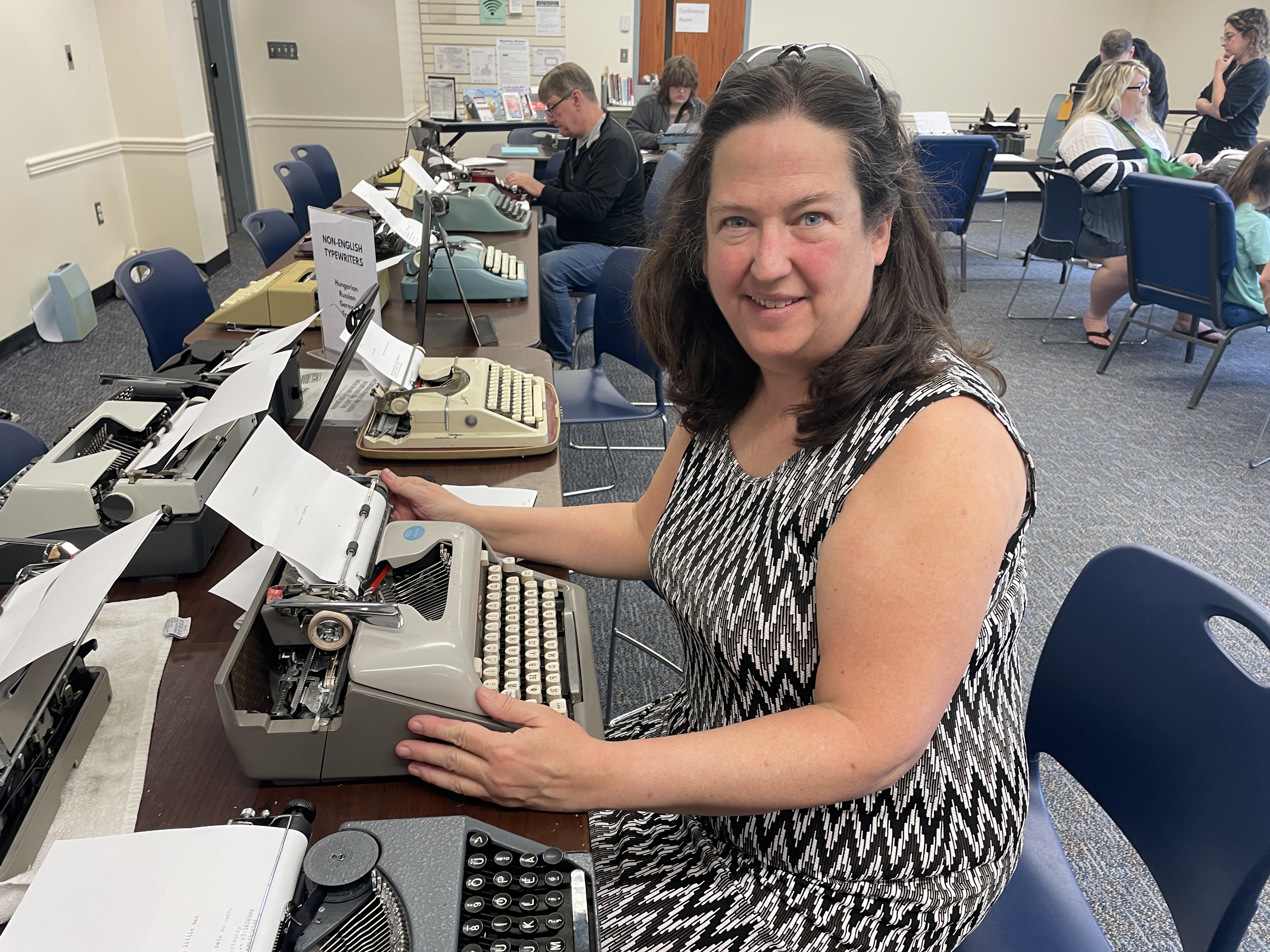
Monica B., one of our gracious type-in hosts. Her husband Stephen is further down the table.
Monica and Stephen have a collection of beautiful and interesting typewriters, and they had been getting them serviced at Tom Furrier’s Cambridge Typewriter. Sadly, Tom recently retired.
And this is where I step into the vacuum. I am always looking for broken typewriters. I had messaged back and forth with Monica before the type-in and asked her to bring something interesting and nonfunctional for me to tinker with.
They had a broken “Orchid” 193x Porto-Rite, appropriately named Barney which had a carriage that swung back and forth with no catching.
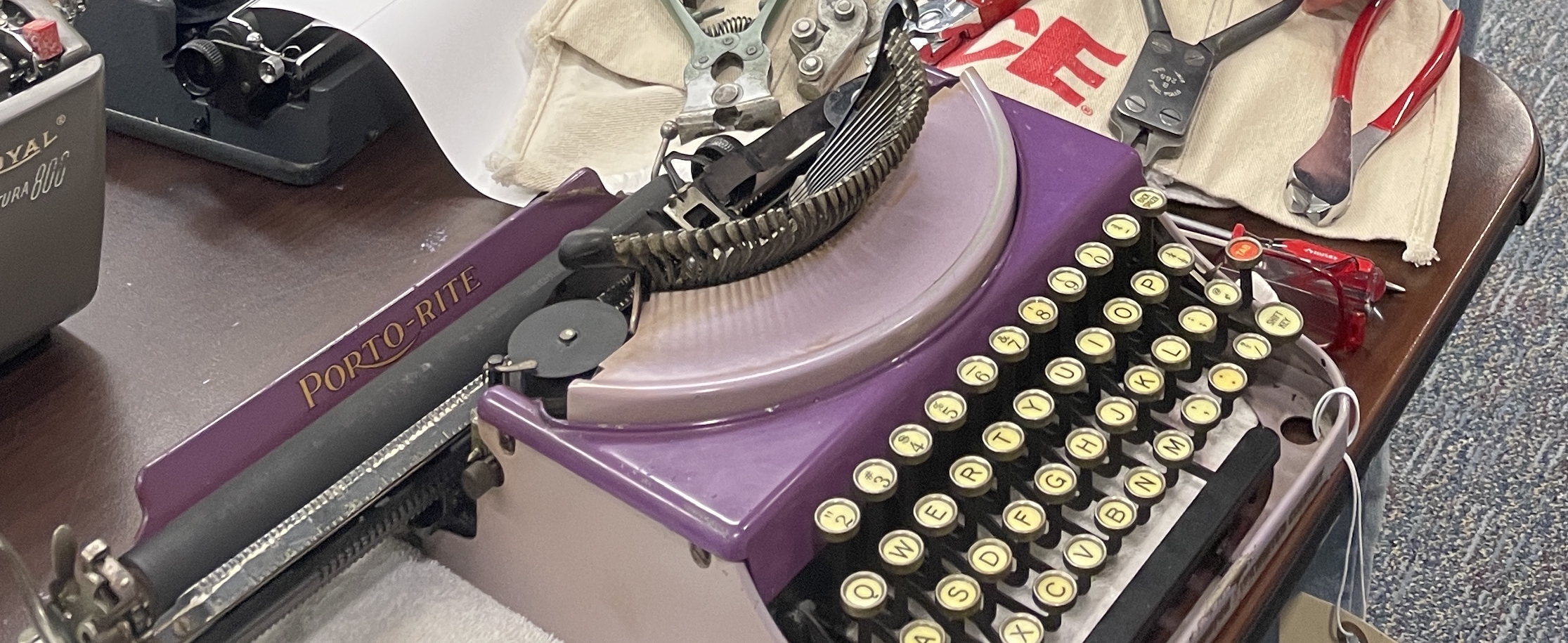
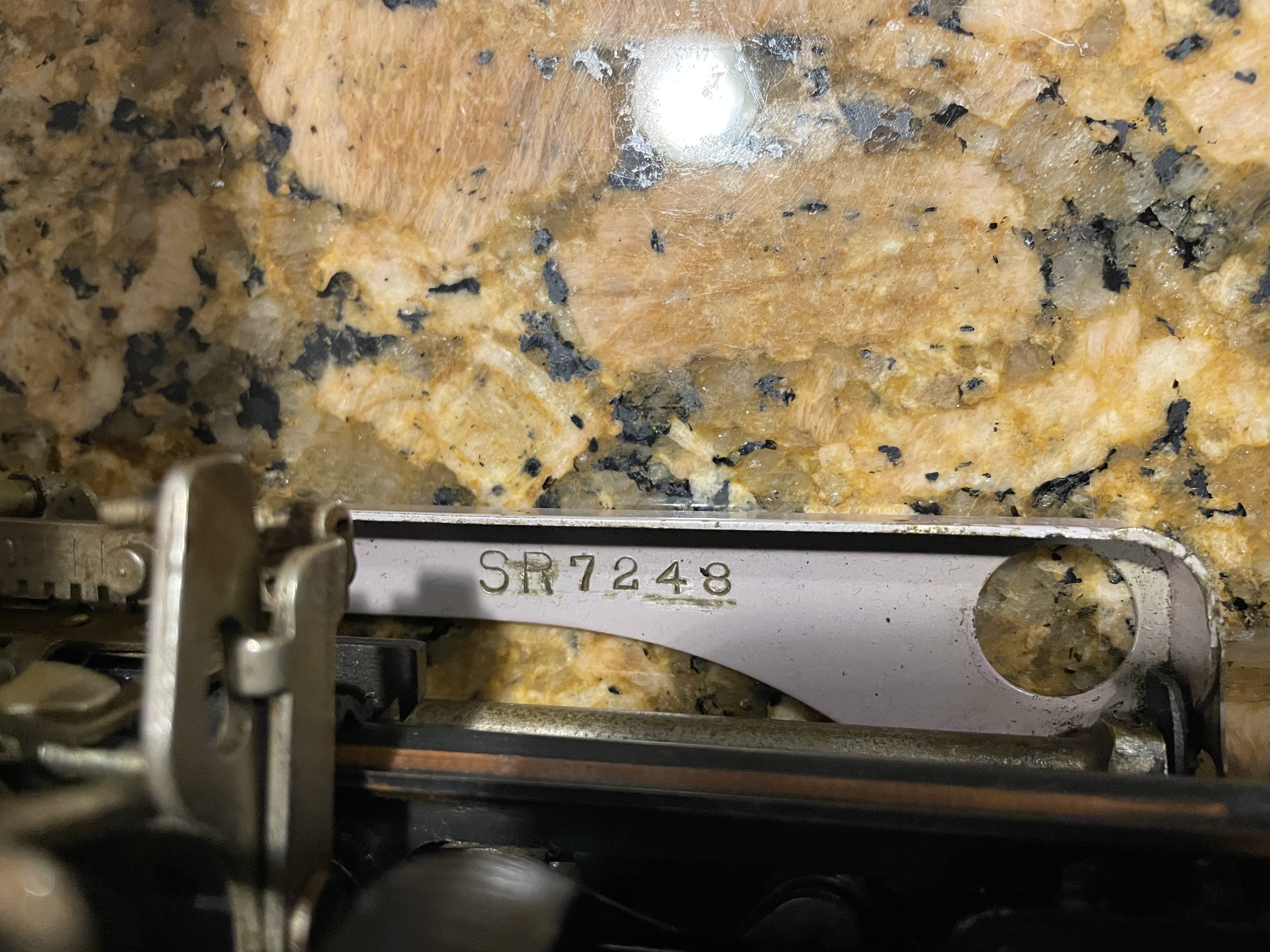
Richard Polt has an good explainer on Remington portables. Porto-Rites are Remingtons made in the 1930s and branded by Sears Roebuck—note the SR prefix in the serial number.
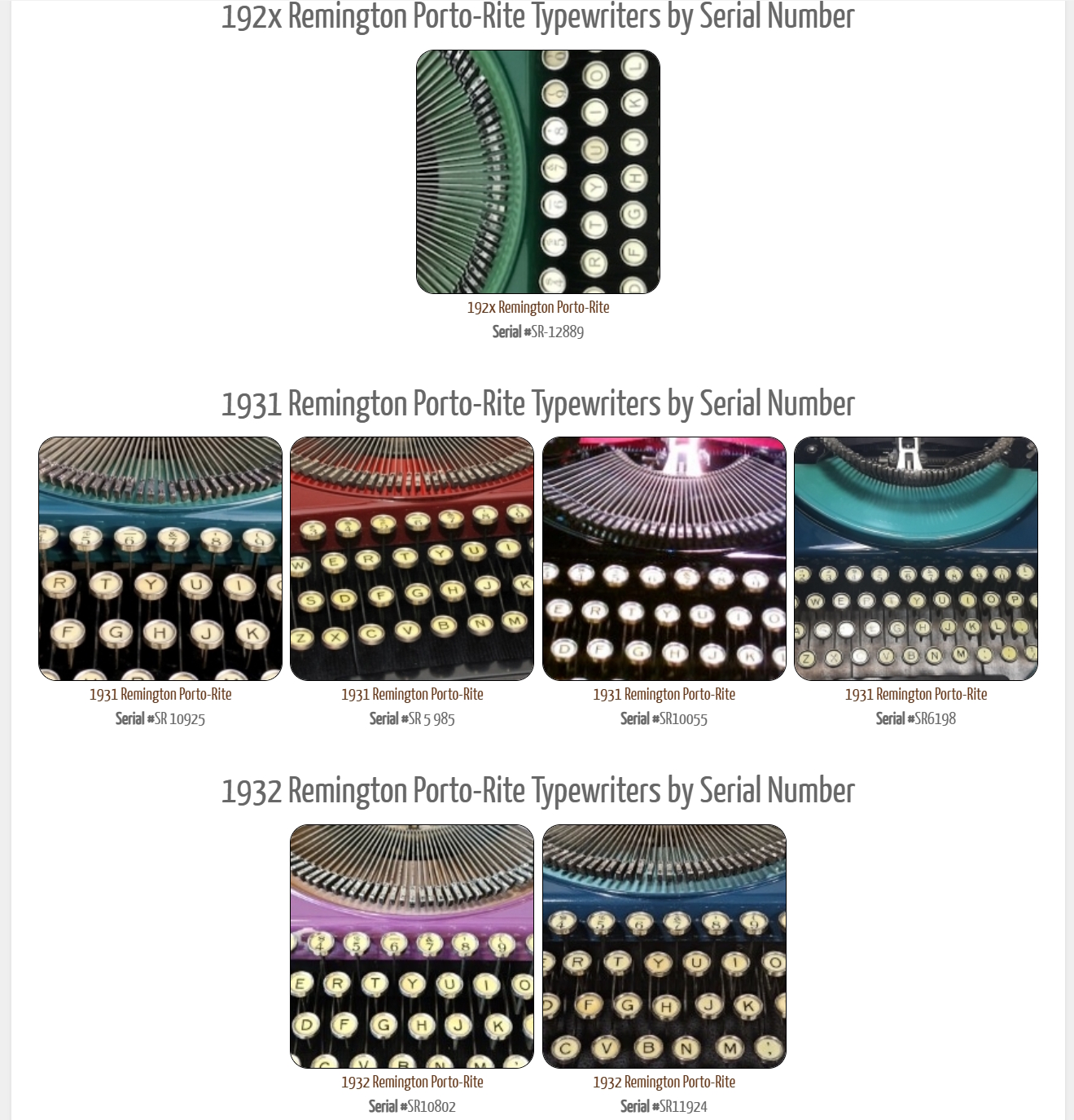
Per a Sears advertisement at type-writer.org from spring of 1930, Porto-Rites cost $51.50 cash and came in black and four other two-tone colors: Orchid, Green, Blue, and Red.
Here are some lovelies at Typewriter Database:
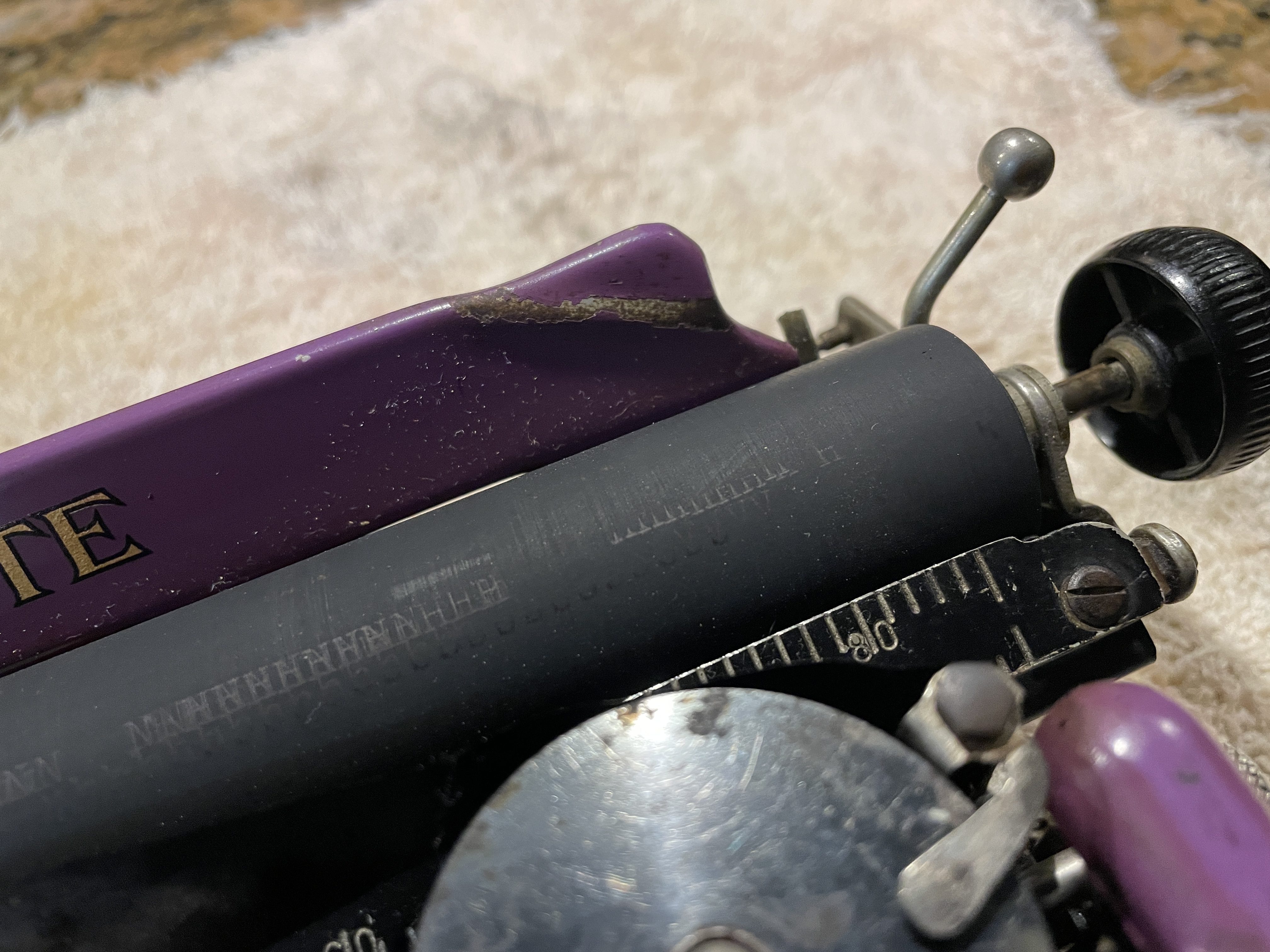
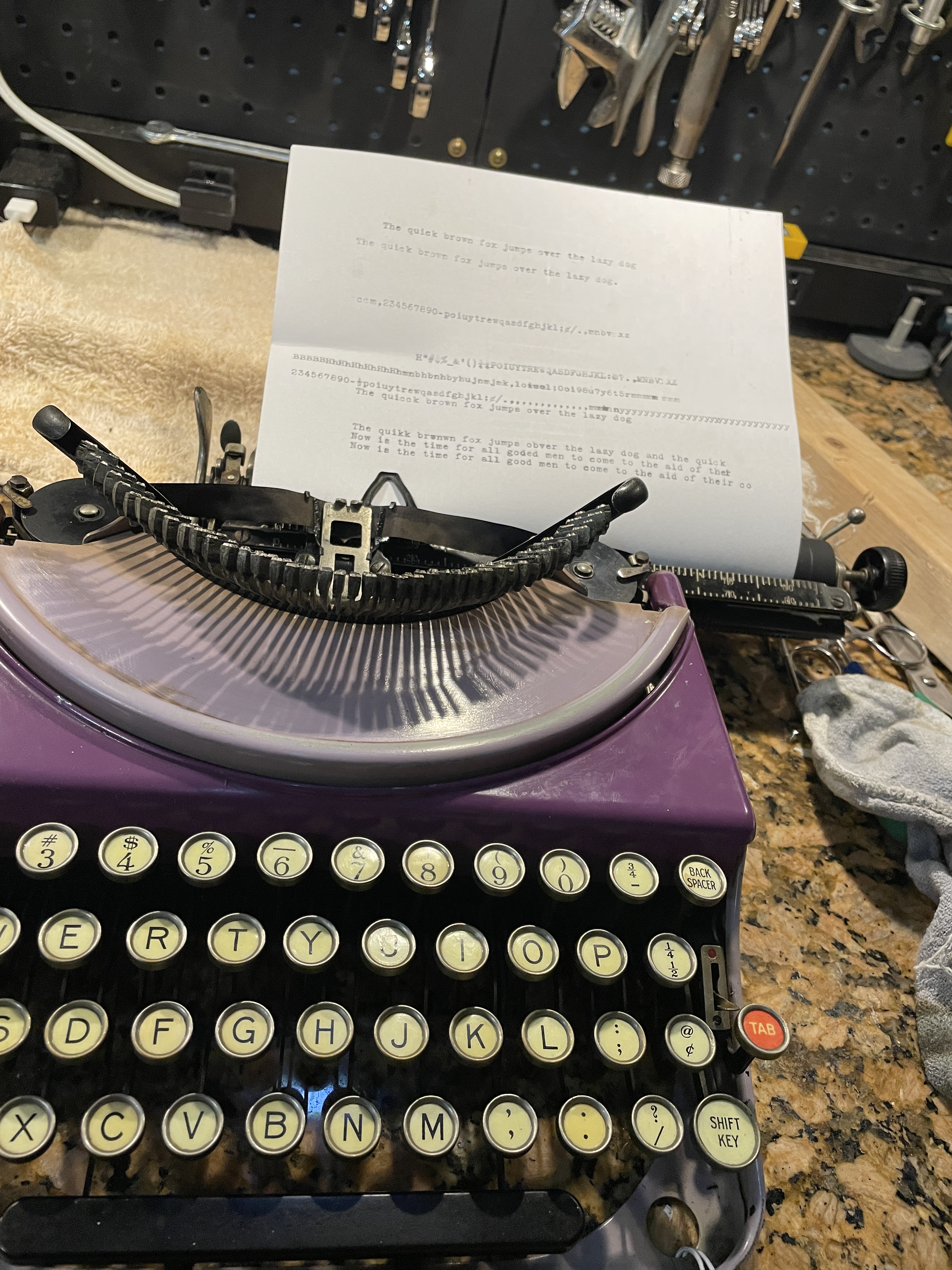
Though lovely, Barney the Purple Porto-Rite was not typing, what with that freely-swinging carriage.
I worked with one clue: the Porto-Rite had taken a hard fall at some point in its life—note the bent paper rest.
A free-wheeling carriage or a stuck carriage could be an escapement problem or something else entirely. I am compiling a list of reasons why a typewriter carriage won’t catch / flies around or stalls / jams:
- Gummy escapement (see post on an electric SCM)
- Rusty, crunchy escapement (see post on an Olivetti Lettera)
- Broken or bent escapement part, especially a dog or dog stop (see posts on a 1950s Underwood portable and a Royal QDL)
- Gummy rails (see post on a Royal KMM)
- Obstruction from tabbing system (see post on an LC Smith 8)
- Missing or poorly positioned carriage bearings / rollers / pinions (this poor old Remington Portable 1)
- Loose or poorly positioned escapement rack (see post on an Olympia SM)
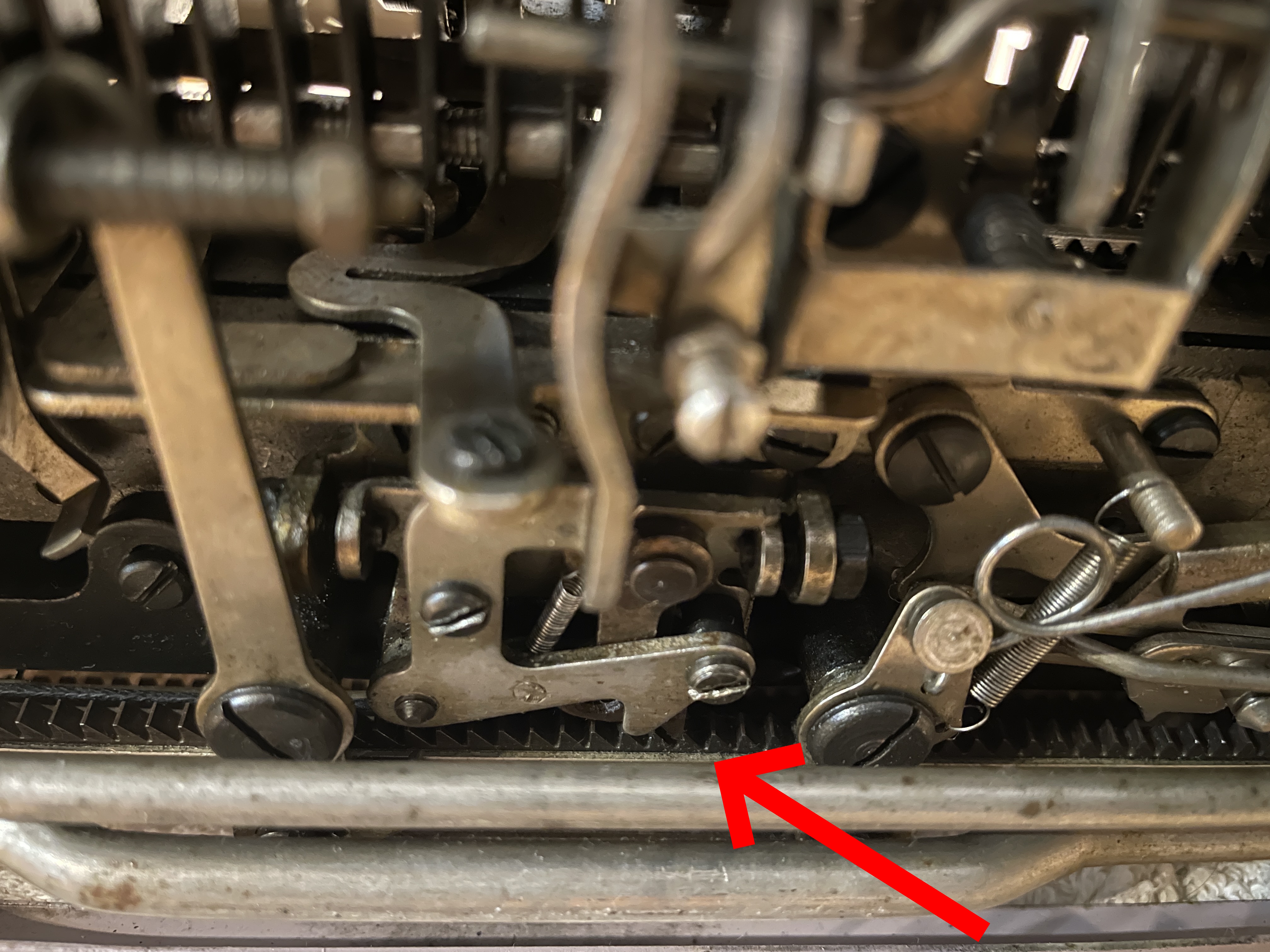
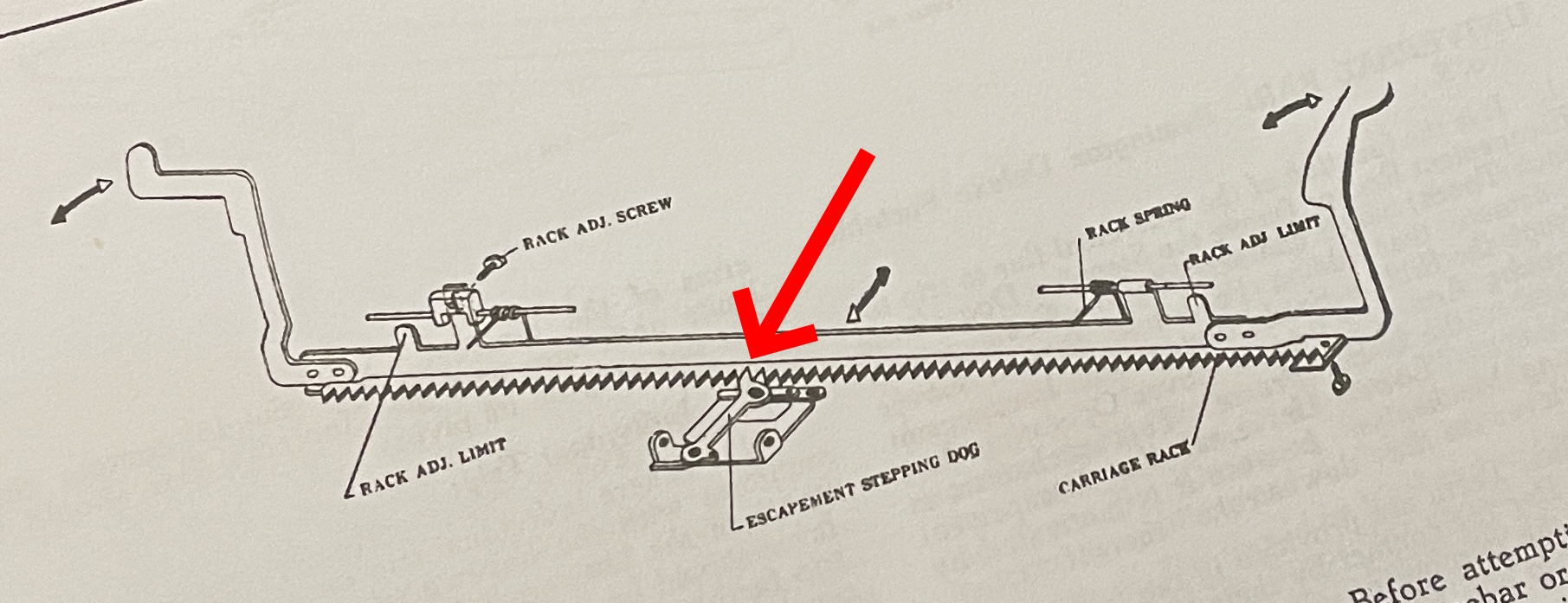
The Remington portable’s escapement doesn’t look like the more familiar watch-style escapement with a big star wheel, but I could see that a little tooth (the Escapement Stepping Dog) wasn’t meshing with the carriage rack, and this allowed the carriage to roam freely.
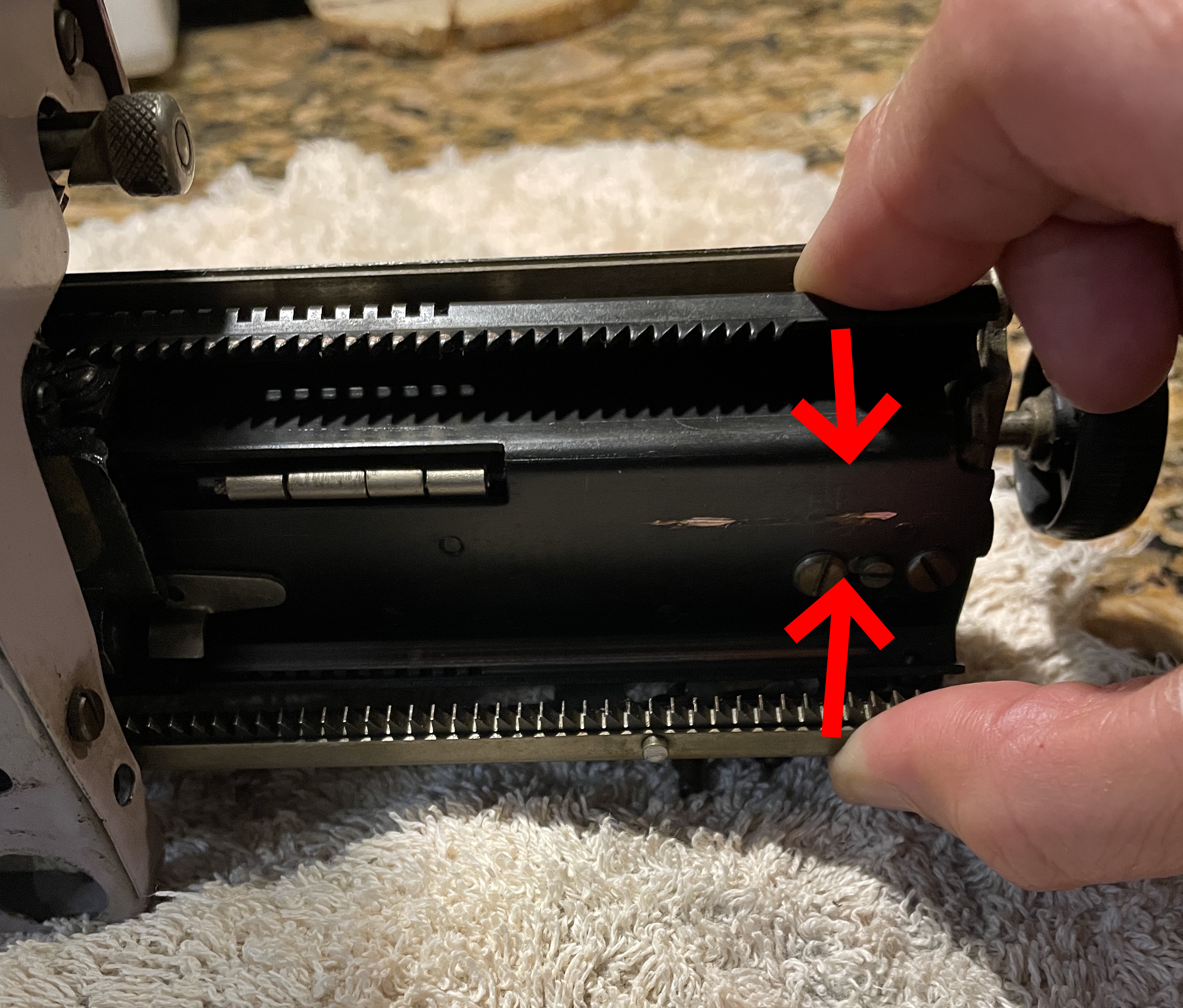
At the type-in, I was able to get the the escapement to catch by squeezing the rails slightly. Here it is, finally catching:
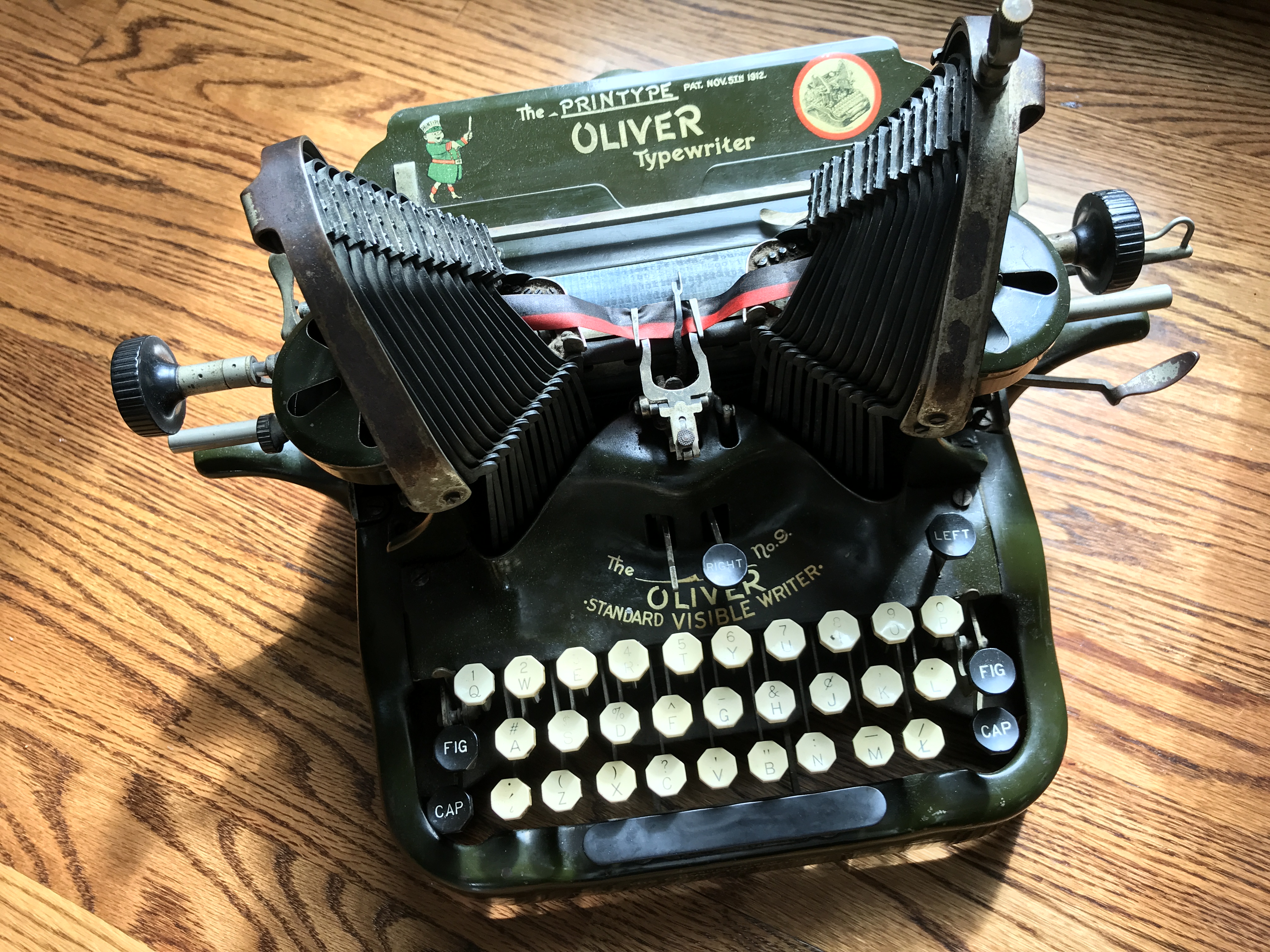
Satisfied that I had found the root of the problem, I asked Monica and Stephen if I could take Barney home to finish working on the Porto-Rite. As collateral, I left them with my Oliver 9 which was a big hit at the type-in. Everybody loves an Oliver—they’re just so weird and this one actually types.
Another typospherian Ross L. brought a Royal Quiet De Luxe that was stalling after every few characters or so. The escapement and carriage rails were smooth and clean, so what was going on?
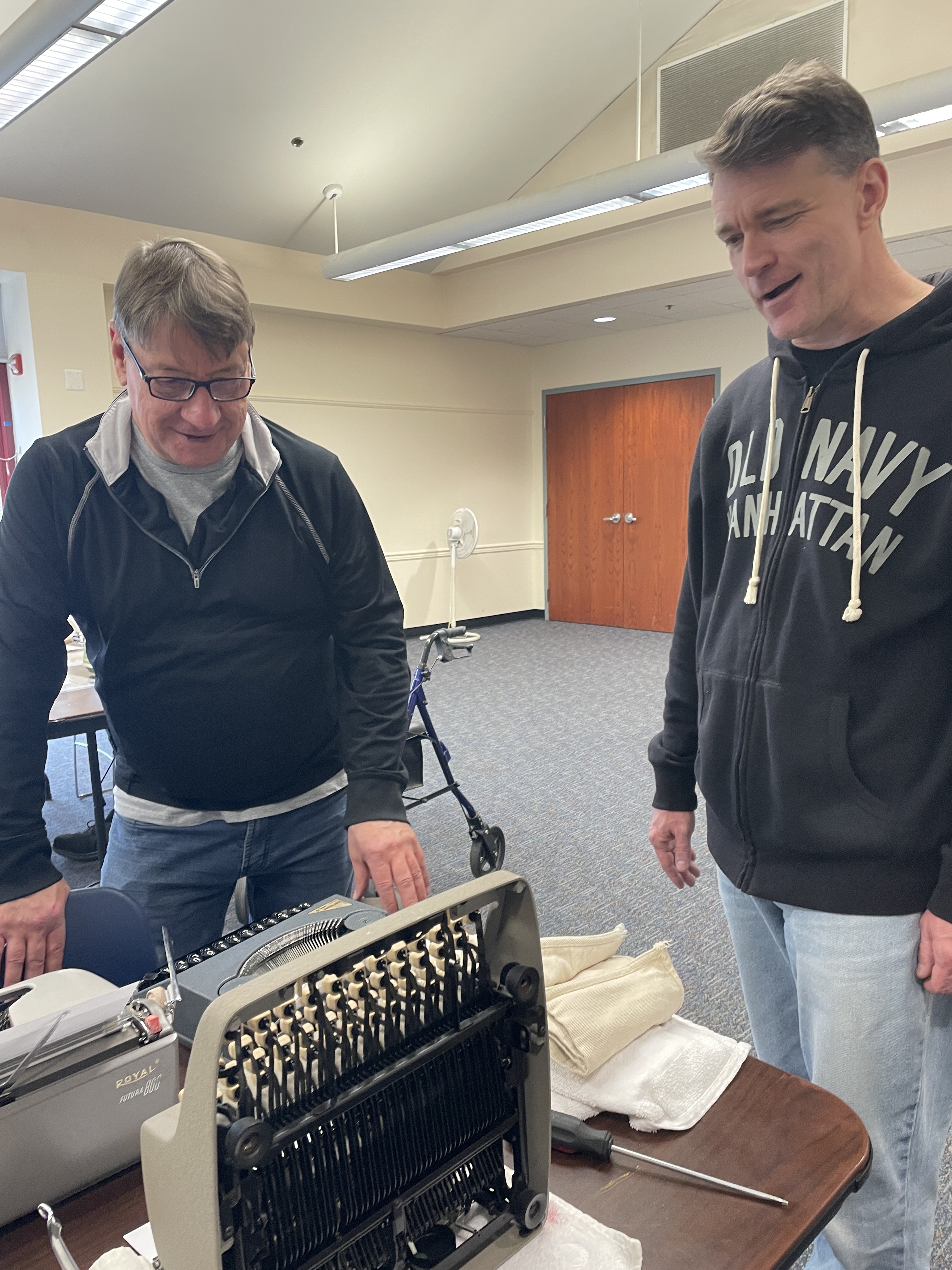
Stephen B, Monica’s husband and co-host of the type-in, discusses a misbehaving Royal QDL with Ross L., another local typospherian.
Both Ross and I agreed it was an escapement problem. He had cleaned it carefully and worked out any gumminess, so we decided to adjust the loose dog stop since the rigid dog seemed to be fouling the escapement wheel. Here is Duane Jensen from Phoenix Typewriter with an excellent explainer on Royal portable escapements.
Ross and I worked on the Royal QDL, adjusting the position of the loose dog stop à la Duane with a modified screwdriver, but no luck. Ross and I shook it off, and I said I would take a look at it at home.
Ross has an envious collection of eBay tool finds. I really need to up my typewriter tool game.

I brought both the wayward Porto-Rite and Ross’ misbehaving Royal home to the garage workbench. Though a type-in at a local public library is not exactly a high-pressure situation, I work best in solitude where I can think slowly and deeply and dig through my manuals.
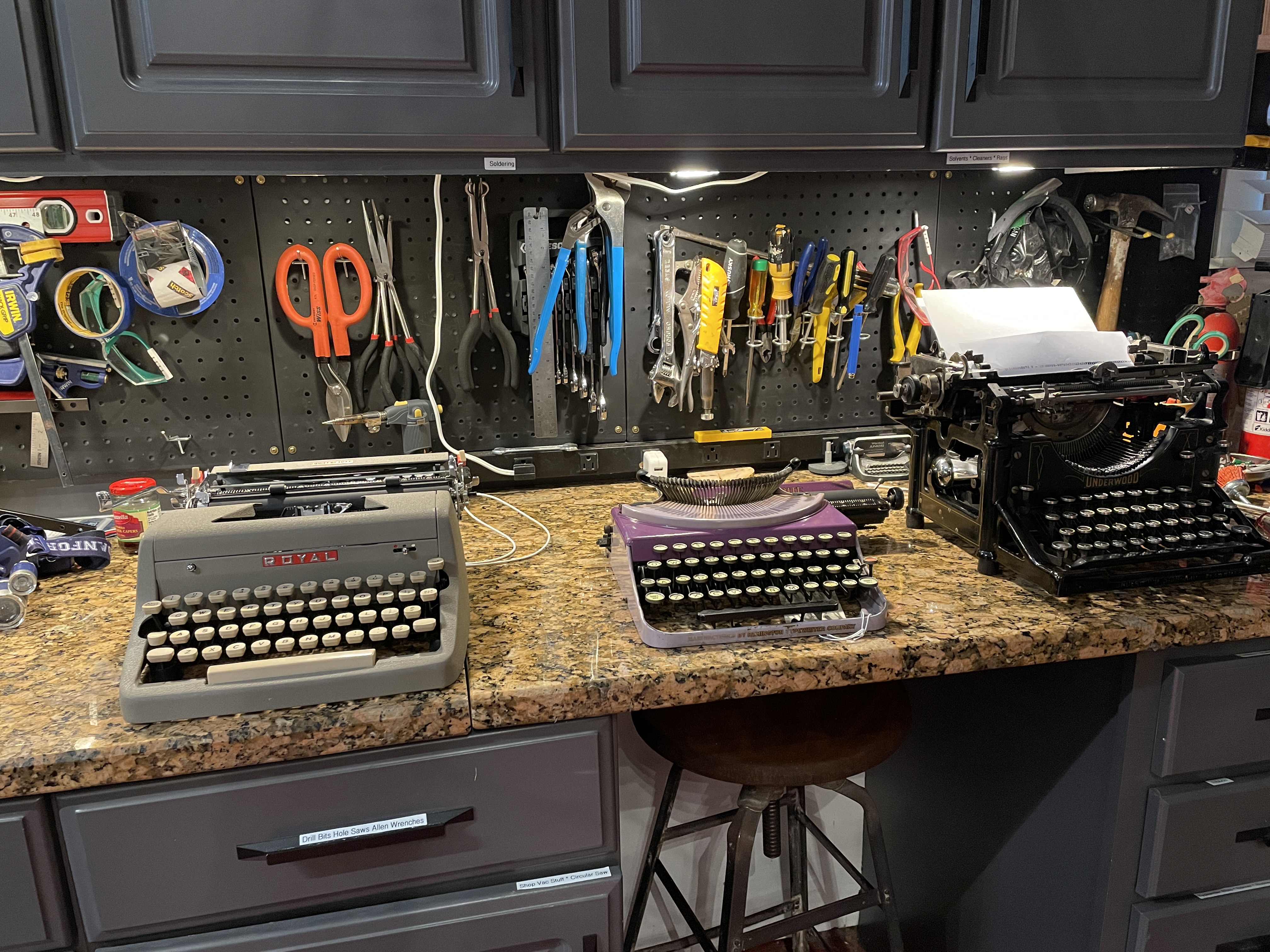
Here are the new kids on the workbench. The Underwood 4 is on his way out the door, but he’s kind of a lens louse, so he hustled into the picture.
I jumped on the Porto-Rite first since I had a better handle on its problem. In the Manual Typewriter Repair Bible, I did research on Remington portables and their escapement set-up:
There seem to be rack adjustment screws, but the rack on this Porto-Rite was a bit bent out of shape. Just a gentle squeeze of the carriage rack was needed to bring the Escapement Stepping Dog back into contact with the Carriage Rack.
Duane Jensen of Phoenix Typewriter has a repair video of a similar machine, a Remie Scout, which has a bent carriage rack causing the carriage to stall.
It was time to throw a drawstring into the Porto-Rite. I followed the instructions in Duane’s excellent video on replacing the drawstring on a Remington portable.
I cut a piece of heavy weight upholstery thread about 22″ long. You won’t need the entire length, but you need enough length to tie a knot at the end (see above video). Of note: I didn’t have the little clip that secures the drawstring to the carriage so I just made a loop and tightened the anchor screw down on the loop.
The Porto-Rite’s mainspring was partially broken—I could see it rattling around inside. Fortunately there was enough intact mainspring attached to the center spindle to produce tension inside the drum.
Ah, yes. This is good. And the ribbon still has some life left in it.
The Remington’s bell was giving a dull thunk at the end of the line. I saw the clapper resting inside bell.
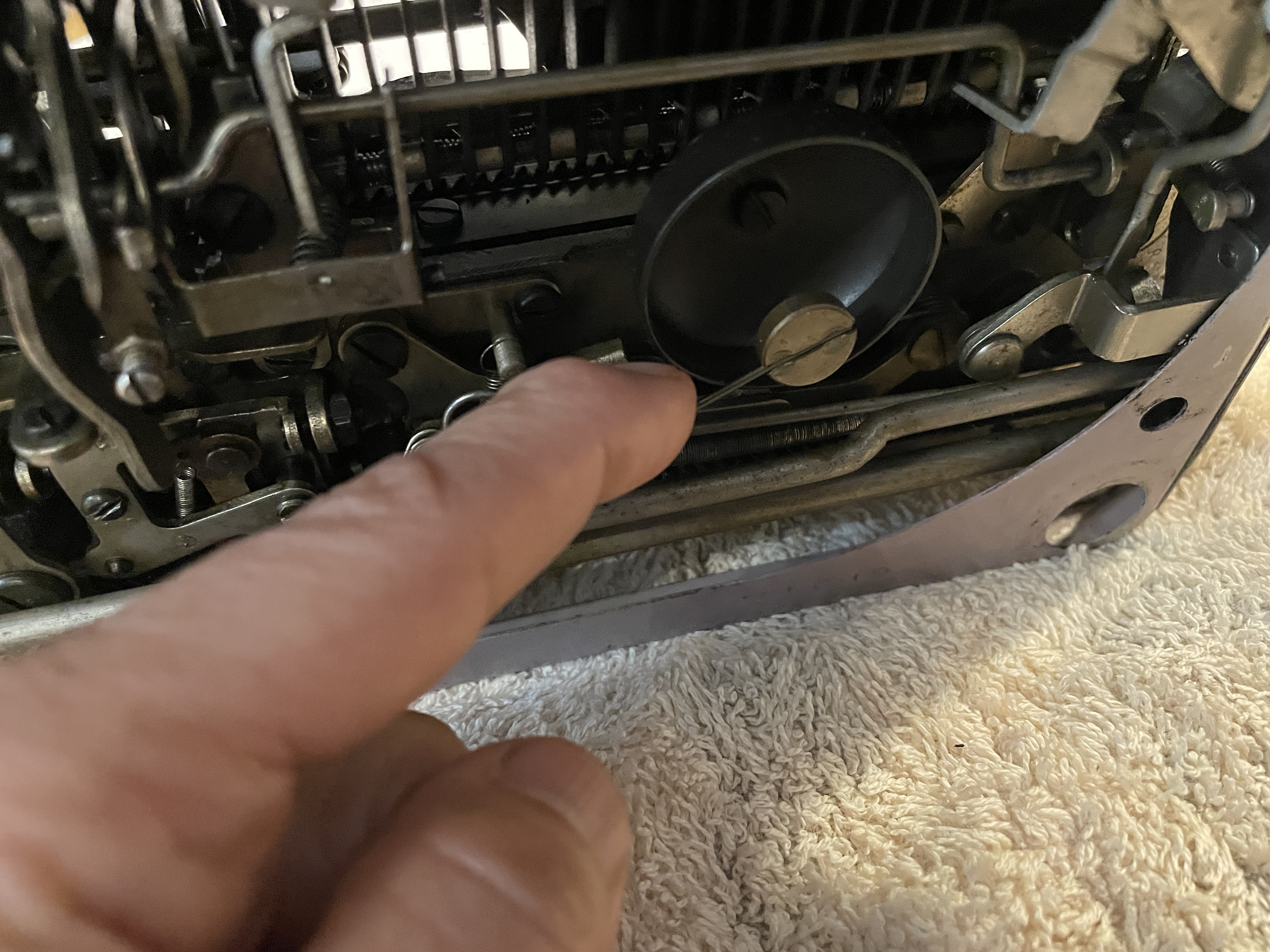
I formed the clapper slightly away from the interior of the bell. According to Duane, there should be a little play between the clapper and the bell so that it rings and doesn’t clunk.
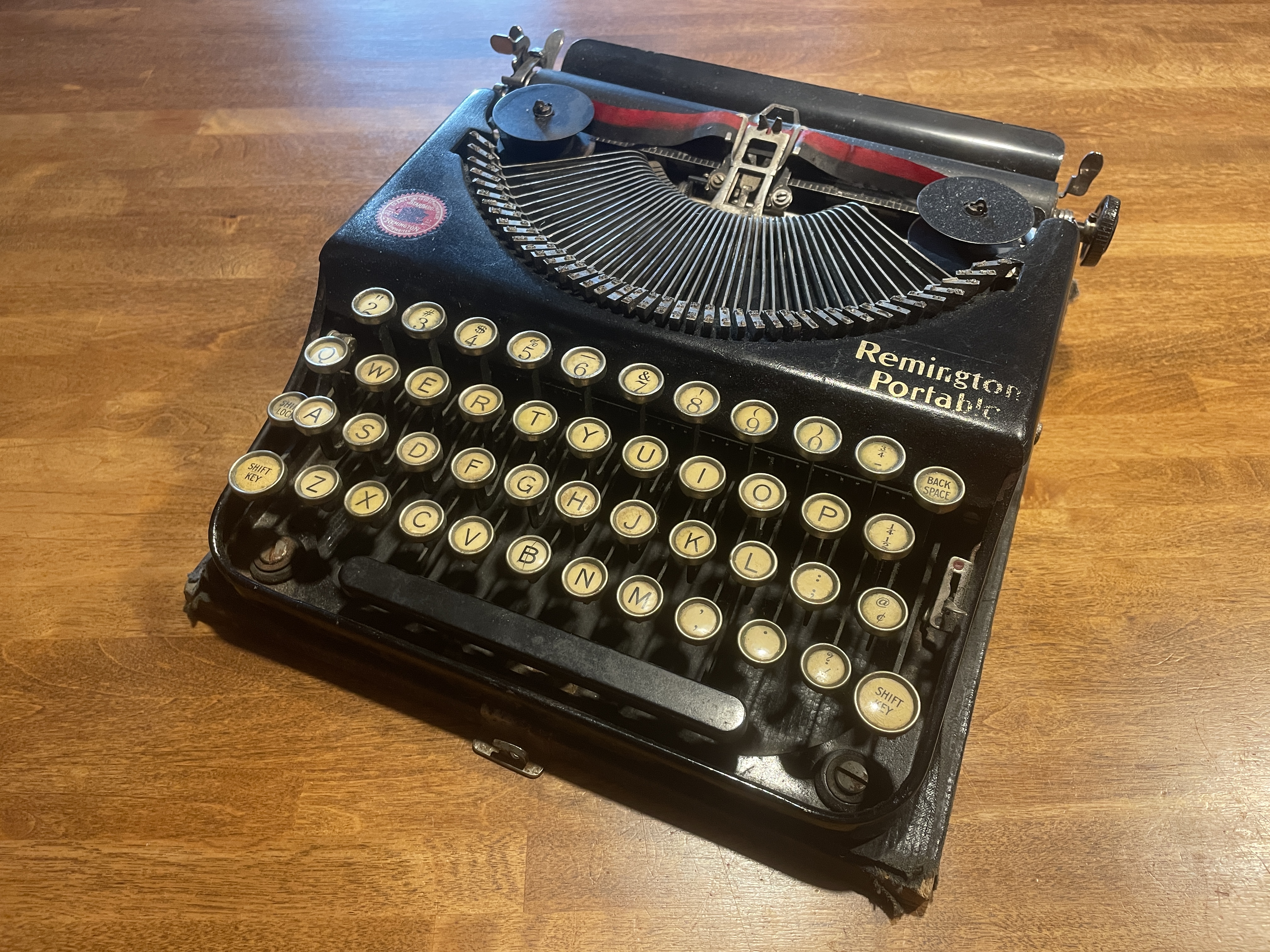
These old Remington portables type wonderfully despite being a hundred years old and seemingly as delicate as tissue paper. I’ve forgotten how much I enjoy working on Remington portables. Once I get a moment, I will fix this 1922 Remington Portable 1 (a freebie that came to me because the carriage is stuck). I think I’m missing a back roller retainer / pinion.
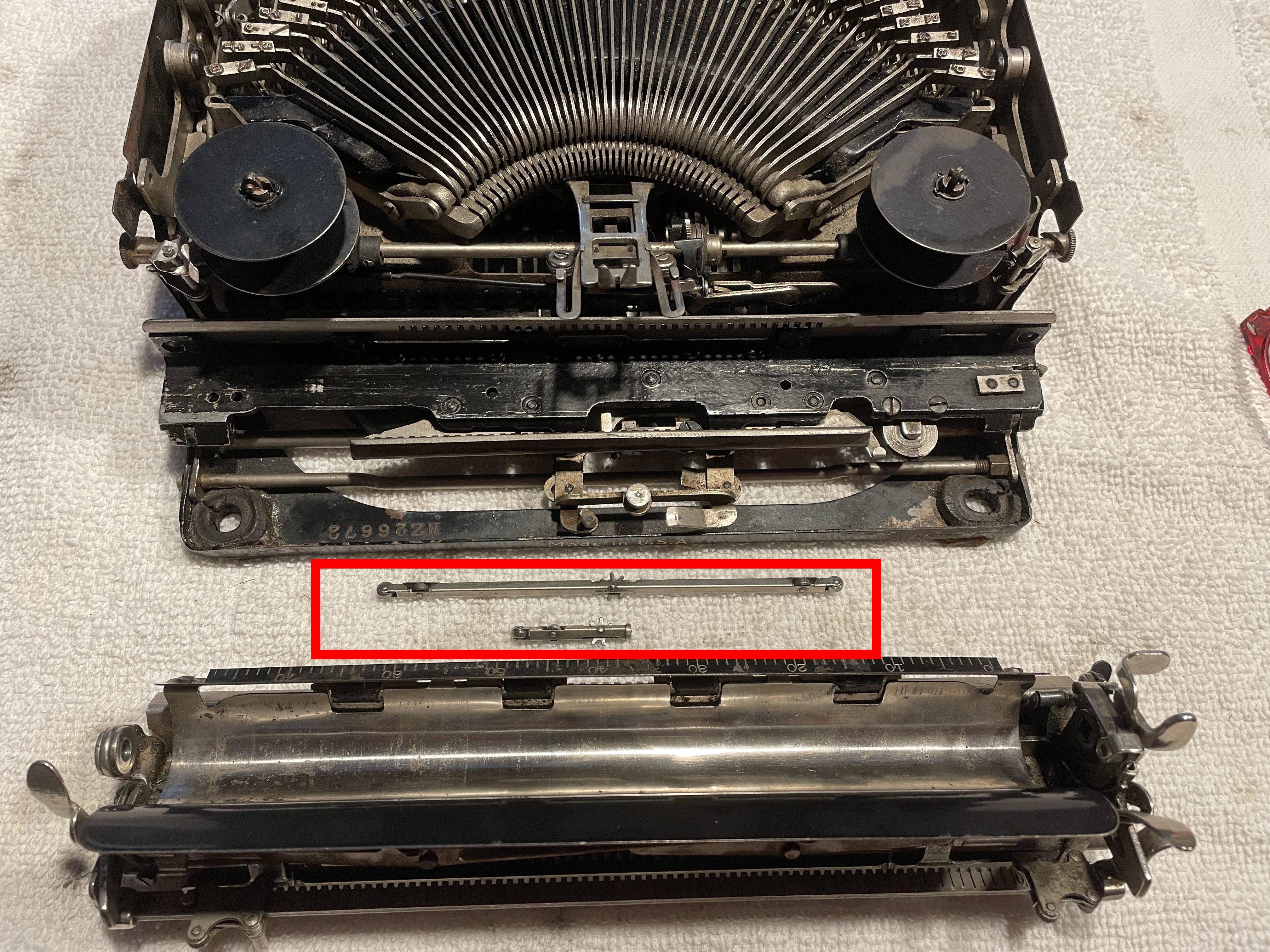
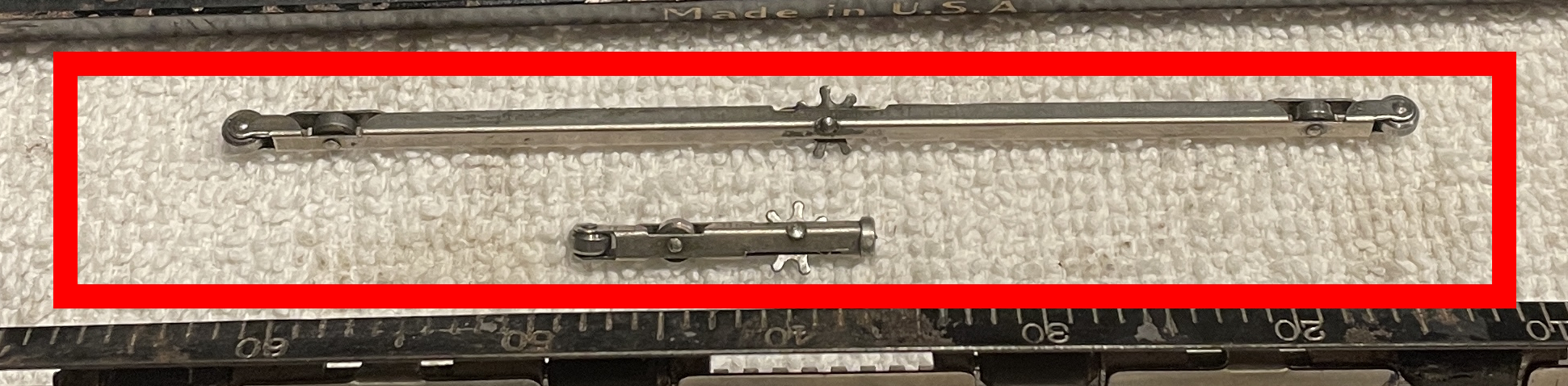
The back carriage rail of my Portable 1 is much shorter than the front, but look at that weird shortie roller/pinion retainer. Should it have a twin? If you have dismantled a Remington Portable 1, please let me know in the comments what the carriage bearing / roller + pinion retainer set up should look like.
Anyhoo, back to the Purple Porto-Rite. It was well on its way to recovery, and it was time to take a look at Ross’ stalling Royal QDL. I have recently been making bender tools from cheap screwdrivers.
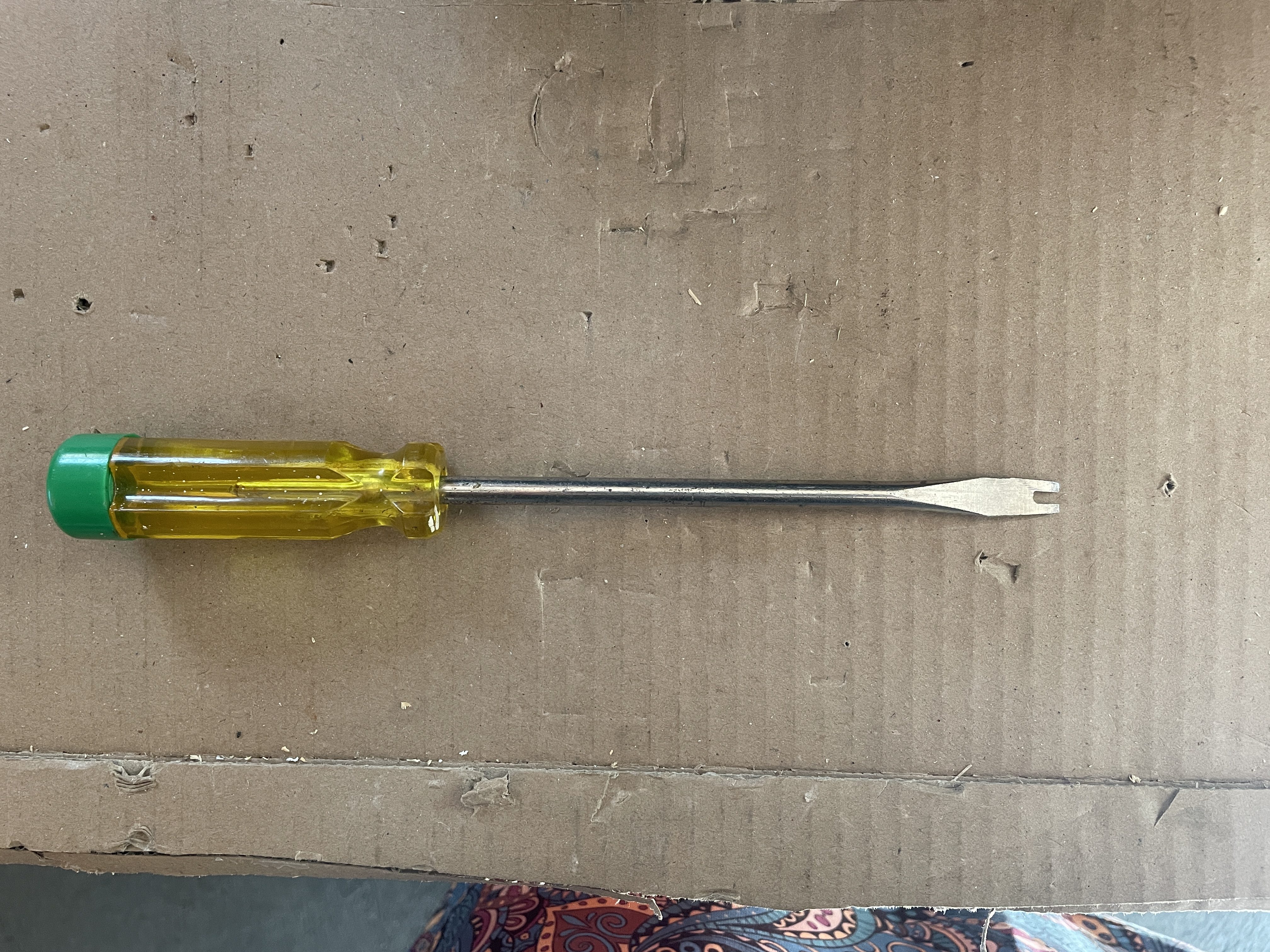
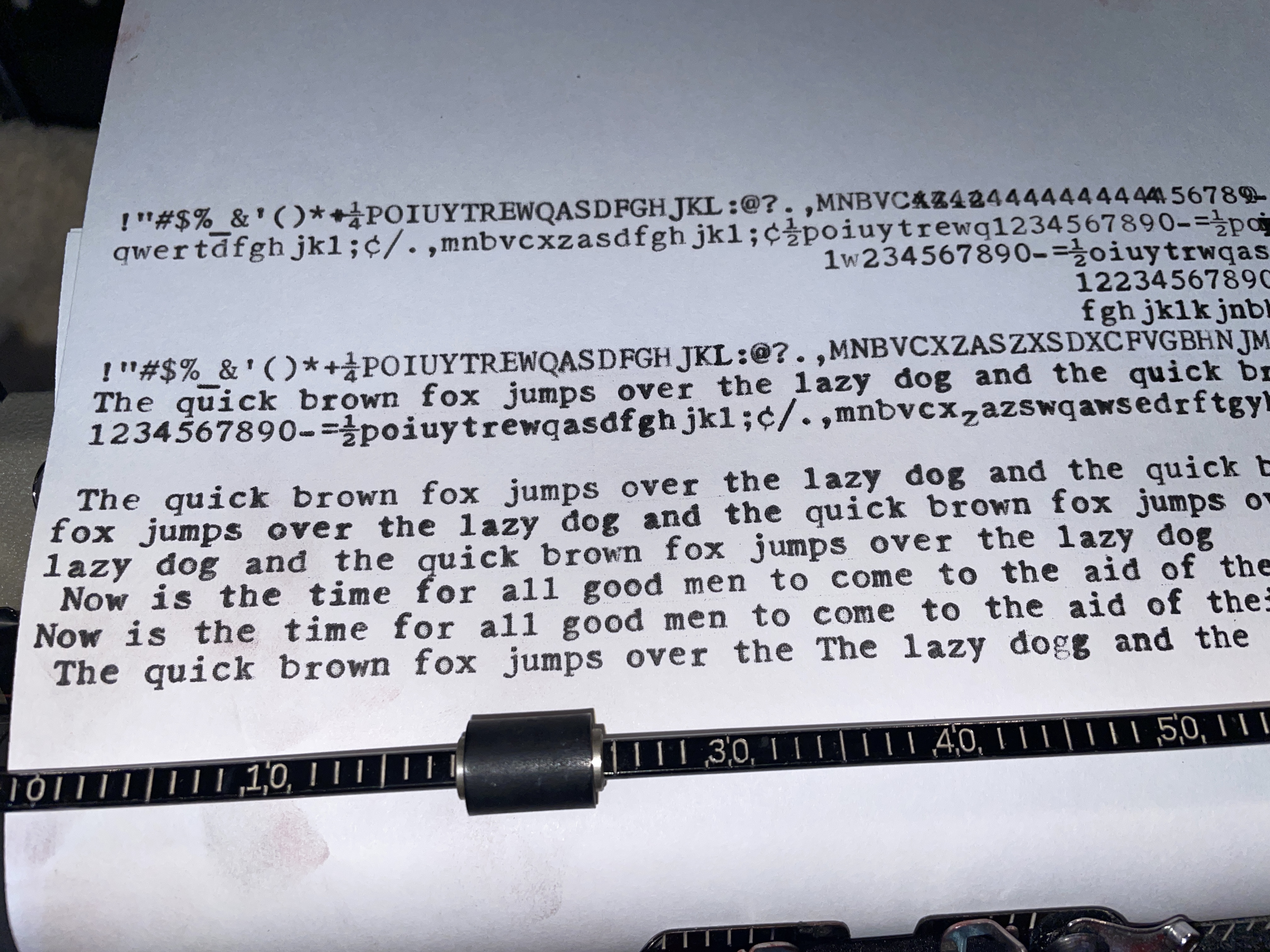
At my workbench, I formed the dog stop down another hair with my modified screwdriver, and that seemed to do the trick. I threw a ribbon in and oh my goodness, it’s Canterbury typeface. What a nice surprise.
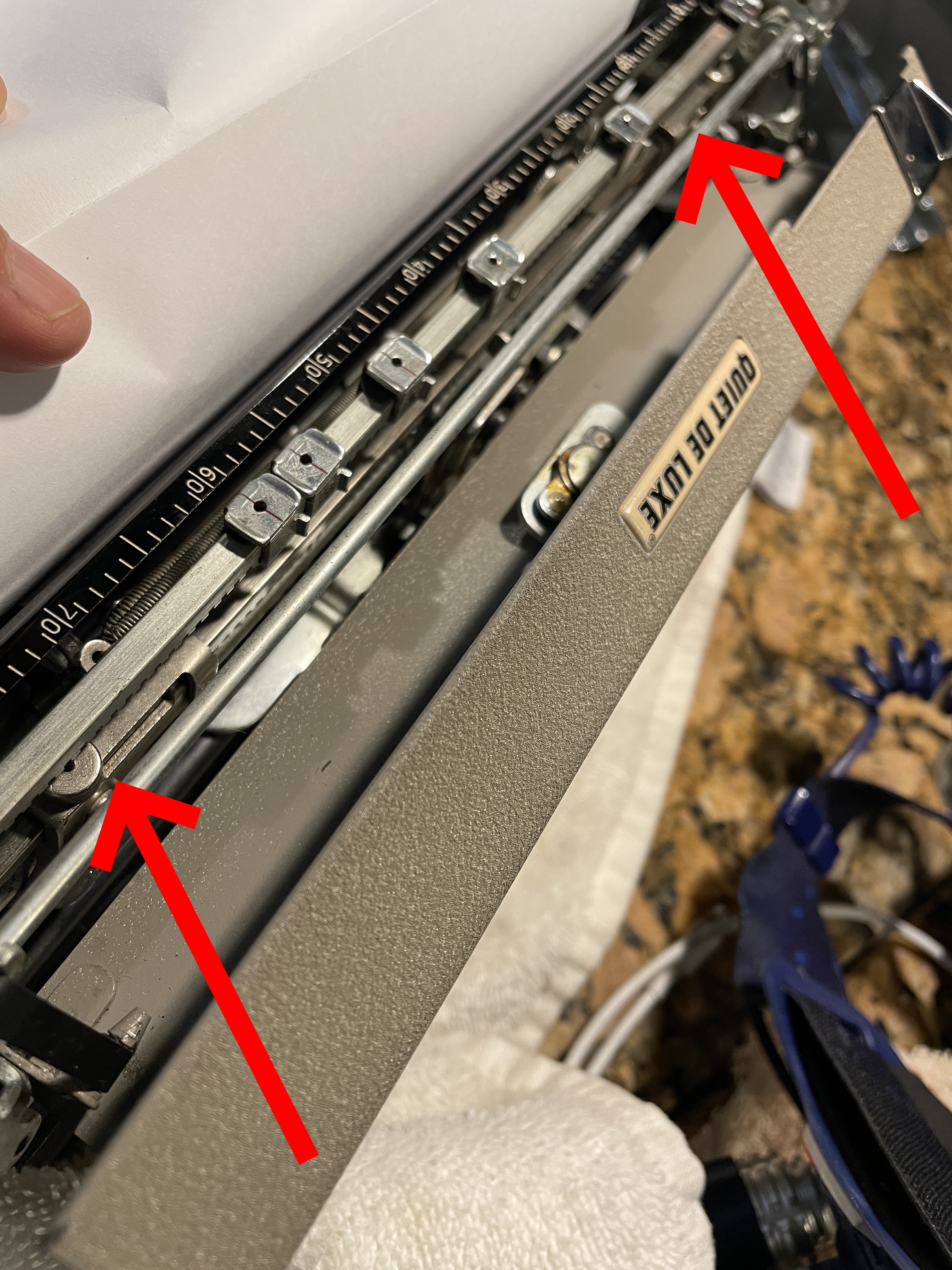
Now that the Royal QDL was typing without stalling, I had to address the gummy Magic Margins that were sticking. I flipped the canopy that covers the mechanisms in back and doctored the margin pieces with mineral spirits.
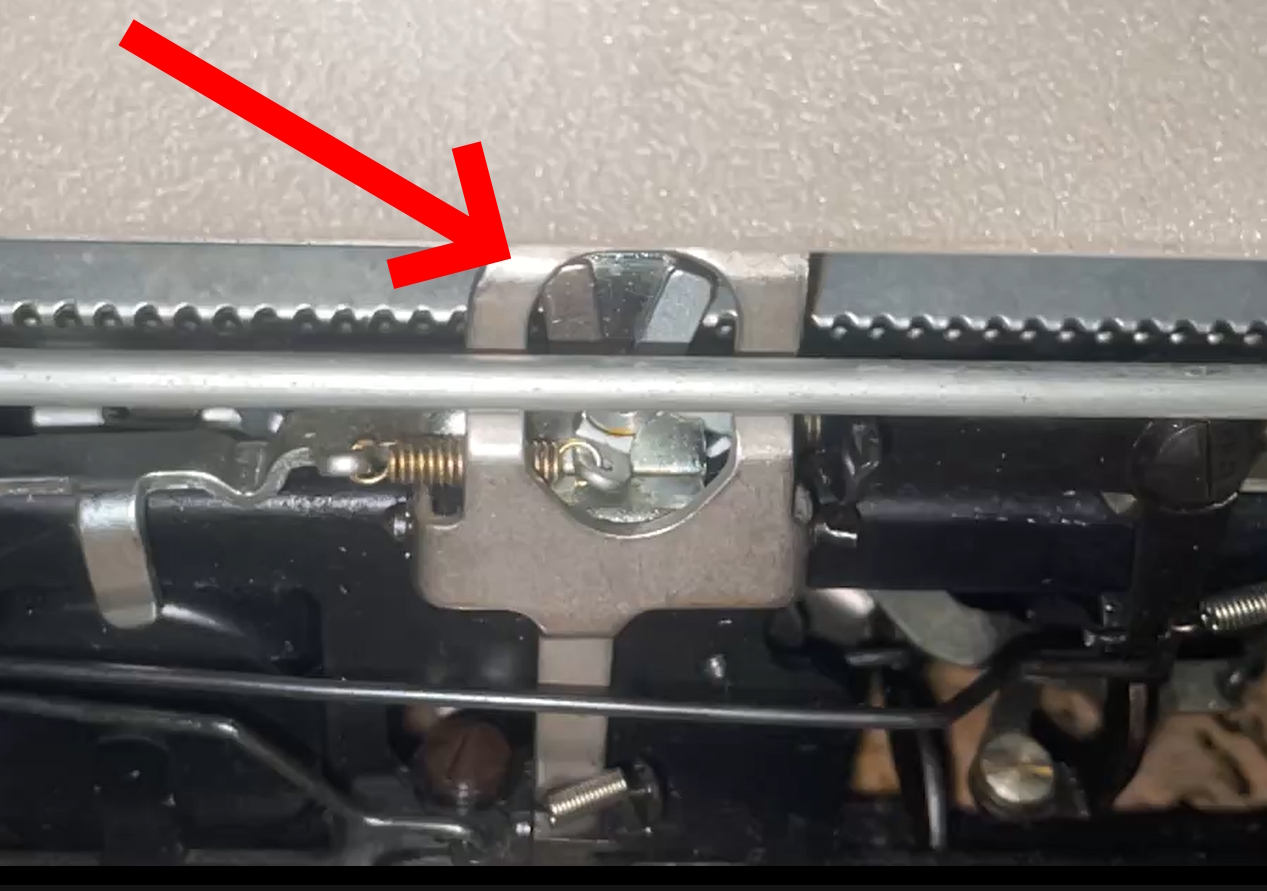
The line lock wasn’t engaging at the end of the line either. According to the Manual Typewriter Repair Bible, I should examine the line lock lever by the center stop post.
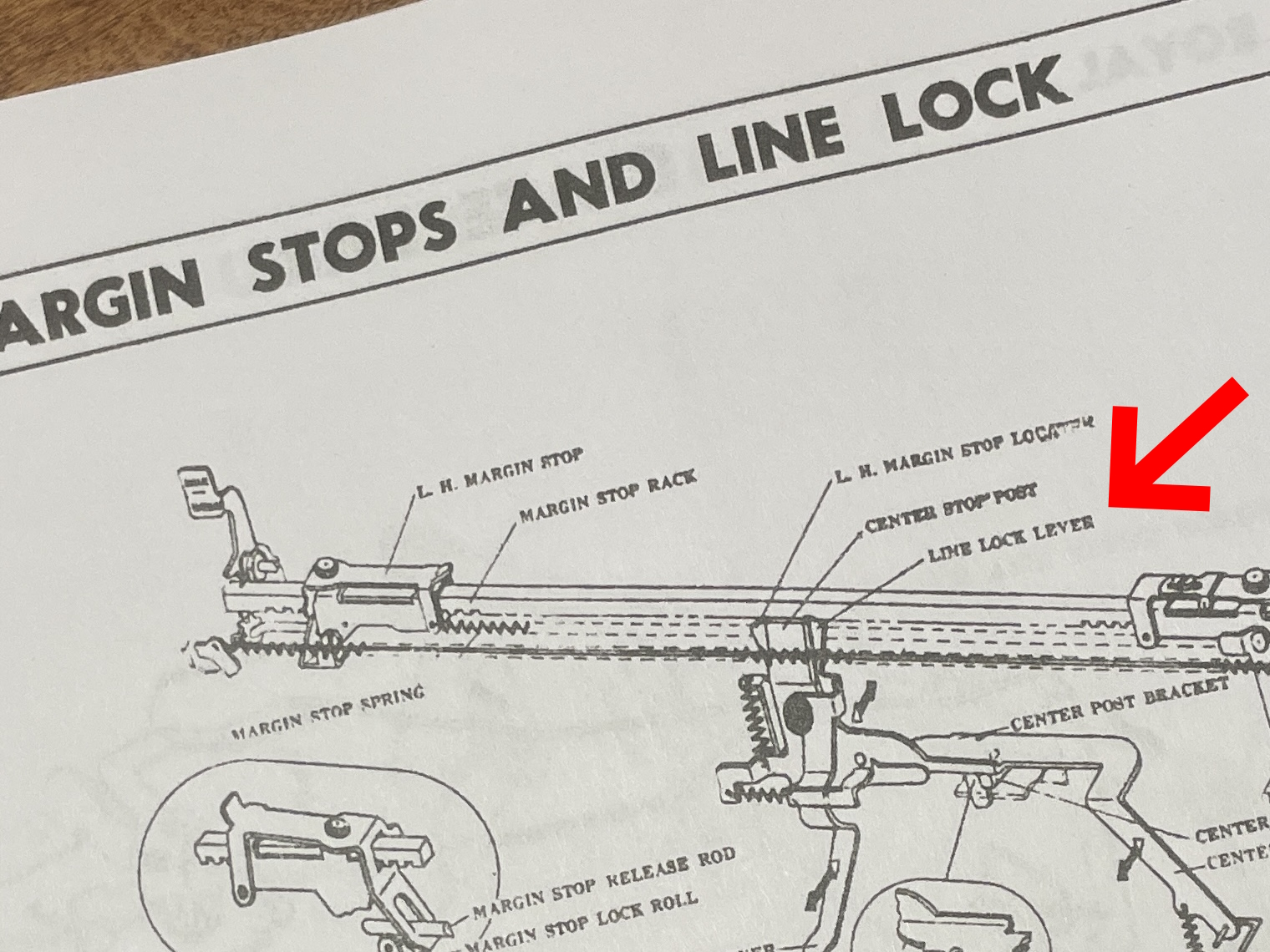
I cleaned the gummy line lock trigger on the center stop post until it went boing-boing-boing and that fixed the problem.
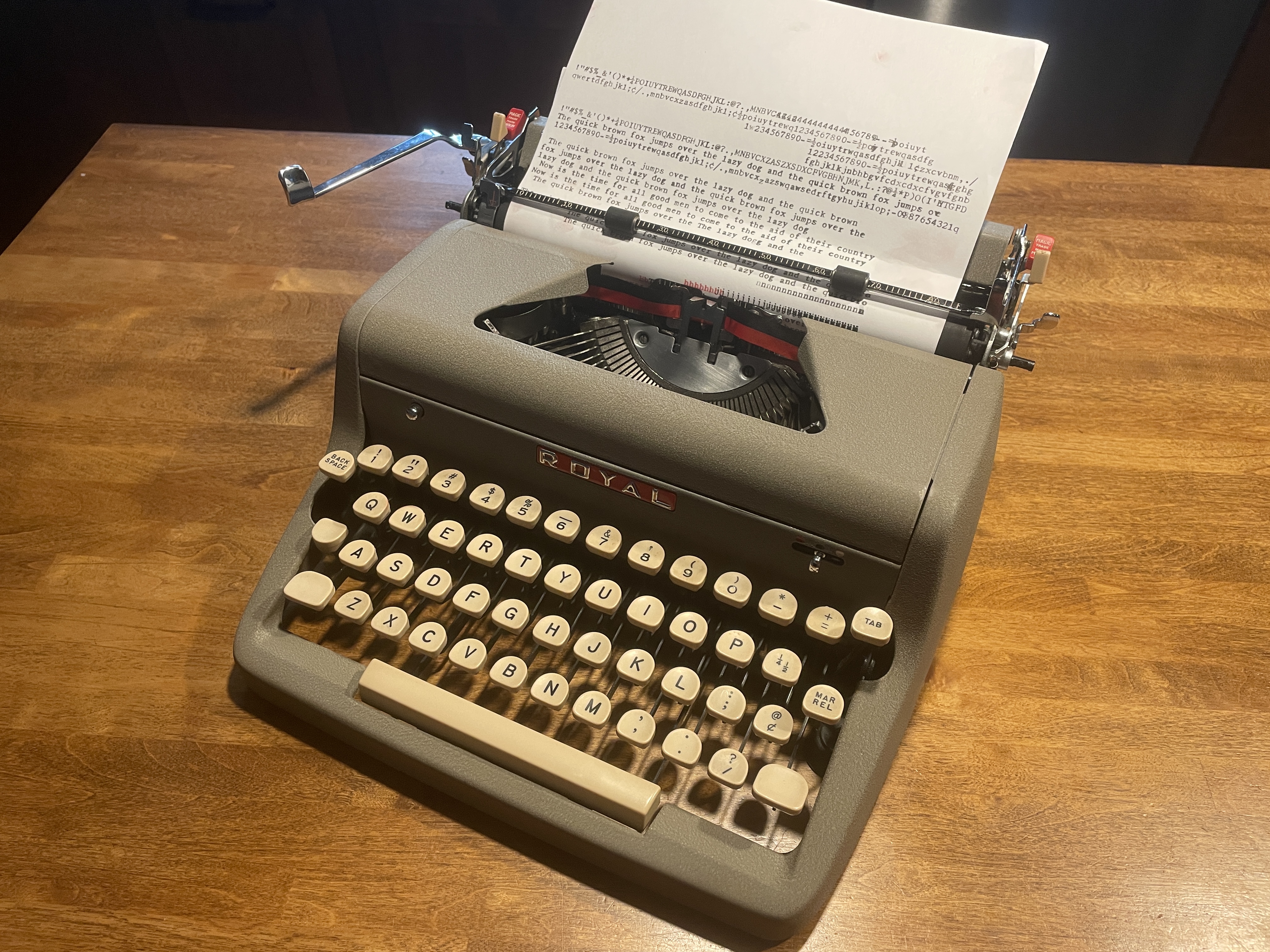
I’m feeling very good about this Royal QDL and will send it back to Ross shortly. I like to let machines sit a few days in case problems creep back.
In addition to typewriters, I have been doing a lot of granny work lately with my grandson. I have a little library of children’s books, including Harold and the Purple Crayon, a book that BLEW MY MIND as a child. My grandson devours books—literally.
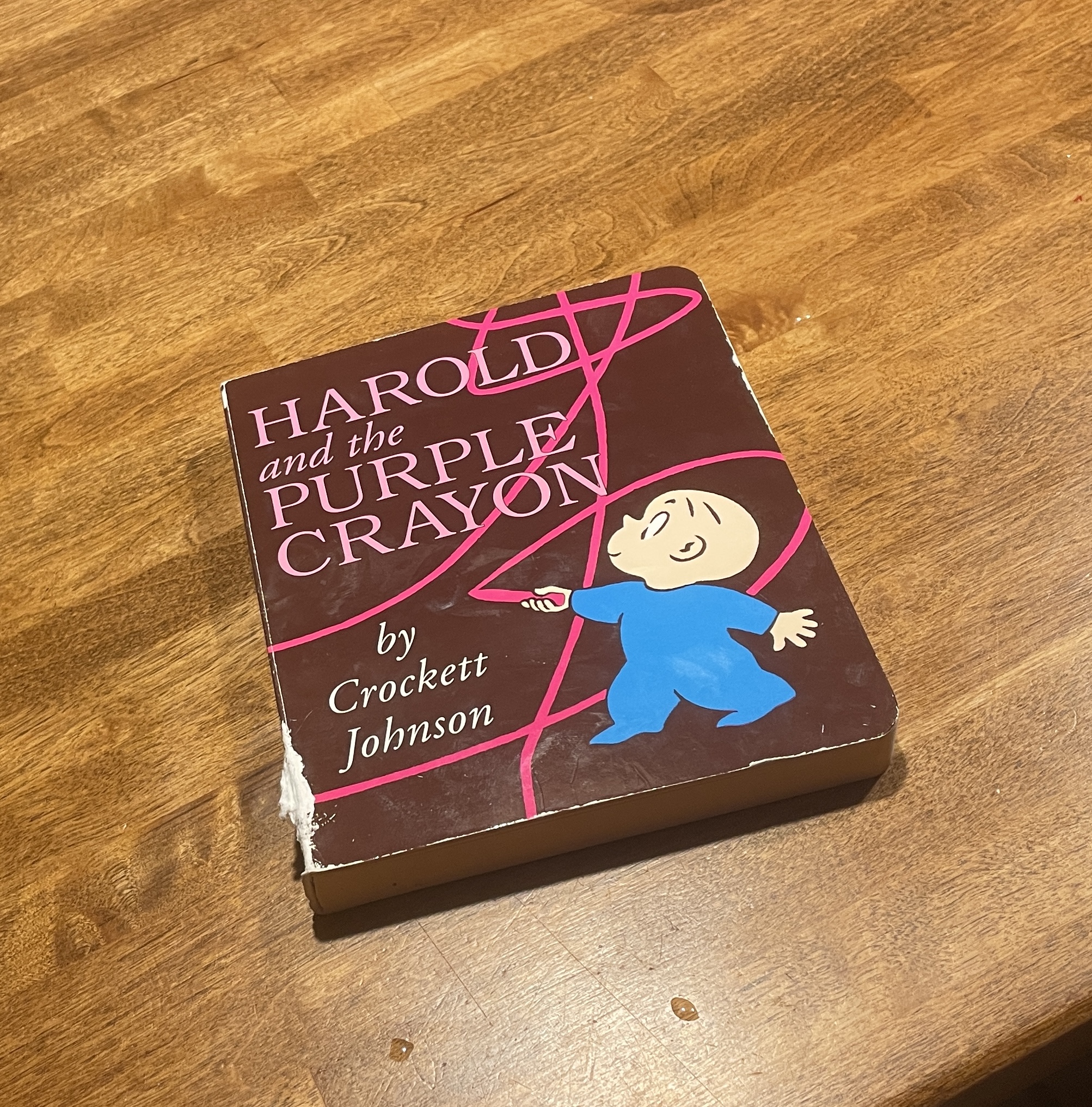
Tooth marks all over this one
Barney the Purple Porto-Rite has a special affinity for all things purple.

I recently went down the Crockett Johnson rabbit hole, and I was delighted to discover that Crockett Johnson was not only a well-known children’s book author, but also a painter who created over a hundred works related to mathematics and physics.

PURPLE ADDENDUM: Here’s another purple book recommendation. Sigrid Undset’s Kristin Lavransdatter trilogy.
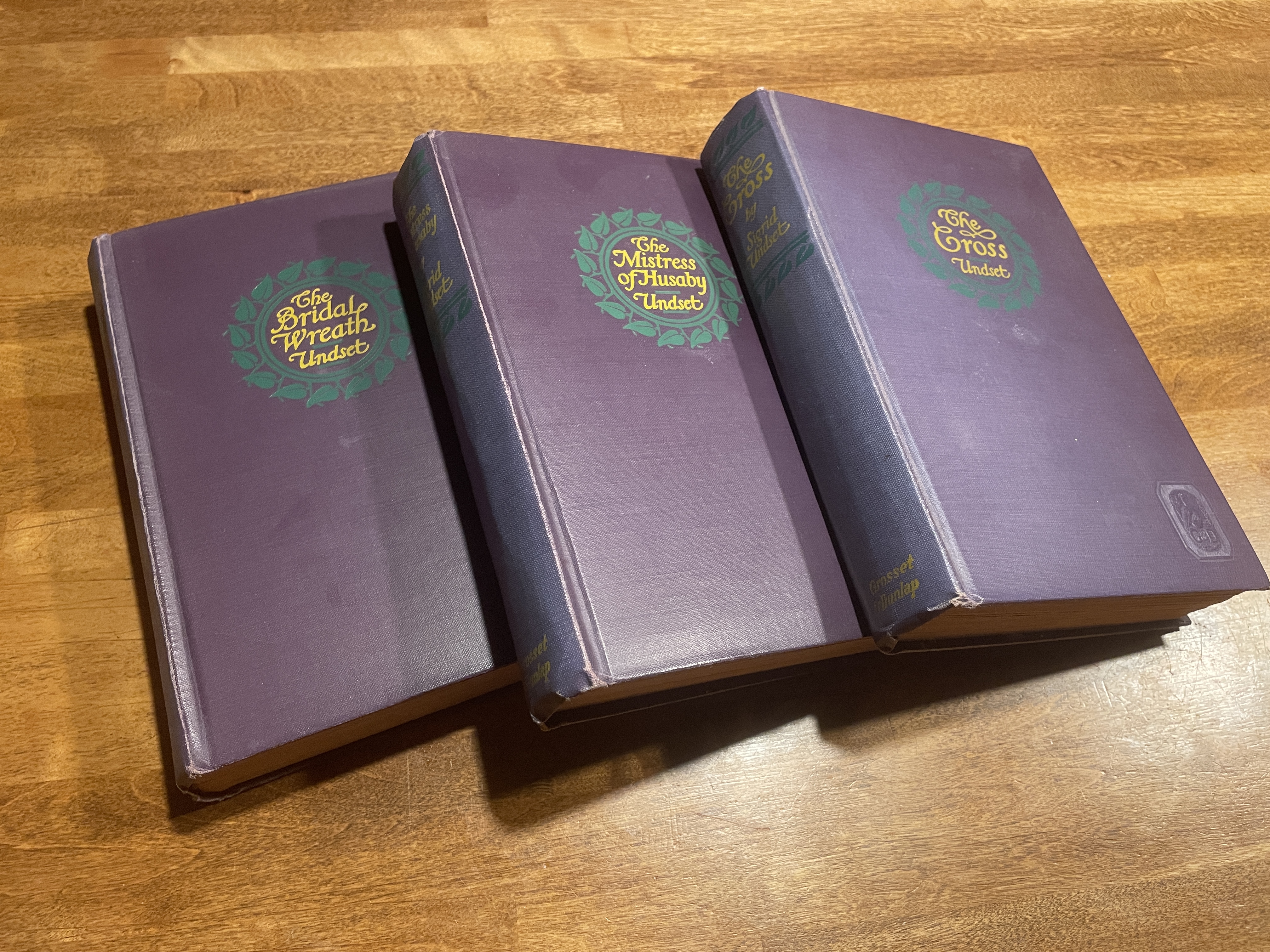
1929 printing. Archer translation.
If you like sprawling sagas about very relatable people in 14th century Norway, this is for you. I’ve read the trilogy several times at different points in my life (young woman, young mother, old mother) and pick out something new with every re-read. I’ve loved both the old Archer and the new Nunnally translations, but most people agree that Tiina Nunnally’s modern version is cleaner and closer to the original Norwegian (and she included the spicy bits that Archer left out :D).


Brilliant! Your fearlessness of mechanics is inspiring and your articles are fun to read *AND* full of information. Maybe we can have a tinkering-focused type-in next?!
LikeLike
Gosh, I would love that!
LikeLiked by 1 person
Here’s another reason for your list:
I don’t repair much anymore, but my friend who took over from me still doesn’t deal with electrics, so I get his referrals from time to time. Recently he asked me if I could take someone’s Smith Corona Electra, on which the carriage was slipping around.
So, this woman brings it over, and it’s one of the later models designed with a correction ribbon, the sort that has whiteout on the bottom half. But she’s enamoured with it, loves the blue colour and the lines. Turns out she ordered it for over a hundred bucks from somewhere in the US, all the way up to Edmonton. The seller apparently did the usual poor job: Plenty of packing around the case, but nothing inside. Sure enough, carriage won’t stay in place, and my heart sinks thinking that it will be the escapement.
I figure out how to take off the outer case, and start to poke around, and it turns out that in transit it must have banged around enough to jolt the power spacer lever just over its trip point, causing it to be held down. A little forming, and it was fixed.
It was good that I went in, since the ribbon mechanism wasn’t working properly, and the ribbon lift wasn’t lifting. I got all the old whiteout out, and she was just delighted when she picked it up, and I was pleased to still have the skills to hand. But most of all I was glad it was such a relatively simple fix, as long as you know what you’re looking for.
LikeLiked by 1 person
Jacy, thank you! I am adding that to my list. Sometimes it is a relatively simple fix, but you really do need to know what to look for. Your insights from years of experience are invaluable, and I wish I could intern with a professional – I’d write everything down.
LikeLike
Nice work. Carriage rails on those old models are many times the cause of problems. They not only get bent, they come loose, and sometimes well-meaning people will tighten them without knowing they also need aligned before retightening.
I like your screwdriver. I made a similar bender something similar with a T handle allen wrench. Allen wrenches are tempered so grinding slowly to make the slot and keeping it cool by dipping regularly in water will keep it hardened.
I have several screwdrivers where I made wide slots to loosen and tighten those nuts with slots that are generally a pain without a slotted driver. Old or cheap gunsmith screwdrivers seem to work best.
LikeLike
I have a Chapman typewriter toolset (they make gunsmith toolsets too) that has proven to be indispensable when loosening hundred year old slotted screws. The only hitch with the Chapman tools is that the neck of the driver is thick and they are short so I’ve had to use a Dremel and modify cheap screwdrivers to get into narrow, distant slotted screws.
LikeLike
I’m always impressed with the thoughtfulness and thoroughness of both your repairs and your blog posts.
I got to meet Monica and Stephen when they drove all the way to Cincinnati for a type-in.
LikeLiked by 1 person
Monica and Stephen are solid citizens of the typosphere – I am so glad to know them. By the way, excellent write up of the Cincinnati type-in. Inspired by Monica and Stephen, I will try to attend more type-ins outside the immediate DC area.
LikeLike
Your posts continue to be a great source of approaches, tips, and joy. Thank you!
LikeLike
Thank you! Nice to hear.
LikeLike
Thank you for another interesting and informative restoration adventure story. I too remember reading ‘Harold and the Purple Crayon’ as a child, and after watching the movie version of it last summer: https://www.youtube.com/watch?v=Wojlv-PVYm8 I was inspired to buy several vintage copies of the book from Wonder Books in Frederick, Maryland to share with family and friends . . .
LikeLike
It’s a pretty great book.
LikeLike
I always look forward to your blog posts. I own one of the Porto Rites in the TWDB, SR6198. Great little machines.
LikeLike
Thank you! And I agree: those little Remington portables are such nice machines to use.
LikeLike