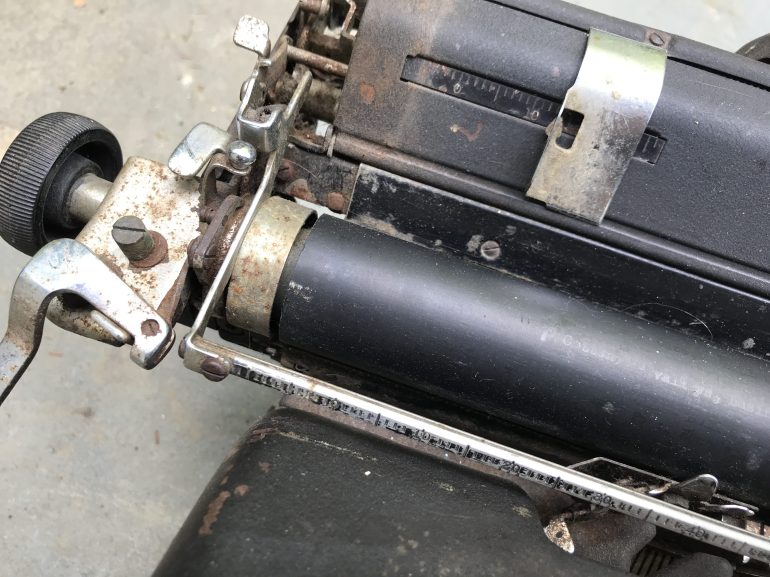
Jammed paper bail

Royal KMM: Broken Things and Fixes

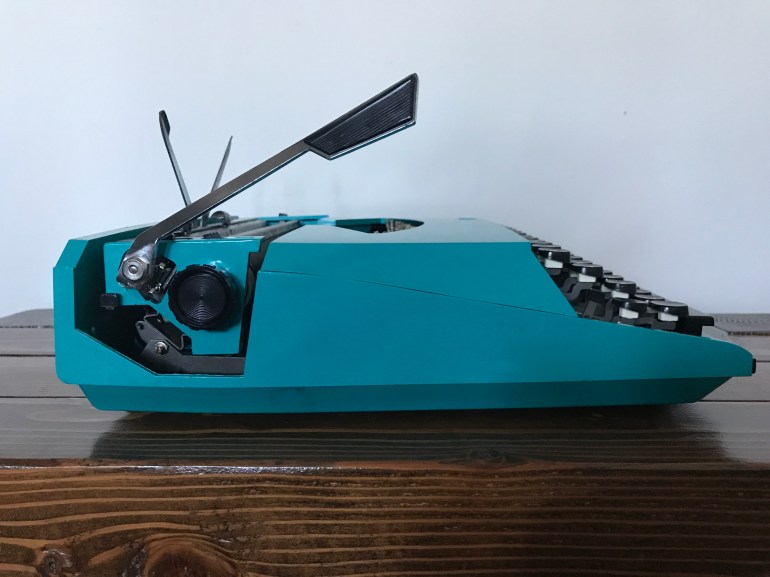
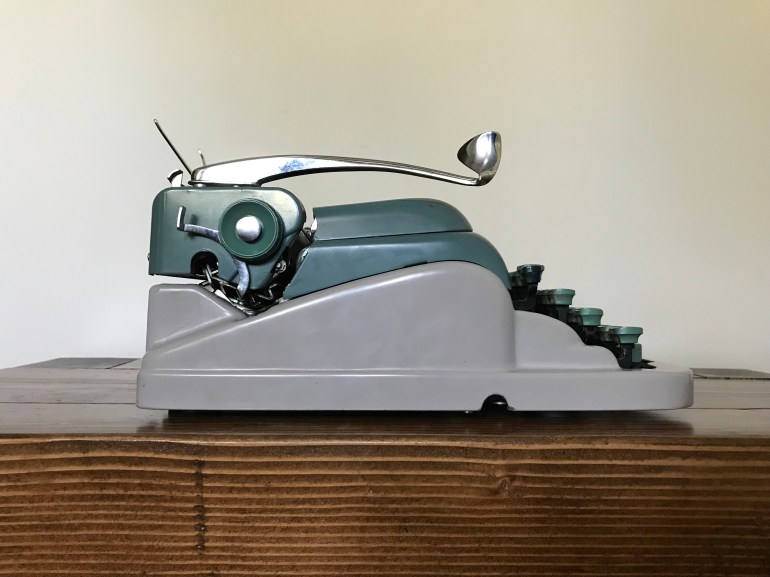
A local lady heard through the grapevine that I liked to tinker with old typewriters.  K. had purchased a Royal KMM at a yard sale and was hoping to get it typing.  I was glad to take on the project since it would be a distraction from my Twitter horror scrolling and my hand-wringing over the broken state of the world. She brought it over a couple weekends ago, and here it is on my porch on arrival:

Continue reading

Garage Band

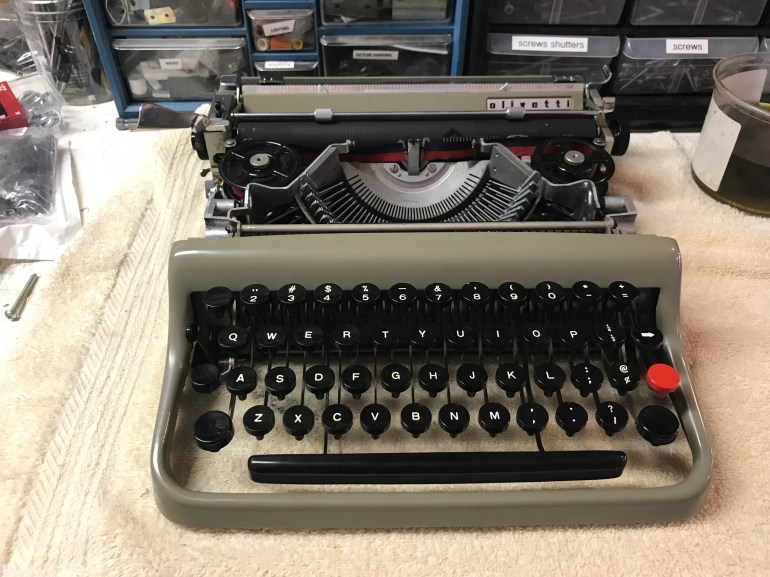
The  marathon of holiday events that stretch from Thanksgiving to New Year’s is pounding along, and I am gamely holding my own.  Others may drop out from exhaustion; but I am a solid long-distance runner, and I will win this holiday season.  To that end, I hosted a Holiday Typewriter Open House.
Continue reading

Party On

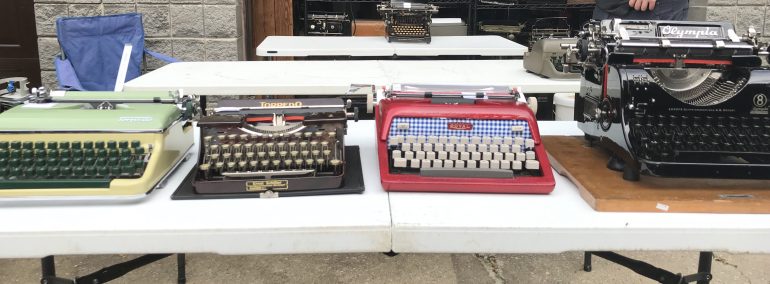
In mid-October,  I attended the Typewriter Jamboree at Herman’s in West Virginia.  This is my third time there, and I get so much out of it.  I had a really good time re-connecting with those I’ve met before, meeting new typewriter people, geeking out over interesting typewriters and repairs, laughing my fool head off over typewriter-related antics.  Really, where else would you get all that kind of typewriter-related fun?
Continue reading

The Regal Royal and a Broken Typebar

The other morning my husband spotted my dear neighbor Connie standing silently, patiently outside my front door with a Royal 10 in her arms.  She had carried the machine up the street from her house despite the fact that it weighs a full third of her body weight. The Royal 10 had been in the family and no one wanted it (!), so she hauled it up the block to my home for unwed typewriters. I haven’t lived here long, but the neighbors are already on to me, familiar with my strange quirks and enthusiasms.

Continue reading

Make Mine Pink: Smith-Corona Super-Sweet

There was so much orange, gummy residue in this S-C Silent-Super that I got from Ebay a couple weeks ago. I think it was old WD-40. The escapement (and carriage rails, margins, shift lock, space bar) responded to a good cleaning with mineral spirits, but the typebars required a lot of work. I searched my mind, but I don’t think I have ever come across as sticky a typewriter as this one.  The typebars were gummy not only in the segment but at many other tight pivot points. Some keys were sticking in the sublever segment, and some were gummy at the clevis connections. Others (I think) were sticking in the key guide comb. I also had a couple type slugs that had little corrosion burrs that caused them to stick in the typebar guide.  I cleaned up the sides of the affected type slugs with some steel wool.

The mineral spirits I buy in Virginia seems to be a more aggressive formulation than the gentle, forgiving mineral spirits I get in California.  I have to be very careful to keep these Virginia mineral spirits away from any painted surface.

After de-gumming the mechanics, I removed the Silent-Super’s tangled drawstring from its guts. I made the new drawstring from heavy duty waxed thread.  I didn’t have the little hook end for the drawstring, so I just made a knotted loop and tightened it down at the anchor point at the right end of the carriage.

I used the Robert Messenger method of drawstring attachment and pre-wound my mainspring before I attached my drawstring to the mainspring. However, I just saw a very interesting Phoenix Typewriter video that demonstrates a Smith-Corona mechanism that allows you to wind the mainspring after you attach the drawstring. You learn something new every day !

The tabbing mechanism was still halting and sluggish.  I wiped down all the pivots points I could see, but it was still slow on tabbing.  Fortunately I had Ted Munk’s Smith-Corona Floating Shift Typewriter Repair Bible. This repair manual is also available as a PDF download. After reading through the section on the tabulator, I found the buried spots I had neglected to clean with mineral spirits. After a good clean, tabbing was fast and smooth.

This service manual is also available in PDF format. I like the hard-copy books that I can paw through with my grimy hands.

The uppercase/lowercase alignment was a little off. The lowercase letters were printing a wee bit high.

I referred to Ted Munk’s post about making vertical alignment adjustments on segment shift typewriters.  Phoenix Typewriter also has a very good Youtube video on making the adjustments.

I used a 3/16″ nut driver to loosen the lowercase lock nut and turned the adjustment screw a bit with a teeny screwdriver.

Whoops!  Wrong way! It’s going up higher. Other way, other way.  That’s better.

I tightened down the lowercase lock nut and it’s all good.

Here’s a parts diagram for the Silent-Super that I snagged from a 1958 Silent- Super/Sterling/Clipper manual in Richard Polt’s typewriter manual archive:

I removed the platen to clean it and all the bits around it which were still very sticky and furry from congealed something-or-the-other.

Removing the platen is pretty easy on this type of Smith-Corona portable.  Joe Van Cleave has a good Youtube video describing the features of a S-C Silent.  At about 11:30 in the video, he demonstrates how to pop out the platen.

  • Lift the paper bail
  • Tilt back the tab cover
  • Pull out the variable line spacer on the left platen knob
  • Press the platen release latch forward
  • Lift platen out

I cleaned the gummy residue from the platen, rubber bail rollers and feed rollers with denatured alcohol.

Pinkie’s outer skin was still pretty rough.  She had lots of surface rust and bare metal.

I used diluted Scrubbing Bubbles to gently clean the pink paint.  I was worried that it would remove paint, so I tested in an unseen spot in the back.  It removed gray grunge but no pink paint.

Here’s a photo on my work bench after I had cleaned her backside.  The machine arrived from Ebay with a gray, grubby cast, but a careful cleaning slowly revealed her bright pink flesh.

Pinkie’s pink paint was very bright, but she had some major dings.   I primed bare metal spots, and I made up an acrylic paint mixture of various pinks for paint touch-up.  It was tricky because the pink was not uniform in color over the typewriter:  salmon here, coral there, dusty rose over there.

I made very conservative, respectful paint touch-ups. This Silent-Super is a Smith-Corona Super-Sweet:

Old Pinkie has lost a lot of her grungy, corrupt toy vibe.  However, I “kept it real” with this clean-up, so she still has her charming smattering of corroded freckles.

X Over It has a nice collection of Smith-Corona portable advertisements. Pinkie’s color is officially called “Coral Pink”. In 1957, Silent-Supers’ list price was $129.00. If you convert that to 2019 dollars, that’s about $1160.00. That sounds like a lot, but I know that I spent more on computers in the early 1990s that are now considered e-waste. Hello, 386/33 with a whole 4Mb of RAM!

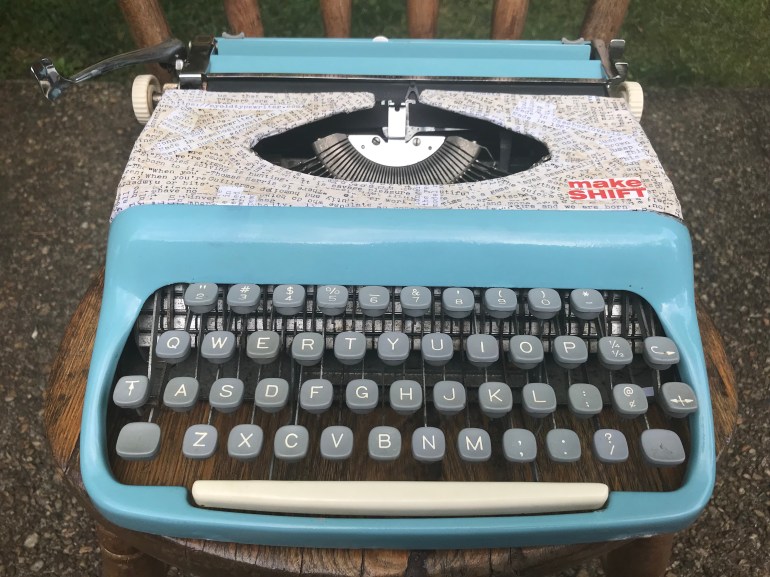
Pinkie gets along great with her blue S-C Sans-A-Tab brother. Maybe I can rent out my pink and blue Silent-Supers to people throwing gender reveal parties.  Typewriters seem safer than involving  alligators.

Blue Boy and Pinkie

I have a pretty collection of colorful Easter eggs sunning themselves on the bookshelf.

Sing it, Pinkie:


Old Pinkie the Smith-Corona Silent Super

In our dining room, we have a framed artifact from a simpler time.

This is Old Pinkie.  It started out as a Halloween costume and was worn every day for several months in 2005/2006.  Here is Old Pinkie in late December 2005.

It was about 50 degrees and foggy, so my daughter is wearing Old Pinkie and flip flops.  Contrary to the opinion of every grandmother out there, going coatless and wearing the same ballerina costume every day are not life or death situations.

We framed Old Pinkie because it serves as a reminder of the limits of power when faced with a wily, tenacious, and vocal adversary.

Welp, there’s a new Old Pinkie in town: a 1956 Smith-Corona Silent Super, serial number 5T 416581X.

Last week both my husband and my daughter were out of town, so I had the whole house to myself for a few days.

I conducted a science experiment in the garage. More about that in a future post.

Hmmm.

I thought that having the run of the place was going to be a lot more fun than it was, but I was at loose ends without the customary structure to my days.  I binged-watched Russian Doll, finished off a bag of marshmallows for dinner, and trolled eBay.

I found an Art Nouveau beast at eBay that I really, really wanted, so I put it on my Christmas wish list.

Also on eBay, I found this SC Silent Super that I impulsively, guiltily bought. What a honey. This is my kind of typewriter: one that looks like it will involve many pleasant hours of tinkering and cleaning.

It’s seen some action.

It came with a “Holiday” case:

I had no idea you could remove the metal fastening frame from the case, but you just push the frame release lever to the right and lift it out.  This is going to make cleaning so much easier.

Here’s a Godfrey’s Fix-it Shop (Seattle, WA) price list from September 1969:

It looks like rotisserie repair was more lucrative than typewriter repair at that time.

The typewriter itself was impressively dirty, full of orange gunk and hair. Touching it left me sticky and hairy.

The drawstring was snapped and twisted around the mainspring.

None of the keys moved initially, but I got the letter T to type.  I pulled left on the carriage to see if the escapement would advance, but no go.

Underneath, all the dogs and rockers and wheels and springs and whatnot were paralyzed in orange congealed goo – perhaps this typewriter was the victim of WD40?

I did a quick wipe down with mineral spirits and manually worked the escapement  until it was springy and responsive. The carriage began to advance when I hammered the letter T.

This Old Pinkie is going to be just fine. I have another Silent Super to refer to if I run into problems:

To be continued.