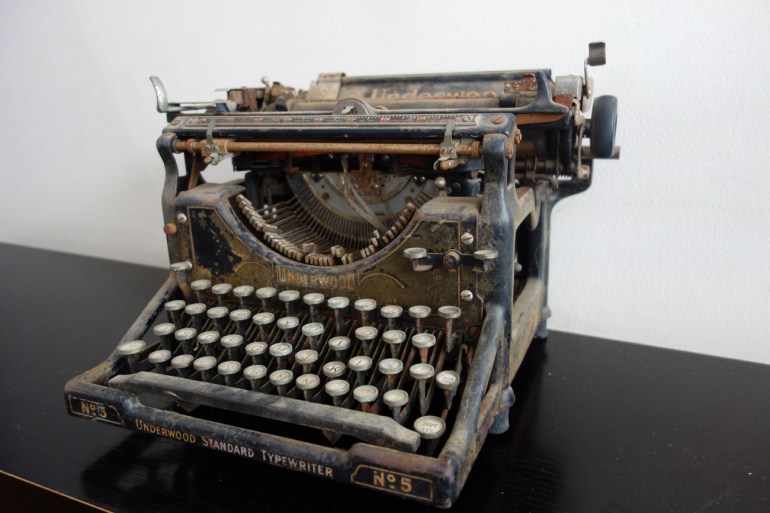
I have been spending many happy days outside by the garage working on the Underwood 5 for the young writer, Quin. When I first got it, I had doused the machine in Liquid Wrench penetrating oil to loosen the rust. That horrible burning smell persisted for days and days – working in the fresh air was necessary. Fortunately the weather was warm and pleasant, and I cleaned and tinkered and listened to the neighborhood children play and the neighborhood dogs bark.

Modesto
A couple weeks ago, I got an email out of the blue from a young writer named Quin from Modesto. Quin had recently attended a writers’ conference and had run into another writer, Kirsten, who owns an Underwood 5 I had cleaned up some time ago. Remember this lovely 1915 Underwood 5?
Eine Kleine SurfMetall
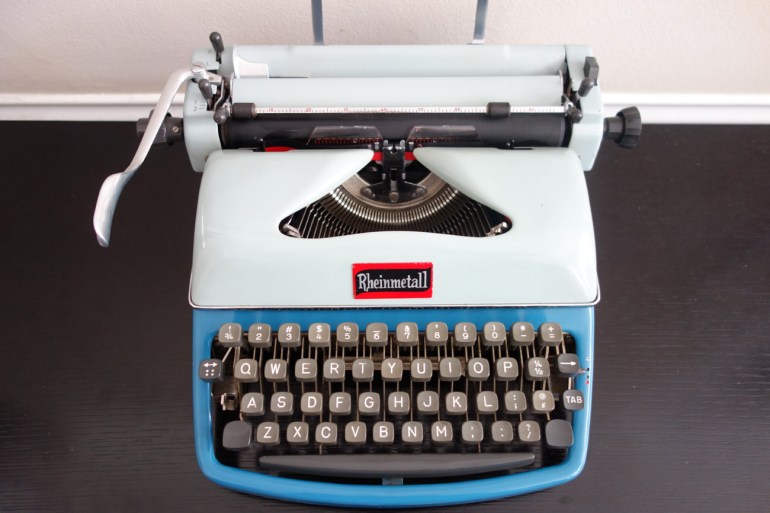
A couple weeks ago I ventured into the mist-shrouded hills of San Francisco where I bought a 1961 East German Rheinmetall KsT from a pair of hill sprites (or Houses of the Holy photo shoot extras). I continue to clean and tinker with the KsT. I got spools that fit on its three-pronged spindle and went to town typing.
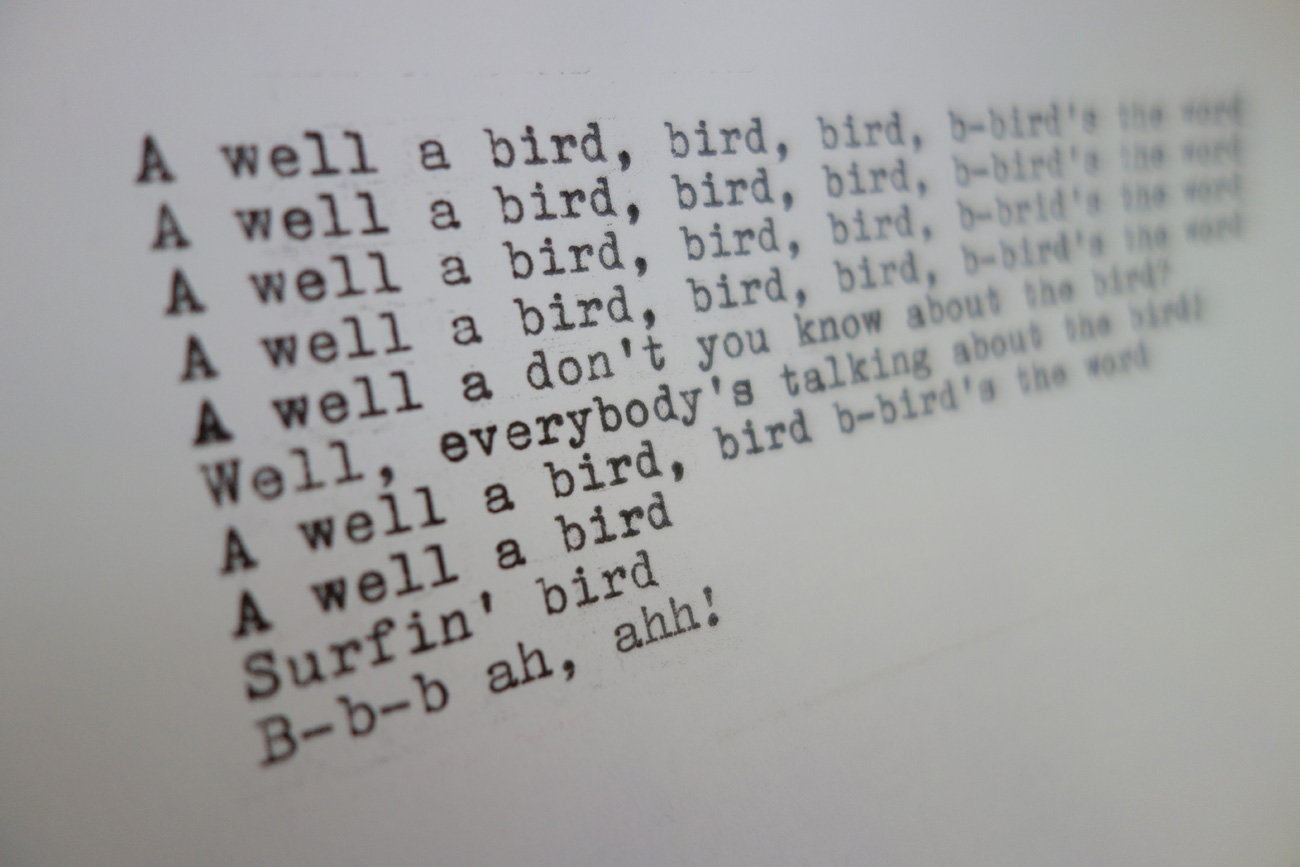
I sure love the way this Rheinmetall KsT types. Solid and classy with a nice snappy *snack* and a big, readable imprint. I am riding a wave of smooth class. I am very glad that it’s got a QWERTY keyboard.
I recently cleaned and re-ribboned a 1924 Corona 3, and I was not a fan of that particular machine. Beautiful and strange though it was, typing on the Corona 3 was an alarming experience. I felt as though I were in a Model T on a dirt road that might at any given moment break an axle and fly into a million pieces. And me with no seat belt. And the threat of a rigid steering column straight into the sternum. What a rattly old ride that Corona 3 was. It typed just fine in a wobbly sort of way once it was de-gummed, but I was relieved to return it to its owner. I can’t believe I said that about a typewriter.

On the other hand, the Rheinmetall KsT is a delight to use. It cleaned up so beautifully and types so competently. I am discovering that I really love the mid-sized portables of the 1950s and 1960s. I also really like big heavy standards, no matter the age.
I removed the foil dealer’s sticker that was plastered on the typewriter’s forehead. I know that this sticker is a part of the typewriter’s history, but I couldn’t get over how bad it looked. I also knew that it would compete with the cool Rheinmetall badge that would soon be re-attached to the ribbon cover.
I carefully pealed the foil dealer sticker from the side while I warmed the sticker’s adhesive underbelly with a hair dryer.

Fortunately, I did not damage either the paint on the ribbon cover or the foil sticker which I relocated to the the interior side of the ribbon cover:

Quality and Origin
I think that I have made some headway into the mystery of the “S” in the triangle on the back of the Rheinmetall. A commenter on the last post, mentioned that he had seen similar markings on East German weapons and that set me off on a chase.

“S” = “Sonderklasse für sehr gute Qualität (Special class for very good quality)”
“09” = The first two digits indicate the territorial base key of the district. 09 is the district of Erfurt where the Sömmerda factory was located.
“2552” = operating point / production facility, perhaps the Sömmerda Rheinmetall factory itself.
Vertical Alignment
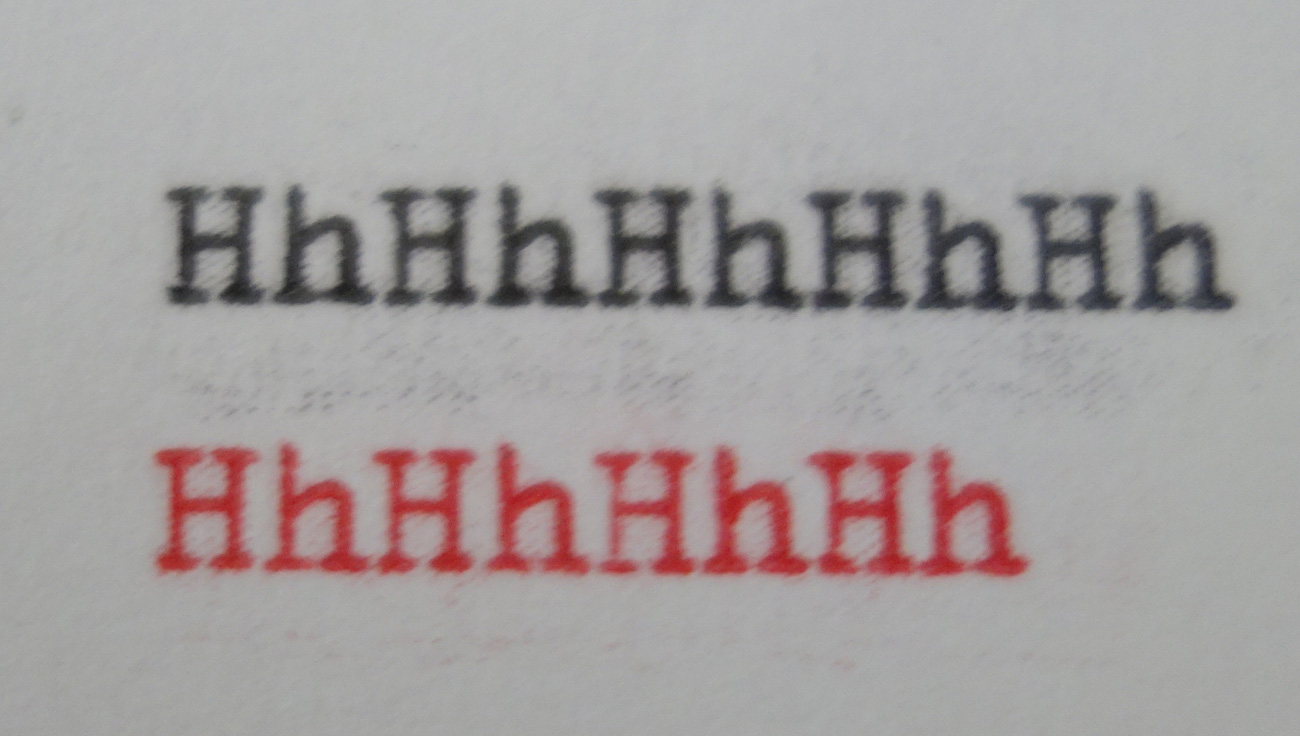
The KsT had a few little issues that bothered me. One was that the vertical alignment was a bit off:
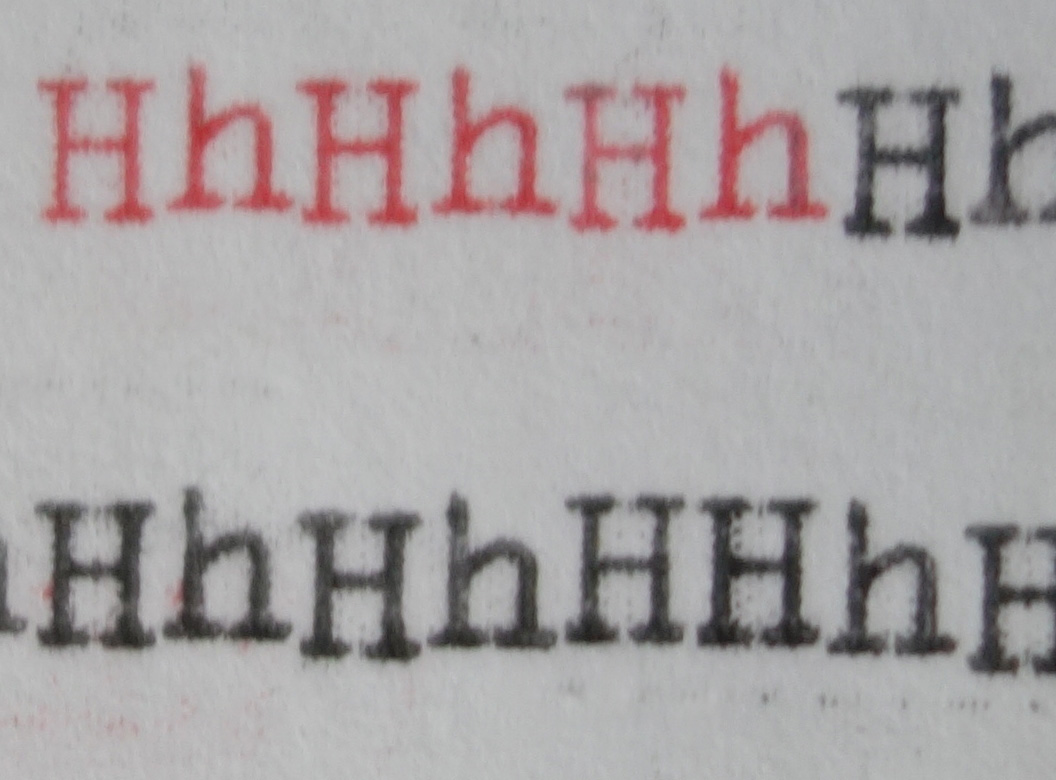
Weirdly, I don’t think this lower case “h” has a serif at the top of its stem.
Ted Munk has a couple really good posts on adjusting vertical type alignment on both basket shift and carriage shift typewriters. Unfortunately, this carriage shift Rheinmetall doesn’t seem to have the adjustment points that his carriage shift machines have.
I had taken the platen knobs and side covers off for cleaning and de-gumming of the carriage release button. I noticed two interesting screws on either side of the platen that seem to limit shifting. I loosened the lock nuts and made small adjustments to see what would happen.

These lock nuts and adjustment screws are found on either side of the platen
Yeah, Baby!
After the fact, I found a West German Alpina service manual in the repair documents library at Typewriter Database. Funny how the schreibmaschine is typing “schreibmaschine”:


My Google Translate German is a little rusty, but I think it says: 01.0202 and 01.0209 of Fig. 1 are the adjustment points for upper and lower case letters. The West German Alpina appears to be very similar to my East German Rheinmetall – at least in terms of vertical text alignment.
Filling Key Depressions with Sugru
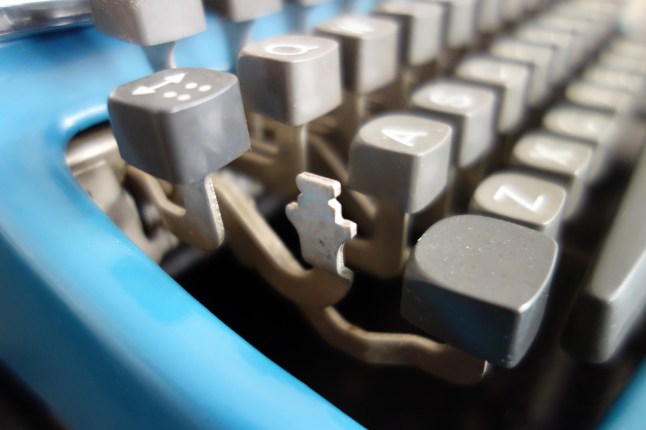
One thing that really bothered me was the empty “D” key. It looked like a missing tooth.

I pulled out the Sugru:
And fixed that thing:

Missing Handle
The carrying case is in rough shape and the handle is missing.

I found this site that sells luggage handles – hmmm – great selection of handles!
B-bird Is the Word
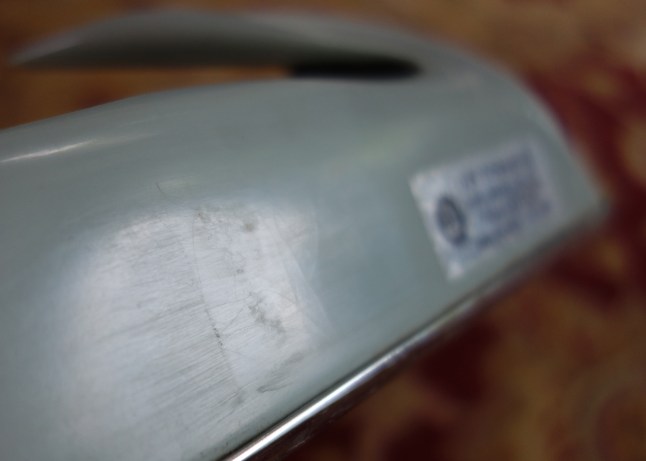
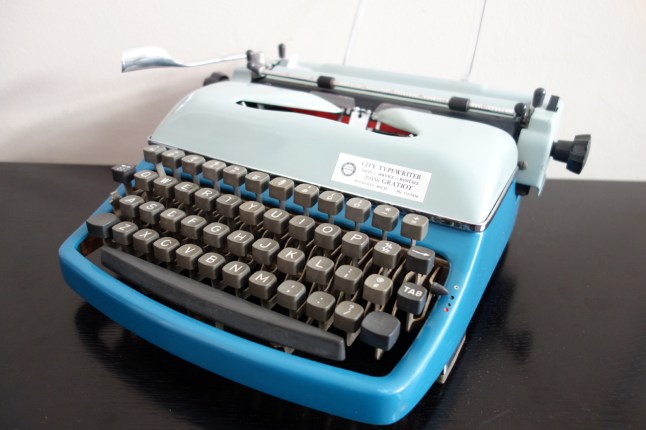
This Rheinmetall KsT has a variant logo badge made of thin metal which is very different from the typical Rheinmetall logo. The badge had fallen off some time ago and had gotten lodged inside the machine. I could see the ghostly outline of where the badge had been before it fell off.
I reapplied the Rheinmetall badge with its jaunty surfing font to the ribbon cover. I used Krazy Glue and that made me krazy nervous, but I think I positioned it in the right place.

Ah, SurfMetall – such laid-back swagger! I pay tribute to your überkoolness.

Let’s go surfin’ now…

Everybody’s learning how…

Come on and safari with me.
I leave you now with a little surfmetall:

The Mystery Machine
It was our anniversary, and my husband got me a funny card that pretty much sums it all up:

He was a dear and took the kids to Maker Faire for the afternoon and left me to my own devices. I lay around the house eating bon-bons and cruising Craigslist and came to a San Francisco listing for a strange-to-me typewriter. The seller wasn’t sure what kind of typewriter it was, and it had no indication of branding on it.
It was very mysterious: a portable with no badge, no decal, no logo. It looked German. I did an image search at Google for “german portable typewriter” and spotted similar machines. Ah ha. Rheinmetall KsT.
The typewriter looked kind of horrible in the dark Craigslist picture, and that perversely whetted my appetite. I snuck out of the house and headed for San Francisco. I ended up in the vertical hills of the Excelsior District where even automatic transmissions flinch and the streets are as wide as goat paths. I found the address of the seller, parked in the middle of the street and fretted. I worried that the seller might be a Craigslist killer who preyed on unsuspecting typewriter collectors. I guiltily regretted not mentioning to my family that I was out on a typewriter hunt.
As I approached it, the house was invisible among huge trees and bushes and a tall wooden fence. I apprehensively lifted the huge rusty knocker on the gate and immediately it was opened by a golden child, maybe around 10 years old. She had been waiting for me. As she opened the gate, I caught a glimpse of a magical vista that’s only seen in Northern California: a cottage shaded by an enormous cypress at the base of a hill, rocky steps, wind chimes, a mossy deck with an old couch where a second beautiful child slept, Tibetan flags, a laundry basket full of stones.
I told the child that I was there for the typewriter and without a word she turned and made her way down to the cottage. When she returned with the typewriter, she asked me if I wanted the case. Sure. Back down the steps and back with the case. I gave her the money which she took silently, and I thoughtfully loaded my car. I never saw an adult. Was the child human? Did I just buy a typewriter from a hill spirit? Mysteries like this are all part of life’s rich pageant.
When I got home, I looked over my purchase. It was so much better looking in person:
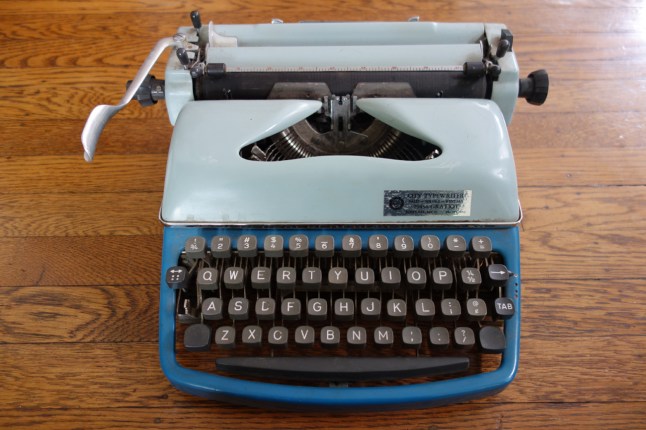
I hadn’t realized that the ribbon cover and paper table were blue – in the Craigslist picture it had looked gray. The typewriter was very dirty, but appealing in its compact curves.
X Over It’s excellent post Post-war Rheinmetalls (1945-1962) is very informative. This Rheinmetall is missing the super-classy Rheinmetall 3D badge on the front. If you look closely at the ribbon cover, you can see a shadow of where a sticker had been. This is probably one of those KsT variants that had a Rheinmetall sticker rather than a 3D badge.
Serial number 564222 – stamped next to right ribbon spool.

I date it to about 1961 per the Typewriter Database
I found the carriage lock, released it, and tested the typewriter. The only thing wrong with it appeared to be a carriage release button that kept getting stuck – probably a gummy dirt problem.

Fur Ball
The typewriter appears to have been over-loved by a cat. I imagine that some happy feline spent many a pleasant afternoon curled up in the type basket.


The Rheinmetall KsT user manual is a delight – it assumes a very competent and somewhat fearless operator. Here are instructions for removing the carriage and type bars (!):

click to view larger – Rheinmetall KsT User Manual, The Classic Typewriter Page manuals archive
Well, what are you going to do? I can’t resist a carriage like this and this is a general user manual after all, not a service manual. Check out X Over It’s very entertaining KsT video.


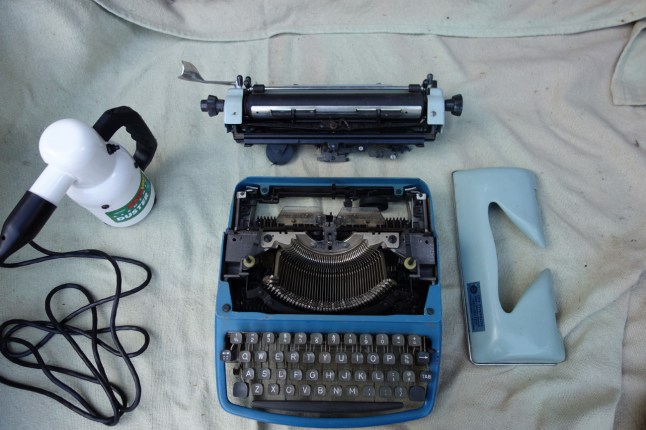
Ghost in the Machine Episode II: The Phantom Name Badge
I released the carriage locks on either side and jiggled the carriage free from the machine. I used my air blower to clear out the layers of cat hair, dust and dander that coated the interior behind the segment.

The congealed grease had a thick layer of embedded eraser crumbs that I scrubbed out.
Hey what’s this? Oh!
HA HA HA HA HA HA HA HA HA
I swear I am not planting these things for a good story!

It was jammed inside the guts in a way that it did not interfere with the mechanics at all. How many years had the name plate lain there, waiting for me? I would never have seen the hidden name badge without removing the carriage.
I carefully pulled it out – a little bent piece of thin metal (not foil or paper) with dried adhesive on the back but no generally no worse for wear.

What a jaunty, surfer-style font. A German surf-metal band inspired by the Beach Boys would have this logo.
From the Teachings of Blender:
If your typewriter is missing a part, check inside the machine first.
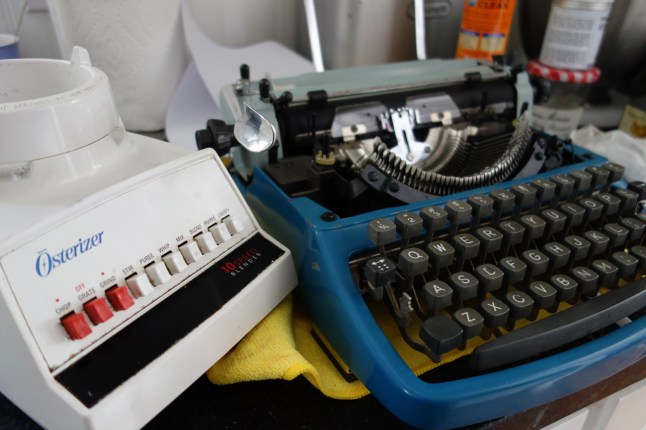
I’ll need to re-secure the Rheinmetall badge somehow – I am considering Super Glue for permanent adhesion.
This typewriter didn’t have any spools when I bought it. It needed three-hole spools, and all I had were four-hole ribbon spools.
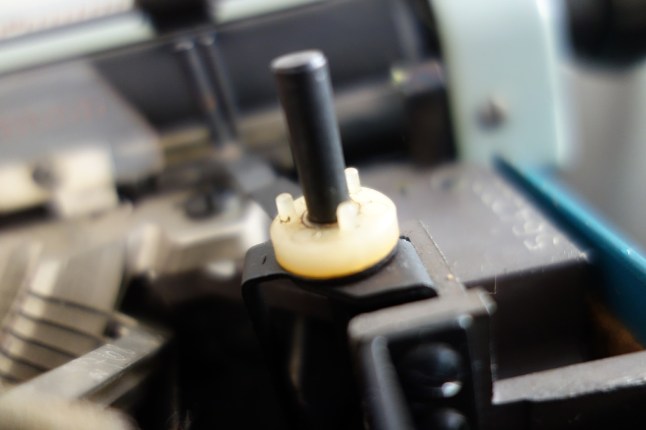
I ordered some “Rheinmetall KsT” spools online. Unfortunately they didn’t fit. They were labeled Adler and the holes were too small for the spooling spindles. Drat! I really wanted to test the typing on this thing.
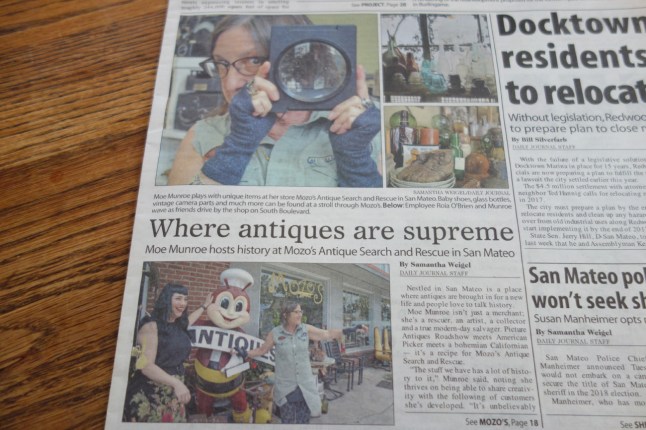
Then I remembered something. I had seen a stray couple of typewriter spools at Moe’s recently. They didn’t seem to belong to any typewriter and were just laying around near her typewriter collection. I was dropping off a newly-cleaned Corona 3 at Moe’s shop that belongs to her friend Alan, so I investigated the orphaned spools. Hurray! Three holes! Moe graciously gave them to me and they fit, they fit!
While I was at the shop, Moe told me that Mozo’s Antique Search and Rescue had been featured in the local paper last week. I am so fortunate to live near such a great place.
I am still cleaning the KsT, but it’s looking great after a preliminary wipe down. I am going to cautiously remove the foil dealer’s sticker from the front with a hair dryer to loosen the adhesive. I plan to re-locate it to inside the ribbon cover. I just hate seeing it on this poor typewriter’s forehead.

What “S 09/2552” mean? It’s on the back of the typewriter. Could it refer to Sömmerda where the Rheinmetall factory was?

I still need to re-attach the newly found Rheinmetall badge and figure out a solution to my missing shift lock key top. I might make a silicone mold and use a thermoplastic like InstaMorph to create a key top. Stay tuned.

Ghost in the Machine
I have been working on the Royal FP, carefully cleaning and testing for skipping. The typewriter still skips when keys are pressed rather than jabbed. The skipping only occurs when I use a Pressing Massage typing technique – which isn’t considered great form but is fairly common in “inexperienced operators” who aren’t familiar with manual typewriters. There is no skipping at all with the textbook staccato jab.
I decided to adjust the escapement trip just for funzies to see if that would affect the skipping situation. I needed to identify the escapement trip adjustment screw, and Richard Polt recommended that I take a look at the 1945 Ames Service Manual and the 1968 Ames Service Manual which are both archived at the Classic Typewriter Page in the typewriter manuals section. They both had the information that I needed.
Here’s the important diagram that identifies the trip adjustment screw from the 1945 Ames Service manual:

I mentally rotated this diagram in my head and determined that this screw that I spotted through the springs in the bottom of the typewriter was the trip adjuster (I had turned the typewriter on its back to see this):

Sighted through palm fronds. Dr. Livingstone, I presume?
I loosened the lock nut (7/32″ wrench) and rotated the adjustment screw (3/16″ wrench) clockwise to make the escapement trip when the type slugs were further from the platen. This did not affect the skipping; in fact, the stuttering skipping seemed worse. I turned the adjustment screw counter-clockwise to have it trip closer to the platen. That did not improve skipping. I returned the adjustment to its original state (tripping 1/4″ to 3/8″ from the platen), tightened up the lock nut, and called it a day.
I may try adjusting the trip on individual keys since the skipping seems only to occur with keys in the center of the keyboard (eg “h”, “g”). I don’t know. I don’t want to throw a perfectly wonderful typewriter out of adjustment as a concession to bad technique.
The Davis Brothers produced a very funny video on typing technique. The gist: many output problems like skipping, piling, and shadowing are related to operator error – plain old poor technique. Check out their video – it’s entertaining and informative. It features a particularly beautiful red Smith-Corona Galaxie.
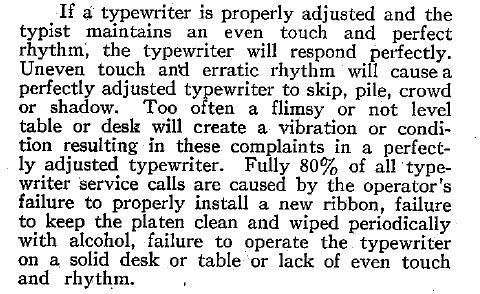
I have to concentrate to simulate the strange, lingering touch required to reproduce the skipping in the FP. I am going to follow the Davis Brothers’ lead, chalk it up to poor technique, and try to educate users in good typing technique. As the 1945 Ames Service Manual puts it:
Color Poll
As you may recall, I am considering a re-paint of the ribbon cover, front plate and paper table of the FP. Here are the results of the poll that asked “What Color Should I Paint the FP?”:

I ordered some coral pink powdercoat paint (RAL 3017). I am still debating about whether I should paint the typewriter. At least one person polled felt that I shouldn’t do anything to it. That gives me pause.
And Now for Something Completely Different
Moe has a lot of friends with terrific typewriters. Her friend Alan had an Underwood Standard Four Bank portable that he wanted me to look at. It needed a new ribbon and a cleaning for sure.

I took the typewriter off the base. Instead of latches, I removed two medium sized screws with associated springs to free the machine from the base. I am glad I did. It was filthy under there.
The typewriter was missing one of its knurled thumb nuts that hold the ribbon spools on. Some time in the past, someone had substituted a round nut for the missing thumb nut. It works great, but it isn’t a very close match to the original thumb nut.

This got me thinking about spool thumb nuts that go missing – lots of different sites online sell knurled thumb nuts in different sizes for a variety of applications. I have seen typewriter-specific thumb nuts before too.
This machine was otherwise in very good cosmetic shape with glossy paint and lovely decals. Obviously it had been well-protected in its case over the years. However, it did smell very musty. I’ve found that much of the odor from stinky typewriters comes from their old stinky ribbons. So: out with the old and in with the new.
I love the look of a red and black ribbon on a typewriter, and I have a stash of brand new ones that I ordered from Oregon. I always test a typewriter with a little scrap of red/black ribbon to make sure that the ribbon carrier is rising and falling properly so that text is all black or all red on typing.

I hate to re-spool an entire length of red and black ribbon only to find out that the typewriter types half red / half black in print. Sometimes I just can’t get the ribbon vibrator to cooperate despite cleaning and lubrication. In those cases, I just install a solid black ribbon.

With my finger, I quickly spin the new ribbon onto the old spool.
Once I confirmed that the ribbon carrier was rising and falling properly, I needed to re-spool. This machine had metal spools so I re-spooled the new ribbon onto the old spool. I know that I could do this on the typewriter in the spools holders, but I don’t like to get the machine dirty and smudgy with ink. And sometimes the plastic spools don’t fit on the typewriter spindle. I usually set up a spooling set-up with bamboo skewers so that I can quickly move ribbon onto the old metal spool.
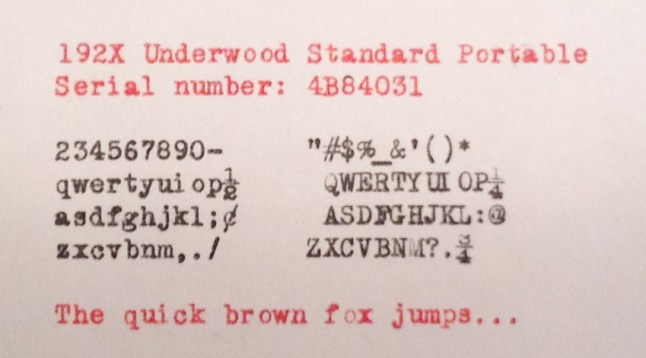
The typewriter was pretty dusty and a bit gummy, but it was typing great after I cleaned the segment. I cleaned the slugs. Elite typeface is the worst to clean. It never looks as crisp as I want:
I scrubbed the “a”,”s”, “f”, and “d” a little more.
As I was putting the typewriter through its paces, the “8” key would hang up and its typebar would not return to resting. I turned the typewriter on its back and peered around. I struck the key again and the typebar returned to resting. And then it happened again and again to different letters. I’d continue testing and then an adjacent letter such “6” would get stuck in the “up” position:

My hunch was that the linkages for the typebars were somehow colliding underneath the machine. I focused my investigation on the linkages near the segment and watched as first one and then another typebar would get stuck in an “up” position. Perhaps there was a bent linkage? Sometimes several would get stuck up together, but I found that just turning the typewriter onto its back to look around and sometimes hitting the shift key helped free the typebars to return to resting position.
The Neural Thumb Net
After it happened for the 100th time, I propped the machine onto its back and got some better light. Lo and behold: the ghost of thumb nuts past.
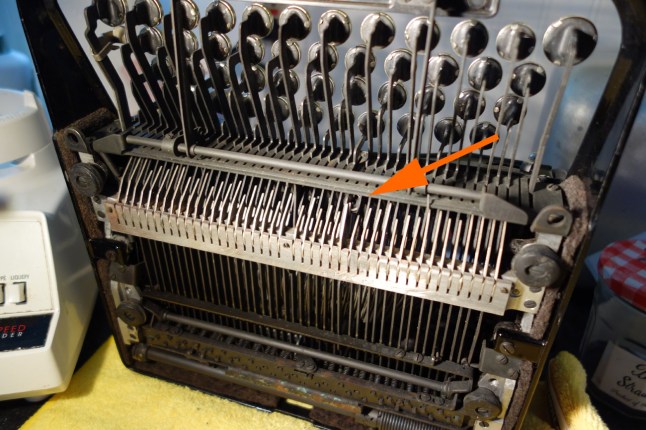
Blender says: I told you that you weren’t looking in the right spot.
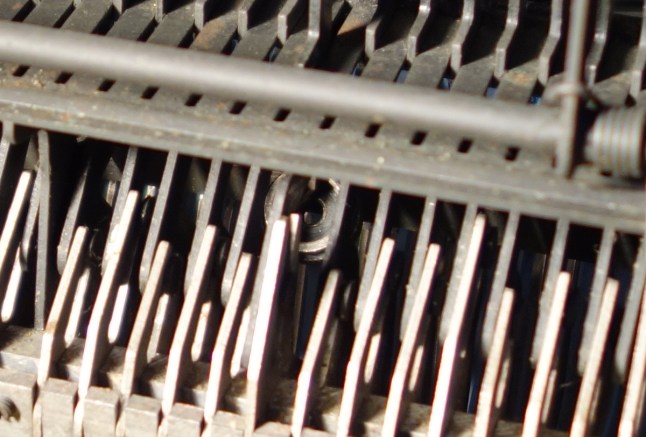
I jumped up and down, shouting, “It’s the knurled thumb nut! It’s the knurled thumb nut!” My husband shouted from his office, “What’s a neural thumb net?”
I worked the nut free from where it was jammed in the key lever linkages using a dental pick and retrieved it from between the typebars using a pair of needle nose pliers:

Oh joy! The matching thumb nut! And no more crazy typebar jamming! I can’t tell you how thrilled I was to solve two problems at once.
I was packing up the typewriter for Moe’s friend Alan when I remembered that the ribbon feed wasn’t working in one direction. Darn. I had made a mental note to investigate when I first noted it. Ribbon feed disorders can be so frustrating. At least it was working in one direction.
There was a dangling feed ratchet thing hanging from the right spool. It had a hole in it that said, “Hey, I need a spring here!”

I found the teeny disconnected spring way, way under the spool cup and re-attached it – and yay, ribbon feed in that direction was functional once again.
Here’s something fun about this typewriter: it’s carriage shift, and the ribbon cups move up and down with shifting:
Wacky, huh? Like its eyes are bugging out on shift.
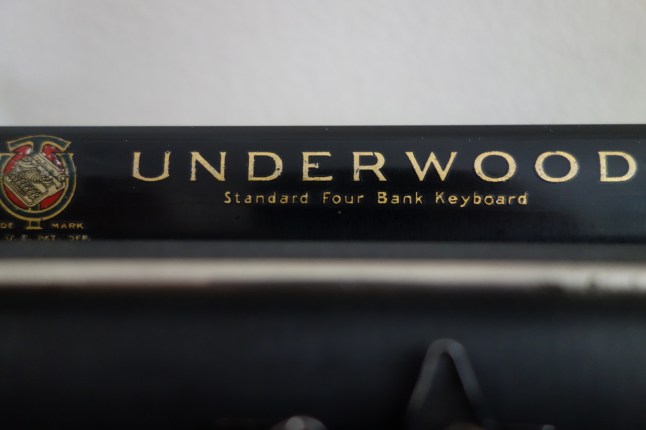
I am having problems nailing down a date for this beautiful 192X Underwood Standard Four Bank Keyboard portable. The serial number is 4B84031. It’s probably an early-ish one since it has only one platen knob, a metal shift lock key and an unusual carriage return lever (Richard Polt has a similar Underwood Four Bank that he dates to 1926)


Lessons learned in this episode:
- If your typewriter is missing a part, check inside the machine first.
- Never underestimate the value of good lighting
Number 12 the Royal FP
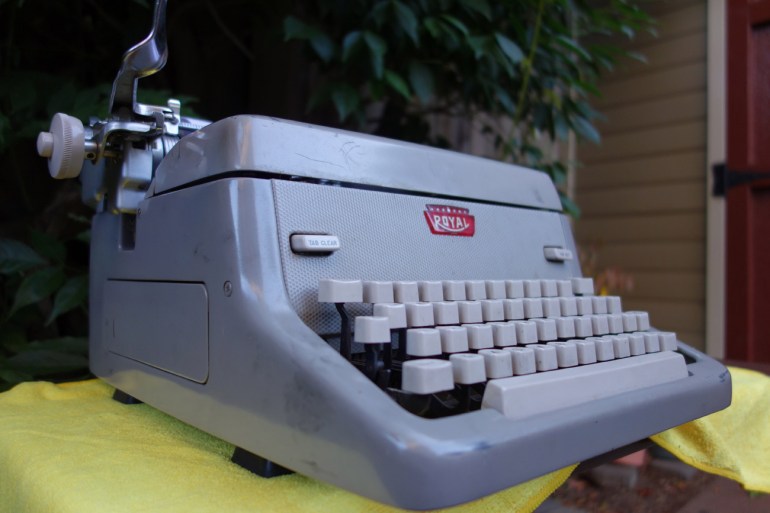
Ari S. just brought home a Royal FP and Richard Polt just threw an FP into his trunk. It’s raining FPs. That got me thinking about the Royal FP at Moe’s shop down the street that has been languishing on her shelves for more than a year. I first saw it last May:

Across a crowded room…
The SCM electric has since been sold and I bought the Olympia SG3. I passed on the FP because its Magic Margins weren’t working.
Moe is now thinking about giving it away. I told her that maybe I could fix it, so I brought it home for a look-see.
I feel bad that this Royal FP did not get any love. I understand that they are marvelous typewriters when they are clean and happy. It’s pretty beat-up with lots of scrapes and dings. Perhaps a re-paint is in its future?
Well-known San Francisco columnist Herb Caen used an FP, so you would think this FP would get a lot of love here in the SF Bay Area.

By Uyvsdi (Own work) [Public domain], via Wikimedia Commons

By Nancy Wong (Own work) [CC BY-SA 4.0], via Wikimedia Commons

The typewriter was typing, but setting the margin on the left using the Magic Margin was not working (the right Magic Margin was a little slow but working). I hoped that it was a gummy/dirt problem that would resolve with cleaning.
The tabs were sluggish, but repeated tabbing freed them up, so I was hopeful about the margin problem – it may just be gummy.
The serial number is located next to the left ribbon spool:

FP = model, E= elite + serial number 6800093 which puts it at 1959 according the Typewriter Database.
What does FP stand for? Flippin’ pachyderm? Formidable package? There was a discussion at Typewriter Talk last year about Royal model names and a former Royal employee who is a forum member said that FP = Fortune Peter Ryan who was President of Royal Typewriters starting in 1951. F.P. Ryan was the grandson of Thomas Fortune Ryan, the railroad, banking, tobacco, insurance, and transportation magnate who financed the incorporation of the Royal Typewriter Company in 1904.
Here’s a teaser from a 1951 article about F.P. in Time magazine:
http://content.time.com/time/magazine/article/0,9171,821750,00.html
This makes me want to get a subscription to Time just to read the rest of the article. I am happy to read that Fortune Peter (a great name) started at Royal as an apprentice mechanic despite being a Yale man.
Back to the typewriter at hand. I like these genuine Royal clear plastic spools:

This FP is typing great right out of the box. There was a little stiffness that worked itself out with the quick brown fox:

Elite and and very dirty slugs. Wonderful typewriter.

I pulled out a piece of cardboard that was jamming the indexing.
This typewriter’s name is Number 12. I don’t know what happened to the other eleven.
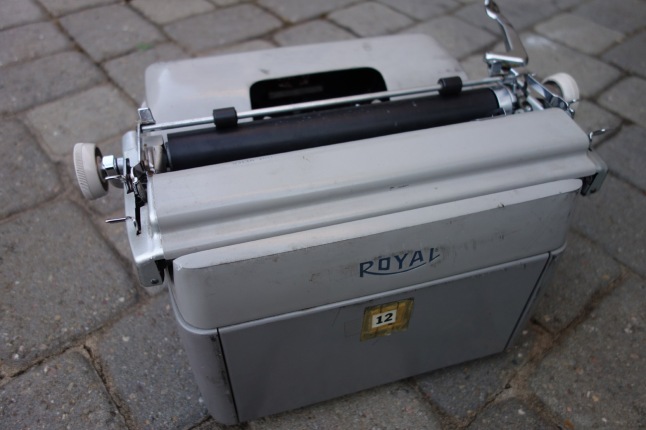
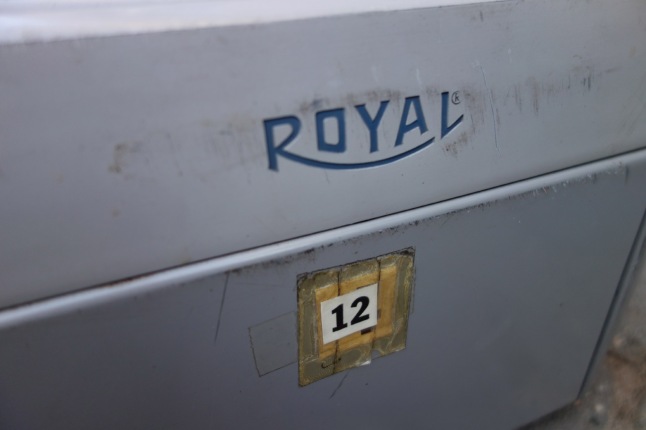

Look on my works, ye Mighty, and despair!

I took off the ribbon cover, front panel, side panels, paper table and back panel and gave the typewriter a good blow-out with the air blower thing.

The foam insulation inside the machine crumbled to the touch, so I scrubbed it out with a toothbrush and blew it out with compressed air and vacuumed.

Gummy Lever
The carriage return lever had no BOING. It was stuck in a gummy way. I worried that there was a spring missing, but all it needed was cleaning and lubrication under the lever:

Now it’s great – BOING – BOING – BOING.
Mystery Margins
I may have mentioned it before, but I am not a fan of complicated margin setting features like Remington’s KMC, Hermes Weirdie Margins™, and Royal’s Magic Margins.
In my mind, this is the perfect way to set margins. Thank you, Smith-Corona Silent-Super, for keeping it simple:

Right in front and what you see is what you get. This is the best system for me.
Magic Margins: those I don’t like so much. I always am flipping the paper table up, peeking back there to see what’s going on. It’s a mystery.

I had problems setting the left margin on this Royal FP, so I investigated when the typewriter was more exposed. There is this complicated set up with long springs and a margin setting mechanism.

I used denatured alcohol to clean the Magic Margin parts. Ta-da! I then had a functional left Magic Margin. I followed up with a little PB B’laster for lubrication.
Skippy the Royal FP
I think I have pretty good technique when it comes to typing. I admit I am not a touch-typist – I use two to three fingers. However, I do have a forceful and quick staccato touch that really does the job. My printed pages are crisp and dark. I type like Olive Oyl. I didn’t think there was any other way to use a manual typewriter and then I observed people pressing the keys as if they were giving the keyboard a caressing massage. What the heck?
Well then. I used to test my typewriters after cleaning with my proper “Staccato Hot Keys” touch. Now when I test, I try to imitate The Pressing Massage to see if there is any residual stickiness in the typebars – which is very noticeable with The Pressing Massage.
I tested this FP after cleaning the segment with denatured alcohol. With Staccato Hot Keys touch, there was no problem.
But check out the crazy skipping when I did The Pressing Massage:
There’s a little stutter and the escapement is twice triggered when I press instead of jab. The Pressing Massage seems like poor technique to me, but I wanted to see if I could decrease the skipping. This typewriter may someday make its way into the hands of someone who uses The Pressing Massage and I don’t want that person to experience the frustration of skipping.
I haven’t experience skipping before (maybe because I use the Staccato Hot Keys Technique), but it is exasperating to those who experience it.
It’s hard for me to emulate the typist who uses The Pressing Massage, but when I do it right (or wrong?) I can consistently reproduce the skipping.
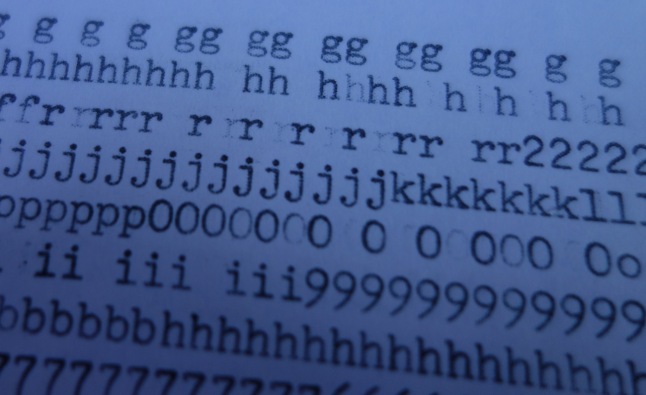
The skipping seemed to be worst with the keys in the middle of the keyboard, especially g, h, b, r, and 5. I first cleaned the escapement with denatured alcohol – it’s not as accessible as on other typewriters – and then gave it a quick squirt of PB B’laster. I also very thoroughly cleaned the segment where the skipping was worst. I feel like the skipping with The Pressing Massage eased up a little, but it persists.
Backspace Does Not Erase had a skipping problem with a Remington Noiseless Portable which he rectified with an adjustment to the escapement trigger. I have a completely different machine, but such an adjustment might fix my Royal standard.
I went to the D. E. Fox repair manual (found in Typewriter Database‘s document library) and found this in the section for Royal standards:

D. E. Fox Typewriter Repair Manual, 1950, pp. 79-80, TWDB
I am hesitant to make adjustments – especially since I don’t have a “Special Dog Washer”. The typewriter currently types great – if used by an “experienced operator”. I am in a kind of WWJD situation. I am fairly certain that this typewriter will make its way to the collection over at The Shop at Flywheel Press where “inexperienced operators” roam. Can they be educated in the touch needed to make this FP sing?
Aesthetic Appeal
Technique-related skipping aside, I want to address the Royal FP’s appearance. The ribbon cover is pretty banged up. Would it be blasphemy to repaint?
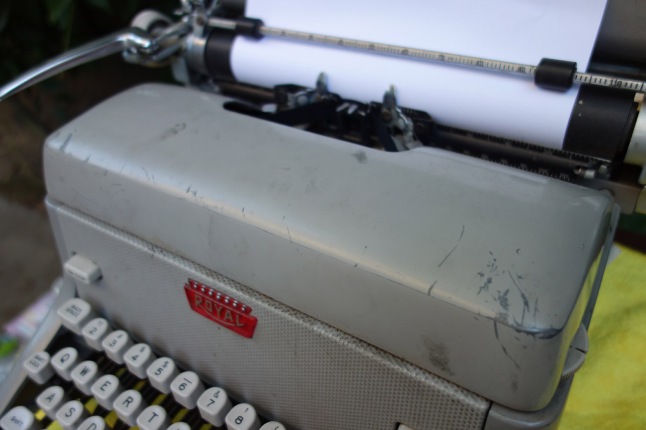
I am feeling pretty good about my sandblasting and powder coating skills, so I think I can do a quality repaint of the ribbon cover, front plate, and paper table.
I am leaning toward a coral pink. I am not really a pink typewriter person, but I recently saw a coral pink FP on eBay that was very popular. If this FP were another color, would it get the love it deserves?
Here are some powdercoat color possibilities from Prismatic Powders:


What do you think? Here’s a poll:

Jammed and Gooey Olympia SM7
A couple weeks ago I stopped in at The Shop at Flywheel Press, a community arts space where I have been doing volunteer typewriter maintenance. I felt like a public health doctor making wellness rounds. The girls were in relatively good shape given that they had just been through a couple kid camps and a few evening events at The Shop – no V.D. However, just about every single one of them had a ribbon malfunction.


I got the ribbons hooked up again and tested each of the machines. A SCM portable had what looked like candy bar or brown glue jammed in the key lever comb. I had to scrub it out with a brass bristle brush so that the key levers could move again. That was about the worst of it except for the poor electric Pennecrest. The kids tend to hit a bunch of keys all at once on the electric and *POP* goes the clevis. Four were detached. I’ll need to come back on another day and straighten them out.

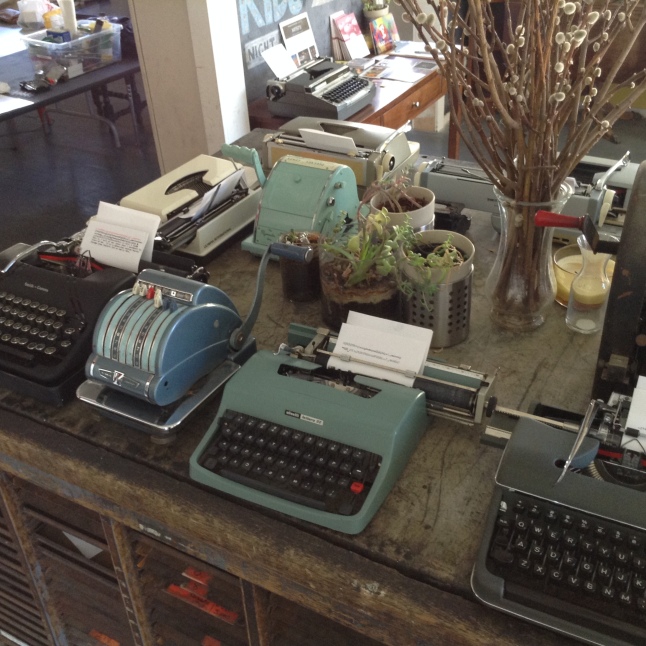
Looking good, ladies! Til next we meet. I am pleased that the typewriters are all working hard and earning their keep.
Samantha who works Wednesdays at The Shop had brought in a typewriter for me to look at. It belonged to a friend who had bought it on Etsy. It worked great for a while and then it didn’t.
It was a 1964 Olympia SM7 – sweet!

The carriage was jammed and the source was immediately visible:

The drawband had somehow slipped off the mainspring drum and was all wrapped up in the mechanics under the carriage.
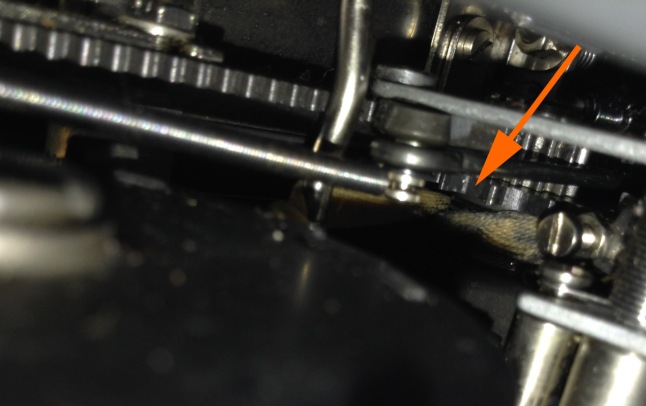
I had to cut the old draw band out from the machine – it very tangled under the carriage. It was about 16 inches long.

I pulled out my fishing line and made a new drawstring.
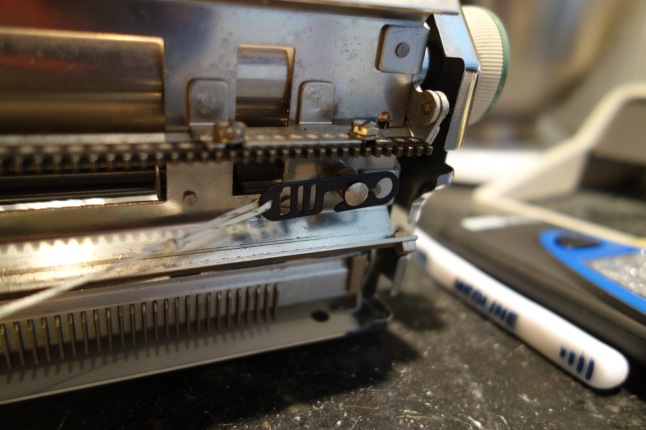
I used the tried-and-true bamboo skewer method to feed the draw string under the carriage from right to the mainspring on the left side of the machine.

Once I got the new string over to the mainspring, I had an issue. Most mainspring drums have convenient slots or hooking areas where the draw band can be secured. Not this Olympia. In order to get the new draw string on, I’d need to straighten this little pin in the mainspring drum so that I could slip a new drawstring under it. The pin was tight against the spring even with the spring completely wound and compressed, so I couldn’t just slip the new draw string under it. I had to pull the remnants of the old drawband out with tweezers. There was no space for slipping the new drawstring.

The little metal pin was extremely tough – it was either Valyrian steel or mithril – extremely strong despite looking like paper clip material. I tried and tried but could not unbend it while the mainspring drum was in the machine.
Though I didn’t want to do it, I had to take the mainspring drum out to work on that pin. I took the back cover off and loosened this nut that holds the mainspring in back. I used a 9/32″ wrench:


Once I had the mainspring drum out I was able to get a good grip and pop the little pin out.
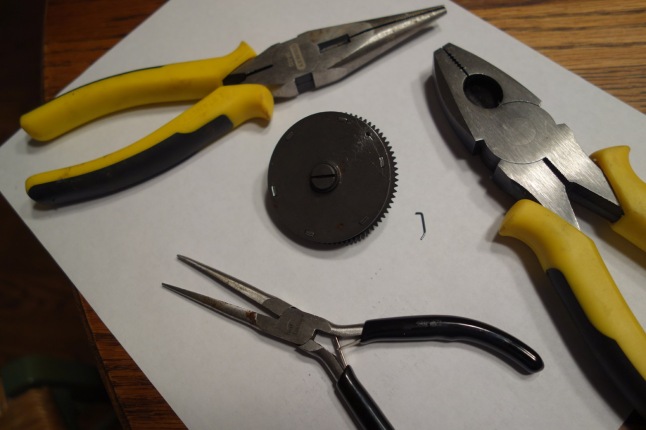
Once the pin was out I remounted the mainspring in the typewriter and wound the mainspring four times. I had my husband hold the mainspring while I carefully re-inserted the pin with the drawstring into the drum. I then bent the pin down to secure the attachment and all was well.

Stubborn Brown Goo & Recurrent Stickiness
With the new draw string, the typewriter was ready to go. It was extremely gummy – the segment needed a really good cleaning. I really like how the machine is almost completely exposed when the front cover is popped off:

It wasn’t so easy to clean. The typebar gumminess was very stubborn. It required repeated applications of mineral spirits and denatured alcohol and naphtha. The two outer keys “+/=” and “!/¾” were the worst. I’d get them freed up and swinging easily and the next morning they would be sticky again. Over and over. Lather, rinse, repeat.
There were gooey, toffee-colored blobs on the typebar rest and up the typebars. I scrubbed and picked it off with degreaser. I have seen this brown goo in pictures of other 1960s Olympias. Like this one on Reddit and this one at Typewriter Talk or this one at TWDB. It must be some kind of brown congealed oil or maybe residue from the old rubber or glue from the typebar rest. I think it crept into the segment.

I had persistent gumminess in the two outer keys of the segment despite repeated cleaning with mineral spirits, denatured alcohol, pure naphtha, and PB B’laster. I finally got the gumminess to recede with repeated applications of carb cleaner followed by PTFE.

New additions to my private Superfund site: carb cleaner and dry lube PTFE spray
I haven’t encountered recurrent, recalcitrant typebar gumminess before. Usually, I clean a typewriter’s segment and it stays clean.
I read another blog post about stubborn typebar gumminess in an SM7. My experience was almost identical – brown gooeyness and problems concentrated on the keys of the outer segment. The author was able to clear up the gumminess with industry-grade ZEP, a degreaser.
I got the typebars swinging freely with cleaning and then – oh my goodness – the NOISE – what was going on?? There was a hideous clanging when I typed! DANG – DANG – DANG. It sounded like the Anvil Chorus.
It was the rock hard rubber typebar rest. I laid some felt on it and that deadened the sound. So much better. Samantha’s friend can decide whether she wants to glue the felt down and make it a permanent feature (or replace the hard rubber rest altogether) .

The one remaining issue is that the tabulator is very slow and gummy. I have cleaned and lubed and cleaned and lubed all the obvious parts, but I can’t seem to get the typewriter to roll smoothly to tab stops. It looks like the tab brake engages and stops everything. I’m a little concerned that the sluggish tabulator is the reason why the original drawband jumped the drum. It is possible that a dirty or broken tab brake stopped the drum and the drawband slipped off. That’s one possibility.
Another typospherian successfully repaired the tab brake system. I should probably take the tab brake out and investigate, but since this typewriter doesn’t belong to me, I will let sleeping dogs lie for the time being. If Samantha’s friend wants me to investigate further, I will. However, she may find tab functionality superfluous. At this point she has an otherwise perfectly wonderful typewriter.
I returned the SM7 to Samantha at The Shop with care and feeding instructions as well as a little jar of denatured alcohol. A couple of the typebars get sticky with sitting and a little dab of denatured alcohol frees them up for a typing session.


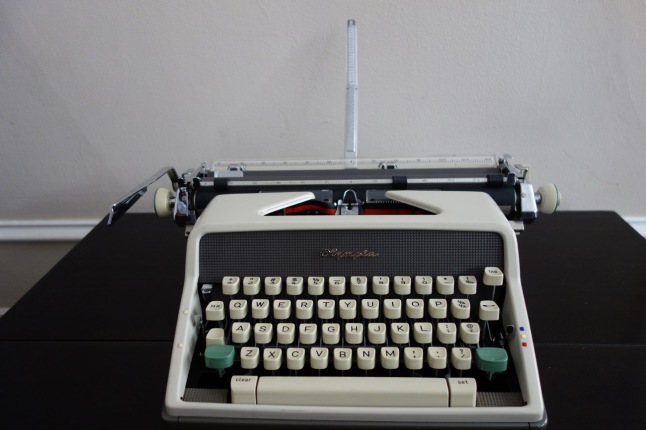
Wiiiiiiide carriage. It makes the carriage shift challenging:


Mid-century Mid-sized Portable Slugfest
I had yet another of Tim’s dirty typewriters in the house for a clean up – a 1955 Royal QDL. This one wasn’t so bad, just cosmetically off-putting. It was gamely typing through greasy dust. The case is lined with green felt – it reminds me of a pool table. It’s a Minnesota Fats kind of typewriter. The typewriter looked like it had been smoking too much and indulging in Wite-Out.
Moe’s friend Tim is a retired newspaper reporter with a taste for typewriters. He has some wonderful typewriters that I have cleaned up: a pretty gray Royal QDL, an adorable Royal Companion, a Smith-Corona Clipper, a very classy Remington 5 and now I have here this second dirty Royal, a 1955 Royal Quiet De Luxe:

I cleaned it up and it looked better though I just couldn’t completely remove the blob of Wite-Out on its cover. It was typing great though.
I recently acquired a junker 1957 Smith-Corona Silent-Super and I thought: Hey! Perfect time for comparison typing! I can host a mid-century slugfest on my dining room table.
I know that there are 1950s Smith-Corona portable fans and 1950s portable Royal loyalists. I honestly didn’t know which category I fell into, hence the side-by-side comparison.
I also decided to throw a wildcard into the fight – a 1957 West German Torpedo 18a. These are all the mid-sized 1950s portables I have in the house presently. How I wish I had a 1950s Olympia to throw in! I haunt eBay now and then, looking for junker Olympias. I am looking for a really bad looking one.
This tournament is not completely serious or scientific: I have three individual machines before me with unknown histories of use and abuse. This would be a fair competition only if each typewriter had just rolled off the assembly line. As it is, each of them has about 60 years of living under her belt. At the end of this exercise, I won’t be able to say that I am won over by a particular brand – only that a particular machine on my dining room table is my favorite.
However. The Smith-Corona feels like the limited number of 1950s S-C portables that have come through my fingers. The Royal feels like the limited number of Royal portables I have had the pleasure to type on. So there’s that.
The Contenders
A 1957 Smith-Corona Silent-Super:
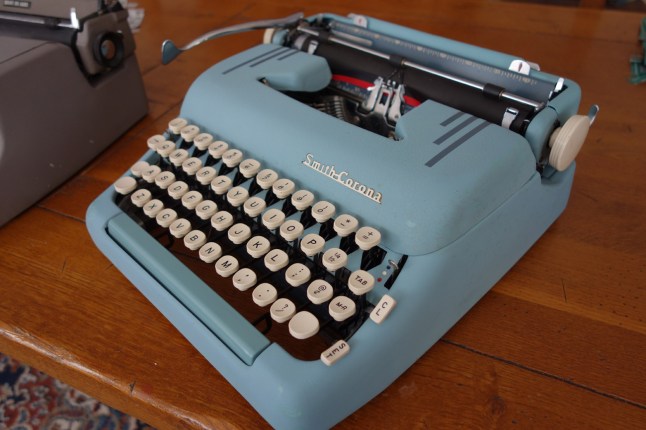
A 1955 Royal Quiet De Luxe:

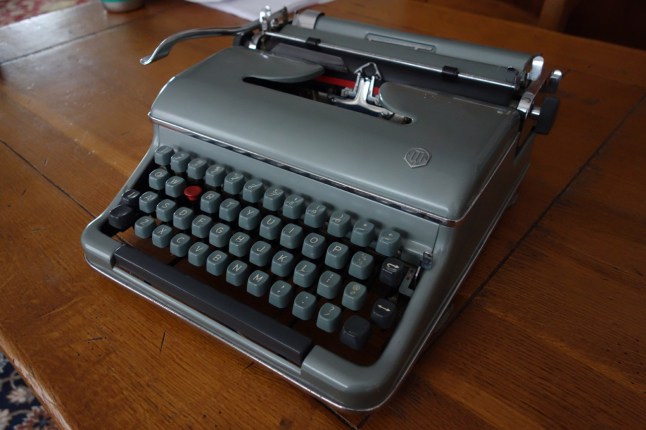
A 1957 Torpedo 18a:

Looks
Beauty is in the eye of the beholder, so the Silent-Super wins me over with its lovely chunky curves. The Royal QDL’s utilitarian angles are all business while the Smith-Corona’s curves promise a bit of solid fun. The Torpedo is a beautiful machine, but for a 1957 typewriter, it seems a little “old school” compared to the Smith-Corona’s more modern lines. Silent-Super wins.
Dimensions
They are all about the same size:
- Smith-Corona Silent-Super: 11.5″ width x 12.5″ depth x 4.75″ tall
- Royal Quiet De Luxe: 11″ width x 11.5″ depth x 5.25″ tall
- Torpedo 18a: 11″ width x 12.5 depth” x 5″ tall
Weight
- Smith-Corona Silent-Super: 12 lbs
- Royal Quiet De Luxe: 12 lbs
- Torpedo 18a: 13 lbs
Shifting
Basket shift for all three. I like that.
Margins
I am not a big fan of the Royal’s Magic Margins. And I am lukewarm on any other gimmicky margin control. I love everything about my Remington Rand KMC except its KMC (keyboard margin control).
The Torpedo’s margin setting is under the paper table in back, not visible.
The Smith-Corona’s straightforward margin setting is PERFECT. You set the margins right there in front and what you see is what you get.
Carriage Return
Smith-Corona’s carriage return is quiet and light as feather. The Royal a little heavier and louder and Torpedo is heavy and LOUD.
Sound
I love the gentle tap-tap of the Smith-Corona. It has a lovely muted quality. The Royal is much louder and I don’t think it’s the platen. The Royal’s typebars seem to accelerate as they approach the platen, giving it that snap in the touch and a powerful thwack. The Torpedo is louder than hell and I think it’s a hard platen. “SNACK SNACK SNACK,” it says.

Ear protection is a good idea
Touch
I love the feel of the Smith-Corona Silent-Super. It’s got a controlled and comfy feel, like I’m typing on a well-cushioned couch. It’s slow, but I don’t think very fast, so do I need to type that fast?
The Royal is such a light and snappy typer. I can type very fast on this one. Maybe too fast. The Royal feels a little hyper – like it needs to simmer down now. It gets ahead of itself, and I get letter piling when it gets going too fast.

If I were a better typist, I would probably prefer the Royal. Unfortunately, I am an inconsistent typist and make too many errors when I pick up speed.
The Torpedo tells me go faster, faster, FASTER – it has, objectively speaking, the best touch of the three, but it’s so loud I can’t type on it very long. I pull it out now and then and each time rediscover its fine, fine touch. It deserves a new platen.
Family Verdict
My husband liked the Royal much better than the Smith-Corona. He is used to lightly tapping away on a computer keyboard. In fact, when he approached the first typewriter, he started hitting the margin release key as if it were an enter/return key. It was hard for the him to switch modes.
He found the Royal much more responsive to his light touch, much better suited to his style than the Smith-Corona which he found resistant and slow. Then he tried the Torpedo. He loved that even more than the Royal.
My daughter weighed in on the typewriter evaluations. The Smith Corona was too stiff and made her hands feel numb. She liked the snappiness and speed of the Royal, but the key tops were too small and too far apart, so she worried that her small fingers would slip in between the keys. The Torpedo had a similar light and fast touch, but its keys were nice and chunky. My daughter’s verdict: the Torpedo was the winner.
My Final Conclusion
My favorite is the Silent-Super. It’s not the fastest typewriter, but it feels good to me: I love its firm and comforting touch and its gentle sound. I grew up on manual typewriters – we had a big black Royal standard when I was a kid and I typed all my college papers on an aqua Kmart Deluxe 100. I have a heavy, ponderous hand when I type, so I like typewriters that have a solid touch. The Silent-Super is not the fastest typewriter, but I don’t need to type very fast. When I type letters, I tend to type slowly along thoughtful, meandering paths. If I typed faster, I would not make any sense at all. I barely make sense as it is.
Also: this Silent-Super has survived against the odds. It was a greasy, rusty piece of jammed metal when it came to me, but it showed me that it had true grit. This Silent-Super has a spunky toughness and intestinal fortitude that allowed it to rise above its unfortunate circumstances and type ably against two formidable typewriters, the Royal QDL and the Torpedo 18a. You win, Silent-Super.
A Random Picture for Your Enjoyment

My son took this madonna and doggy picture recently, and I spotted it in his Flickr photostream. It has nothing to do with typewriters, but it made me laugh out loud.

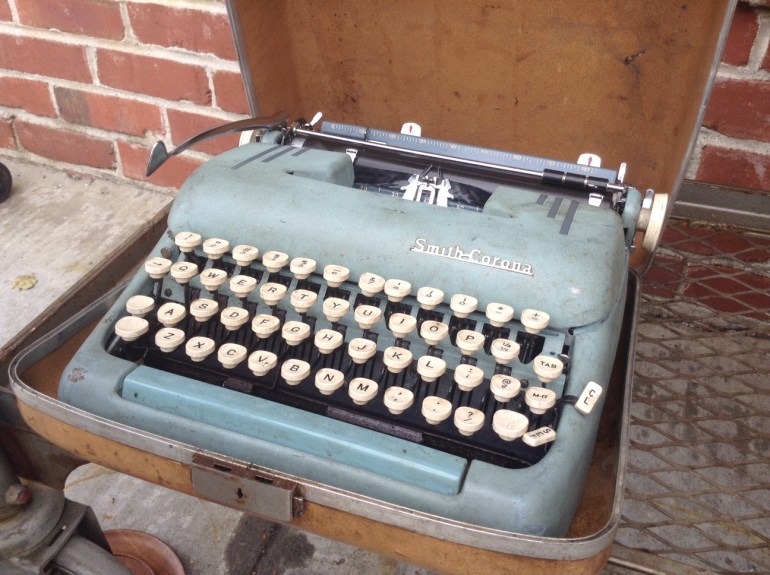
The Smith-Corona Sans-A-Tab
I have been working this past week on the Smith-Corona that was a freebie from Moe. Once it was typing, I began to address its cosmetic issues – which were many. Happily, just cleaning it with Scrubbing Bubbles made a huge improvement.
One thing that really bothered me was that the machine was missing its back top cover plate. Not only did that look bad, but the delicate mechanics were exposed and vulnerable to damage and dirt.

The blender carefully backs away from the greasy hunk of metal I’ve brought home
So I bought a top back cover for a S-C Silent on eBay and hoped that it would fit my typewriter which I guessed was a S-C Silent-Super. It arrived quickly, beautifully packed. Five stars to the eBay seller.
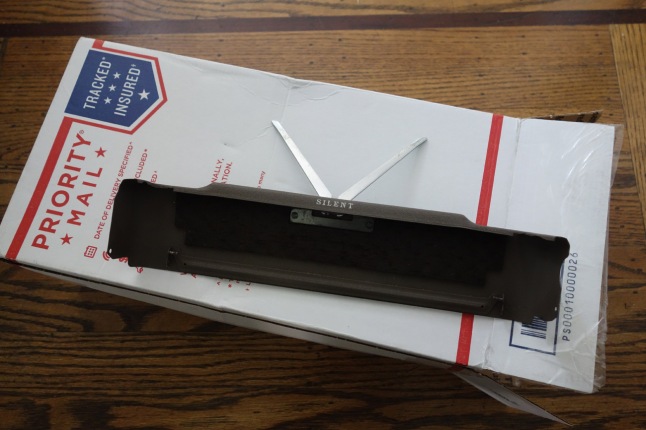
And it looked to be an almost perfect fit.
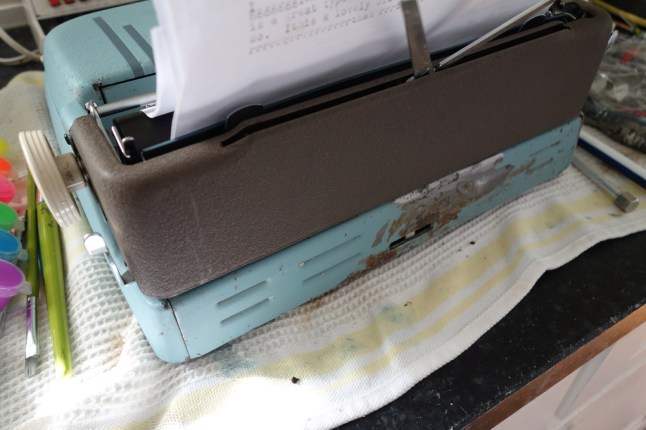
I was unsure as to how to anchor the top cover to the machine, so I needed to do a little research.
Fortunately for the typewriter, Moe’s shop had two comparison typewriters in stock: a Smith-Corona Silent and a Smith-Corona Silent-Super.

I compared the anchoring mechanism for the back plate on each machine and took a lot of pictures. What I came away with was this: if I wanted to use the Silent top cover that I got from eBay, I would have to remove the tab setting/clearing mechanism from my Silent-Super. I was OK with that because (to me) protecting the delicate insides that were exposed is more important than a functioning tabulator.
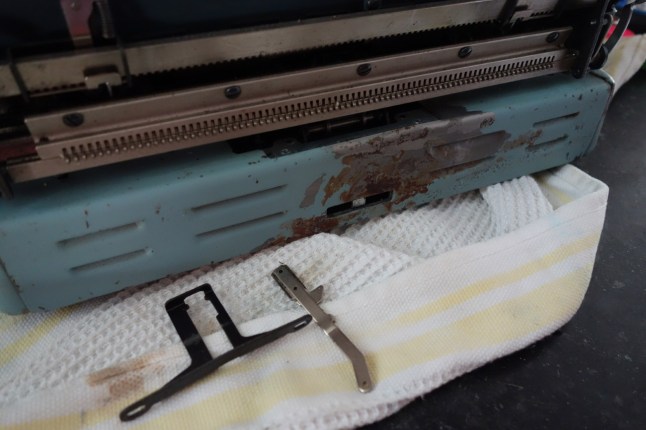
So I removed the tab setting/clearing pieces and carefully filed them away. Perhaps some day I will restore the tab function, but for now this typewriter is a Smith-Corona Sans-A-Tab.
I wasn’t sure what I wanted to do about the mismatch in color – blue machine with a brown top cover. I have seen typewriters that have been decoupaged like this one and I thought maybe the brown top cover plate could be a candidate for fabric decoupaging. Perhaps I could cover the brown top plate with the tartan of my clan, MacEchevarria.

However, I was shot down by both my husband and my daughter who were emphatic that I try to match the powder blue of the main machine. They were right. I couldn’t find the right plaid anyway.
So after carefully washing and degreasing the top cover, I pulled out left-over house paint and sponged on a thin primer coat over the brown of the Silent cover plate.

I then mixed up a batch of flat paint (gray acrylic house paint plus tiny bits of blue, yellow and black acrylic craft paint) and came up with a blue that was fairly close to the original Alpine Blue.

I sponged the paint on because I didn’t want brush marks and I wanted to preserved the pebbly crinkle texture.
After two thin coats, I was getting close to Alpine Blue – it needed just a little more black in the paint to make it just a shade grayer:
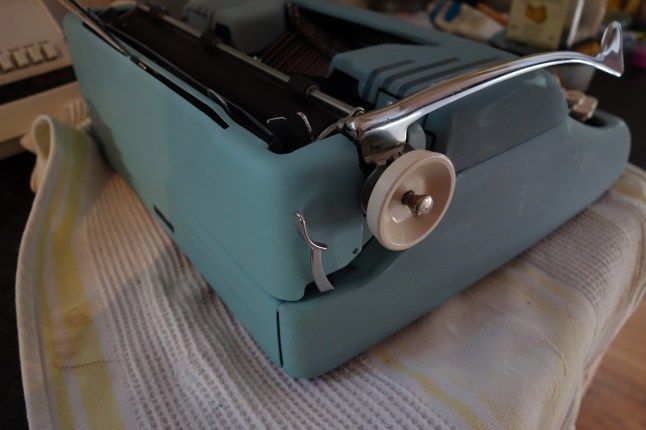
The resulting color match is not perfect, but very close in color. There are big dings in the front that I have touched up. I didn’t sand beforehand because I get the feeling there is plenty of lead in this 1950s typewriter paint. I just painted over the chipped areas with multiple coats and tried to get the surface as level as possible.
I now introduce the lovely Miss S-C Sans-A-Tab:
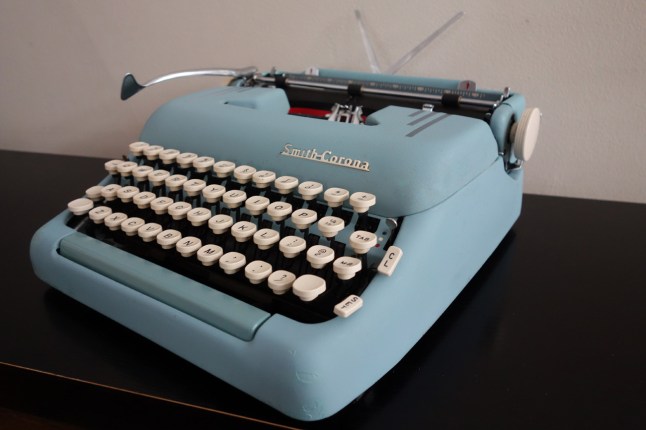


With so many chips and dings, this typewriter is a candidate for a complete sandblast and powder coating. However, I don’t think I’ll go that route. I am currently embracing her imperfections – they are part of her very interesting history.
So Deliciously Low, So Horribly Dirty
One old film that I enjoy more with repeated viewings is 1938’s Pygmalion. It’s the much funnier, smarter predecessor to My Fair Lady. A phonetics professor Henry Higgins makes a bet that he can take a bedraggled Cockney flowergirl, clean her up, train her in proper speech, and pass her off as a duchess. This S-C Silent-Super reminds me of that draggle-tail guttersnipe, Eliza Doolittle.
I’ll be honest: broken, dirty machines like this Smith-Corona are irresistible to me. I take a Higgins-like interest in them: I clean and rehabilitate them, hoping to pass them off as duchesses.
When I saw this S-C Silent-Super in the portico of St. Paul’s, er, in front of Moe’s junk shop, I knew that I had a wonderful project on my hands.

Here’s Wendy Hiller killing it as Eliza Doolittle in 1938’s Pygmalion. Sorry, no typewriters in this film.
The Slippery Smith-Corona Something
Last weekend I had a variety-pack of fun that involved a junior high school musical, a Kentucky Derby hat project, and Star Wars Episode II: Attack of the Clones. It was jammed-packed with excitement, but I still made time to work on this broken beauty that was sitting on my kitchen counter dripping oil:

This is the FREE typewriter that Moe gave me last week. A hauler found it in a house that he was cleaning out. He drenched it with oil but couldn’t get it to work. He was going to throw it out, but Moe stopped him.
I am not sure what kind of Smith-Corona I have here. It’s either a S-C Super or a S-C Silent-Super. It’s missing the paper table/ top back panel with its identifying label, so it’s hard to say. I think it’s a S-C Silent- Super. It looks like the Silent-Supers at Typewriter Database and it has an “X” at the end of its serial number like many Silent-Supers: 5T 477968X. From its serial number, I believe that it’s a 1957 Smith-Corona Something.
When I first brought it home, the machine was as slippery as a greased pig. The machine was so oily and slippy, I couldn’t safely handle it – it was sliding all over the place. Also, just touching it kind of grossed me out.
I wiped it down with a rag to get the worst of it off and considered its major issue: the carriage was jammed exactly in the midway point of the platen and not budging. I assumed initially that there was a carriage lock engaged, but no.
The Name of My Song: Tab Rack Carriage Jam
A couple of typewriters that I have worked on had jammed carriages that were related to interference from the tab system:
And I think I can add this Smith-Corona Something to the list. Here’s the back before intervention:
Ted Munk pointed out in a comment that the tab rack looked strange. Examining it more closely, I saw that the tabs were interfering with carriage travel, so I gently bent the tab setting/clearing assembly back with my fingers:

And the carriage began to move. I could hear the tab setter/clearer mechanism rubbing against the tabs, so I bent it back a little more.
The tab set and clear keys were twisted and mangled:

I straightened the keys out a bit and got the tab setting and clearing mechanism to respond to them, but they are still not reliably setting and clearing tabs. I might not be able to fix the tab system. Fortunately, a working tabulator is not mission-critical to a typewriter.
I decided to get a replacement cover for the top back to protect the tab system and prevent it from getting bent inward again. I bought this – I hope it fits!

The draw string was all tangled up inside the mainspring drum.

I tried to turn the drum gently to free it but it was all gummed up. A firmer hand was required, and I was finally able to turn the drum and free the intact draw string. I then manually wound the drum several times to free it from its gumminess. Boing, boing, boing. Springing easily back now. Make sure to read T. Munk’s post Replace the carriage string in your 1950’s Smith-Corona Silent!
As soon as the draw string was re-attached, the typewriter started belting out Doris Day:

Line Lock Revelation
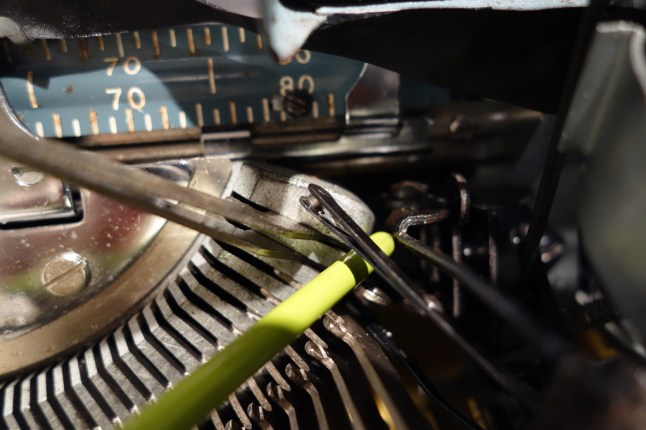
One thing that was really bothering me was that the line lock was not reliably engaging at the end of the line so that letters were piling up on top of each other at the end. I have seen other typewriters with this problem and it always baffles me.
I determined that on this Smith-Corona there wasn’t enough tension in the mainspring to pull the carriage at the end of the line with enough force to engage the line lock. I wound the mainspring another couple more times and the line lock began to engage properly. My mind is blown! I will carefully tuck this bit of new information away.
Of course there were the requisite detached S-C clevises (spring links) that needed to be re-attached to their typebars:
Here’s what I think happened to this typewriter:
- Someone bought it sometime in the mid-50s and used it faithfully for several years.
- When they last used it (maybe about 1970), the carriage was centered using the centering lever and the machine was returned to its case.
- Thirty years passed and the oil inside the mainspring congealed and solidified.
- Around 2000, someone takes the typewriter out of its case and attempts to move the carriage. The draw string slips off the immobile mainspring drum and wraps itself around the inside of the drum.
- A tinkerer trying to figure out what’s wrong removes the easiest-to-remove piece: the back cover, exposing the tab rack.
- Fruitless tinkering yields no results. The back cover is lost and the typewriter is sent to the garage where it collects greasy dirt and begins to rust. It’s leaned on its back and the tab rack and tab setter are bent inward
- A hauler finds it while clearing out a house, drenches it in oil, passes it onto Moe who gives it to me for FREE.
I have made a pass with Scrubbing Bubbles and the grime and grease have receded. The beautiful Alpine Blue is beginning to sparkle.
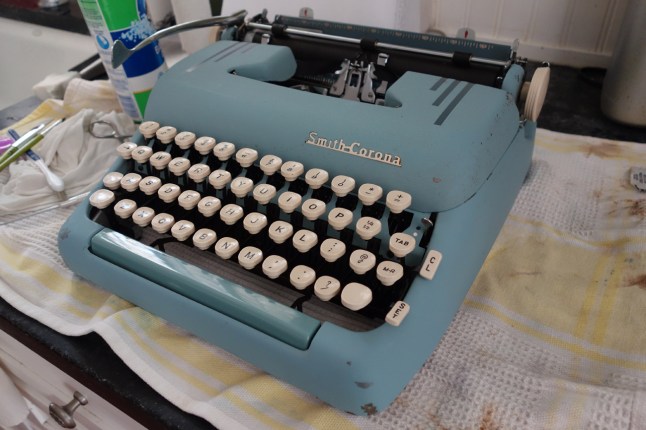
ZetiX says these machine have a “Flintstone-esque chunkiness” which is a spot-on description. This is a Wilma or a Betty.
I have a lot of acrylic paint left over from house projects, so I am planning to mix up a batch of blue acrylic paint to match the Alpine Blue. After carefully cleaning and priming of the chipped areas, I am going to do cautious touch-ups with the acrylic flat paint.

Spring Cleaning: Remington 5 and a Freebie
Moe’s friend Tim has some wonderful old typewriters. I cleaned up a couple of his beauties a while back. Tim called me on the phone to thank me – such a super nice guy. He’s a semi-retired newspaper reporter. He recalls an article about typewriters that he wrote in the late 1990s or early 2000s. He said it was one of his most heavily commented upon articles. He’s going to try to dig it up for me.
Tim has this gorgeous Remington 5 which needed a dusting and a new ribbon, so I brought it home for a few days.
I took the top cover off – two screws in the front and two screws in the back. I cleaned and polished the cover.

It was a beautiful day on Saturday, so I worked out on the back patio. Everything is in bloom right now: lavender, lilacs, geraniums, anonymous blue flowers:

Cleaning the type slugs was very easy. With the cover removed, the type bars are completely exposed. They lie flat, making it easy to scoot a towel under them. I draped the machine and got to work with a tooth brush and mineral spirits.

The red accent pieces like the paper scale and red keys are so attractive.


“Self Starter” is a key that tabs in five spaces – for indenting paragraphs.


The feet are in very bad shape. If I owned this one, I would probably buy or make a new set. It’s a rather low-slung machine and could probably use the extra clearance.
This Remington 5 is such a fine typer. It’s got a big, beautiful typeface:

I don’t think I held onto this one long enough – I didn’t have much time to play with it and do comparisons with other typewriters in the house. I hope that one day another Remington portable (a good junker) comes to stay for a visit.
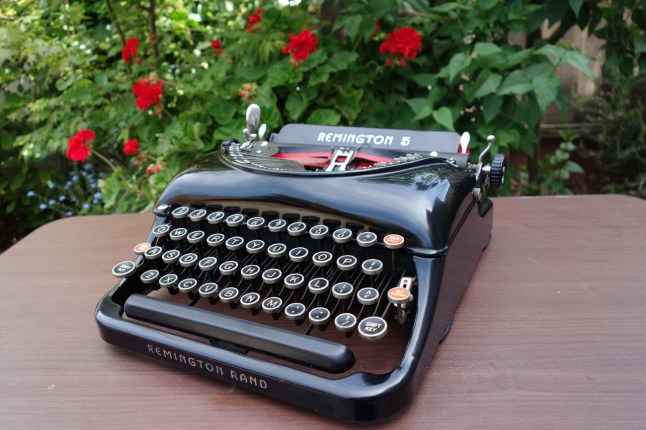
Oh, you beautiful thing. It is high time I returned you to Tim’s loving embrace.
Moe called me last night and left a message. A hauler she works with had been cleaning out a house and found a typewriter. It was jammed, so he doused it with oil. It was still jammed so he was going to throw it out, but Moe stopped him. The typewriter was really broken, so she was leaving it outside her shop and I could pick it up any time – it was FREE if I wanted it for parts or whatever.
I swung by Moe’s this morning to drop the Remington off at Moe’s for Tim to pick up. I took a look at my FREE typewriter.


Wow. I brought it home, and it is currently sitting on my kitchen counter dripping oil. It’s comically greasy.
I can’t get the carriage to move, even when I try to disengage the carriage centering lever.

The top back panel is missing. Perhaps someone tried to repair it at some time?
I think I have several pleasant hours of tinkering ahead of me this weekend.
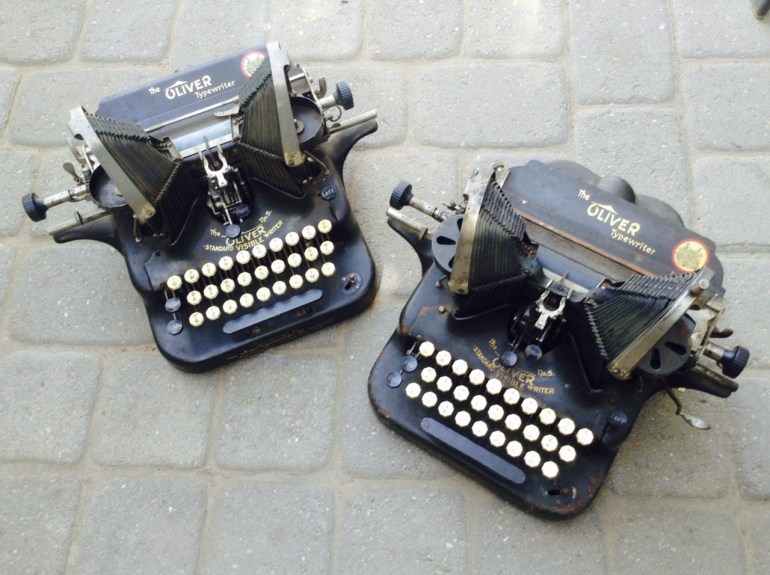
The 103 Year Old Oliver Twins
Some time back, it was Two-Fer Tuesday, and I came into possession of a pair of Oliver No. 5 typewriters. The seller was very glad that the Olivers were going to a loving home.
One was in incredibly good condition; it just needed a little cleaning. The other was dirty, rusty, and nonfunctional.
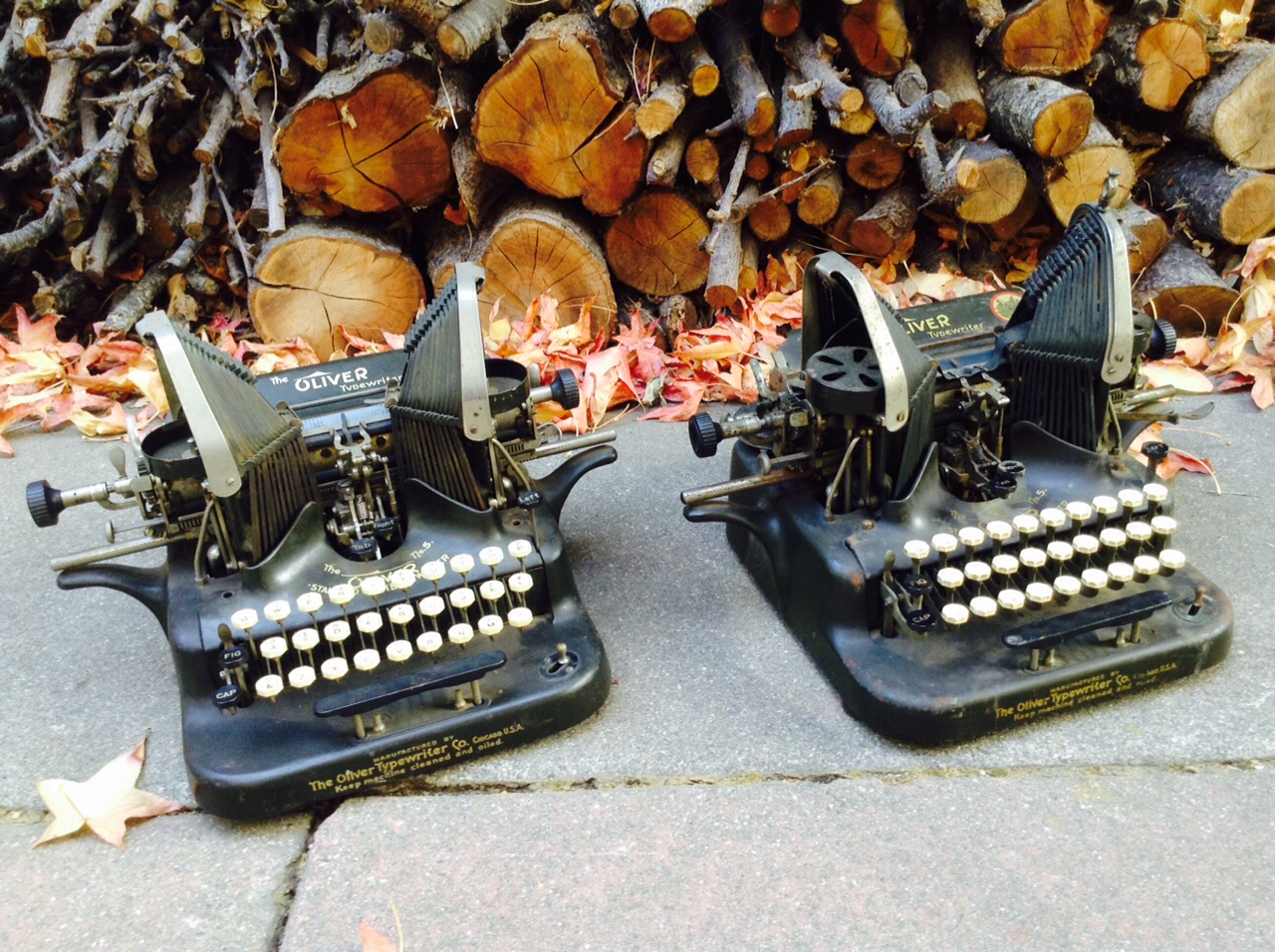
These came to me in the winter – a time for sweaters, scarves and Olivers.
Finding two Oliver No. 5 typewriters here in the wilds of California is unusual – their geographic territory is much further east of here. It appears that they are both from 1913.
One has serial number 285132:

The other one has serial number 342169:

The Oliver in pretty good shape has a little rust and gunk and types with persuasion. It has a metal cover and wooden base.
The other Oliver is non-functional, very rusty, corroded and dirty. It needs a clean up and a new drawband. It should be fine.

They’re so cute. They’re holding hands.
So I had one for me and one to share. The rusty, nonfunctional Oliver is naturally more interesting to me, so I gave the one in better shape to Good Neighbor Brian. Brian is such a great neighbor: he taught me how to repair enormous holes in lath and plaster walls, he showed up with a Sawzall when I was demoing my bathroom, he gave me a shop vac, and he’s helped me straighten out metal parts on my typewriters. He’s a Good Neighbor. He has always admired my Oliver No. 9 which shows he has Good Taste.
Brian’s new Oliver 5 has a base and a cover. No wonder it was in such good condition. It was just a bit dusty and grimy.
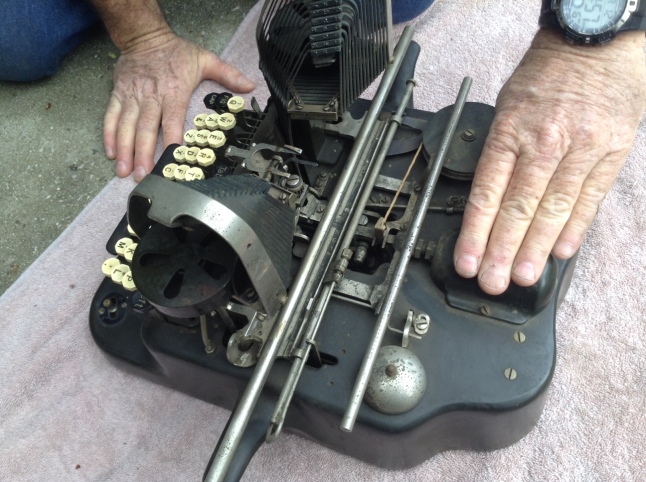
I took off the carriage so Brian could blow it out with his air compressor (set on a very low setting to avoid disturbing possibly loose pieces)
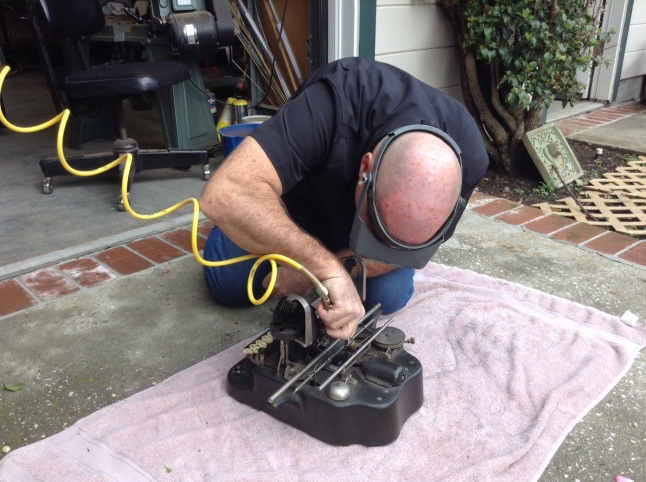
I showed Brian how to take the carriage off and reattach it. He’s a quick study:
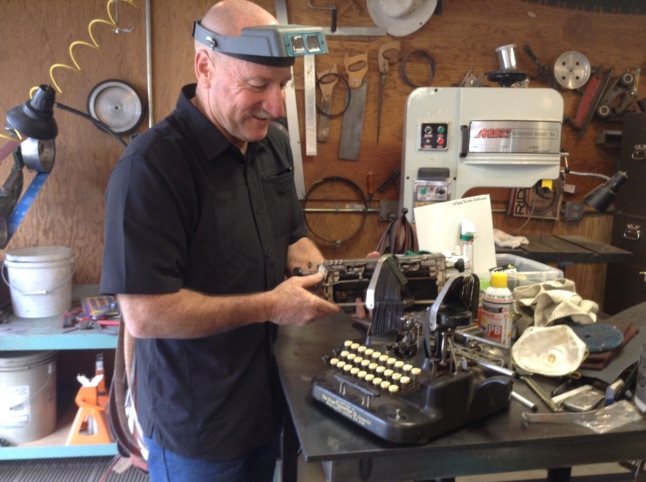
I gave him some pointers on taking care while cleaning it. This Oliver is in such good condition that a lightly damp rag and some Renaissance wax would be all it needed. Brian sent me an email:
Mary:
I can’t express the satisfaction involved with cleaning this beautiful typewriter.
-Good Neighbor Brian
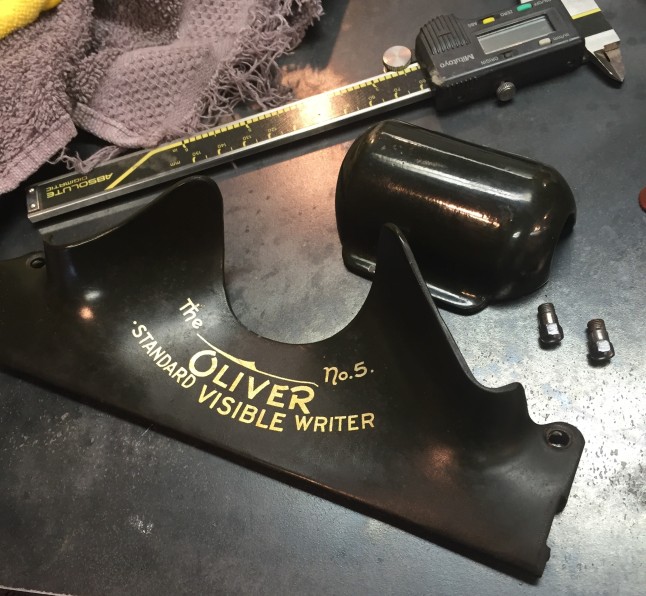
Zen Master Brian said that it is important to clean unfamiliar and complex machinery. The act of physically touching the machine while cleaning will help you to later use it safely and confidently. It is important to become one with the machine.
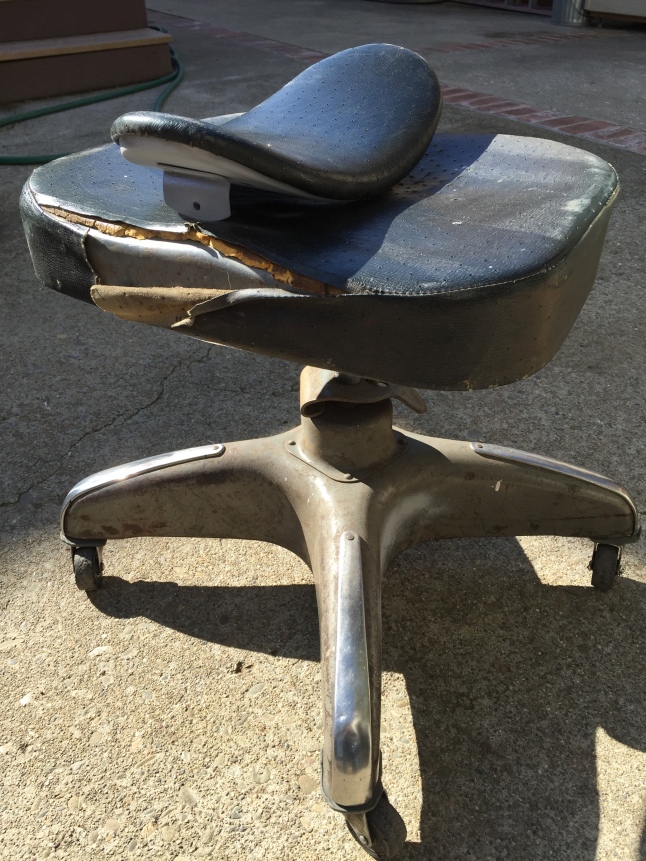
This is an old office chair that Brian is cleaning up. He wants to use it at the desk where his Oliver No. 5 is to reside once it’s all cleaned up. I told you he has Good Taste. And he likes junkers.
I bought 7/16″ inch cotton ribbon for the two Oliver No. 5s. I got one for Brian and one for me. Oliver No. 5 typewriters don’t take ½” ribbon like an Oliver No. 9. That size ribbon is too wide for the ribbon vibrator on an Oliver No. 5; it needs something just a hair smaller. I bought these Oliver No. 5 ribbons from Tony Casillo of TTS Business Products on eBay. I found an interesting article about Tony Casillo – he sounds like a right-on kind of guy.
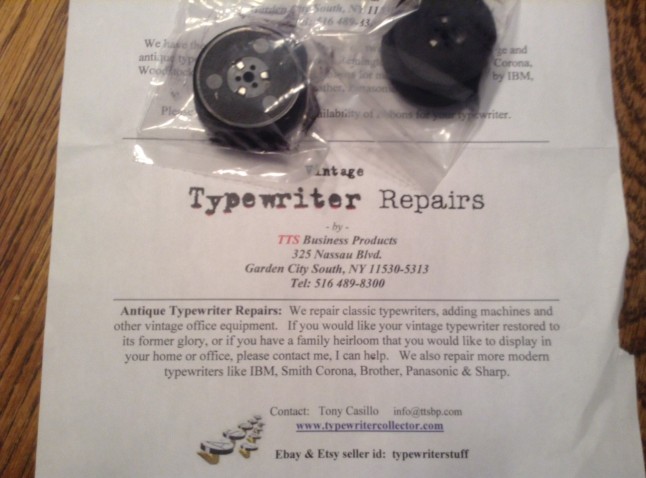
Brian is still working on polishing his Oliver No. 5, but when he’s done, we’ll throw in the new ribbon and let ‘er rip.
SmithBro in a Jam
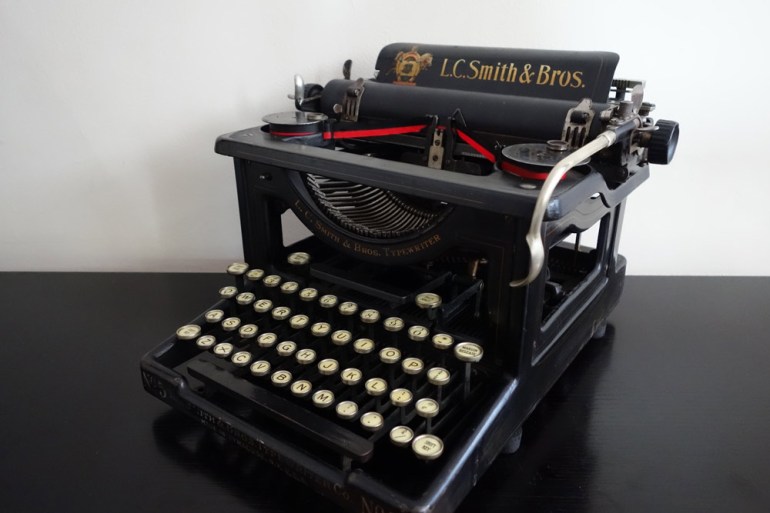
An L.C. Smith & Bros. No. 5 stayed at my place for a few days for some help. This SmithBro has been indulging in some hard living recently at Moe’s shop and needed an intervention.
At Moe’s, the carriage got jammed (inexplicably) way over to the right. I knew that if I left it that way, the typewriter might lose its balance and fall off a chair. I brought the SmithBro home to sober him up with black coffee and figure out what the heck was going on:
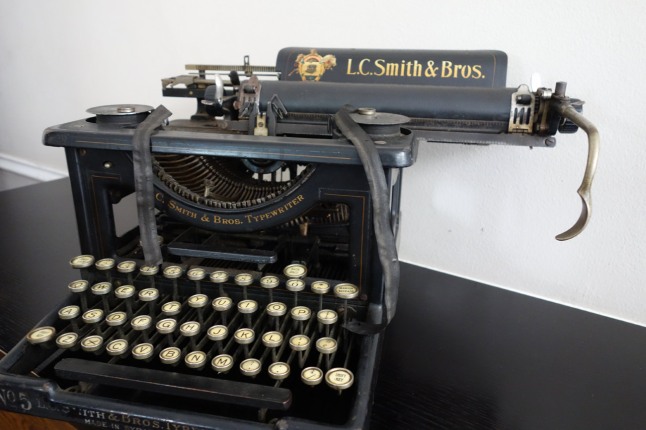
Your tie’s undone, Mister.
Huh.
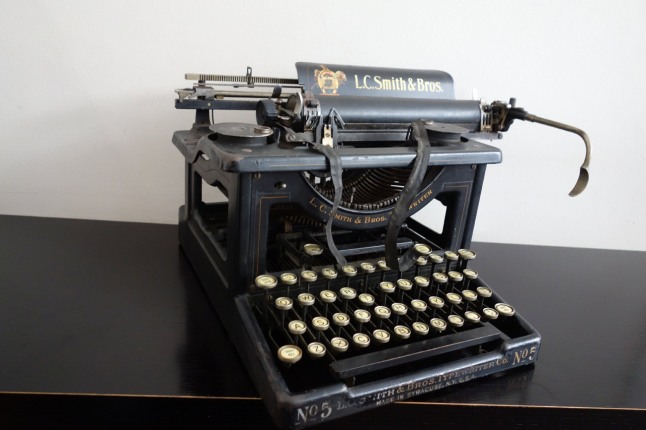
“Lady, I think I’m gonna be sick…”
I didn’t know where to start. I just could not get that carriage to move. For about an hour, I poked and prodded. I coaxed and cleaned. Nothing. I went to the internet. Fortunately, Knife141 had a similar problem. That guy. He. Has. Seen. Much.
Like Knife141’s typewriter, the problem seemed to come from the tab rack. I removed the two tab stops, wiggled the tab rack in back, pressed the tab bar in front and was finally able to move the carriage.
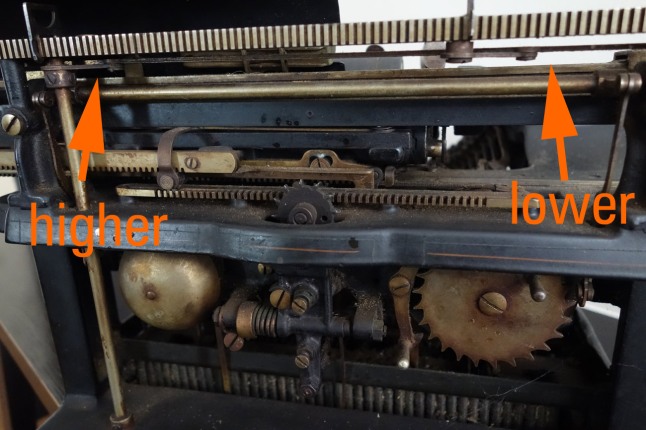
I am not quite sure what I did, but after that, the carriage moved freely – squeakily and crustily because of a very dirty carriage track – but freely. The tab mechanism under the tab rack was a little higher on one side than the other. It was possibly bent. Strategically-applied PB B’laster de-gummed the moving parts of the tab mechanism and the tabbing began to function.
How old is this thing? I found the serial number stamped inside the machine behind the tab bar: 192102-5

This is a 1912 typewriter per Typewriter Database.
This machine was pretty dirty. After an initial blow out out, I doused everything in mineral spirits. I’m starting to warm up to mineral spirits. I love denatured alcohol for cleaning, but it is so dangerous around painted surfaces. A stray drop of denatured alcohol will eat into paint quickly. Mineral spirits are a little more forgiving around paint.
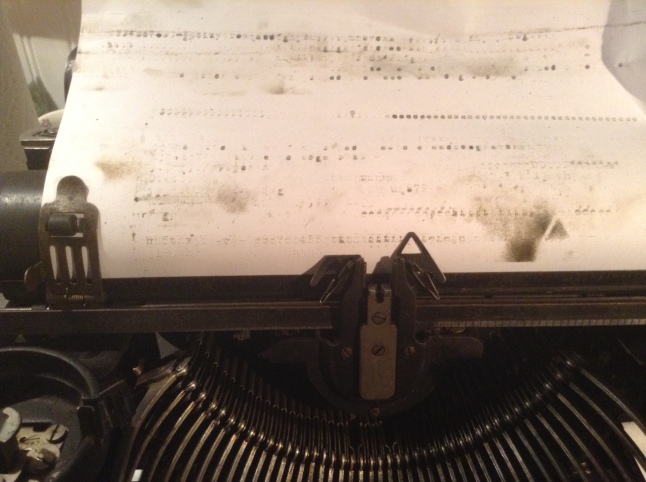
The typewriter was typing great, even without a ribbon, but the platen was filthy:
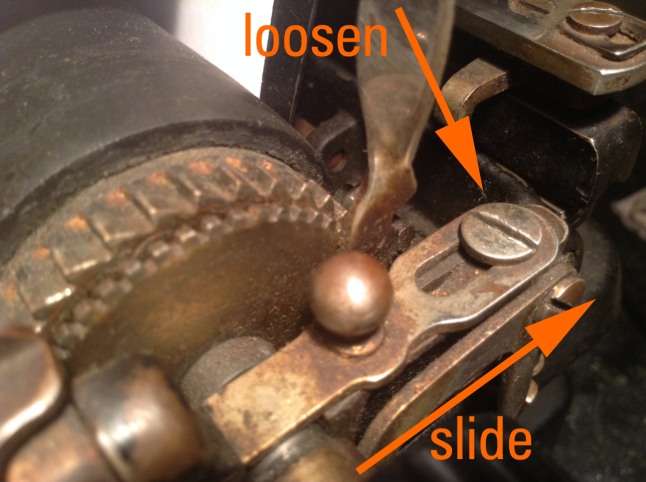
The platen on the old L.C. Smith standards pops out very easily. You loosen a couple screws on each end of the platen and slide the retainer back:
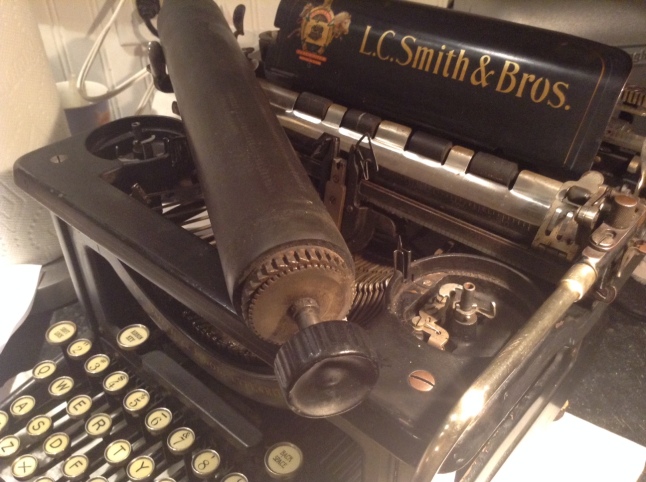
I popped the platen out and cleaned it with Soft Scrub:
It is a 104 year old platen and it’s hard as a rock. Thwack thwack thwack – even with three sheets of paper.
It started me thinking: how much of the typing experience on an old typewriter has to do with the condition of the platen? I recently had a 100+ year old Underwood 5 stay with me, and it was a muted and delightful typing experience. It seemed to have a new-ish, soft-ish platen. The other 100 year old typewriters that I have experienced (Royal 10, LC Smith 8, Fox 24, Oliver 9, Century 10) have had rock-hard platens and been thwack-thwack-thwack experiences. They were springy and responsive typewriters, but very noisy.
Wow! That’s a handsome decal – it’s in such good shape:
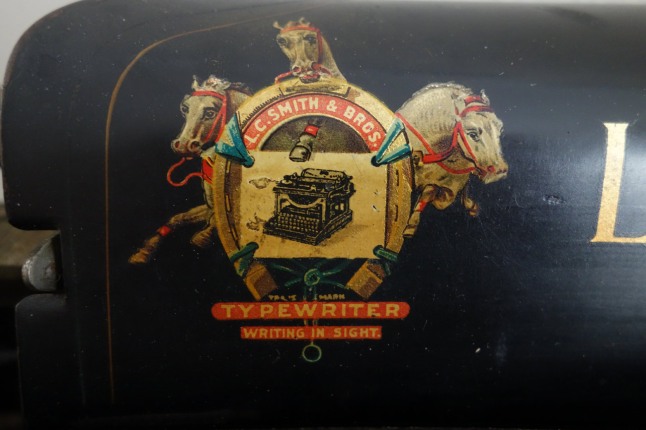
Magritte couldn’t have designed a better decal. Is that disembodied hoof trying to type – or destroy the typewriter? What does it all mean? Horsie the Destroyer.
The back space wasn’t working, so I investigated underneath the machine.
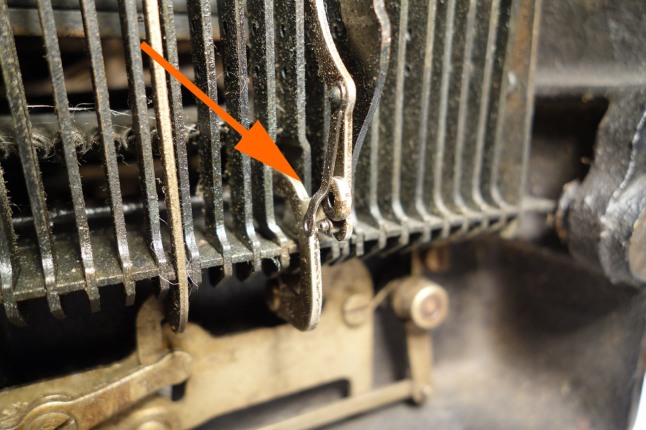
Clevis!!! Er – link spring. Old-timey clevis!! This is the technology that has been be-deviling me as I work on the 1960s SCM machines at The Shop at Flywheel Press. Snapped clevises (link springs) have be-deviled people for the past 100+ years.
Back space linkage is re-attached and all is well:
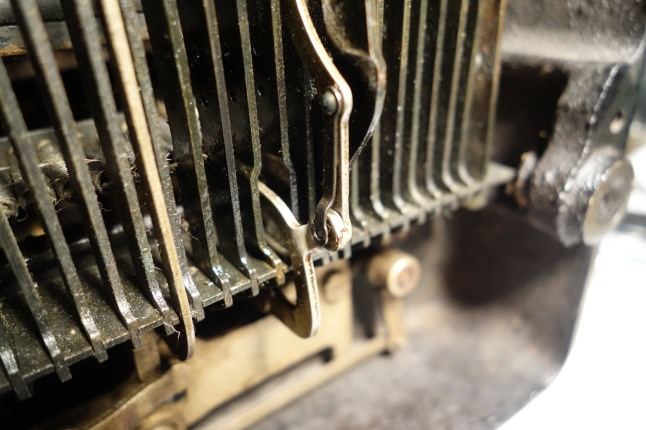
I scrubbed the grimy typebars with Scotch Brite and got the gumminess to recede with an application of mineral spirits. A couple letters were still not freely striking. As it turns out, their key levers were bent going into the comb that is the key lever guide. I had to straighten them out with pliers so they could move freely.
Baby needs a new pair of shoes
The feet were completely gone – just the remnants of old rubber in the hole. I made new feet out of cork:
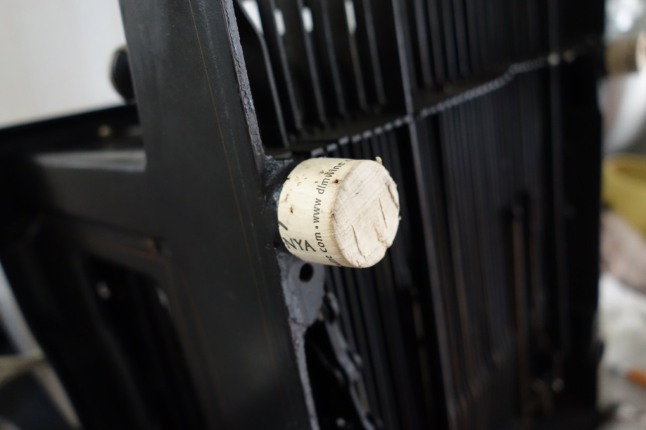
and colored them with Sharpie and India ink:
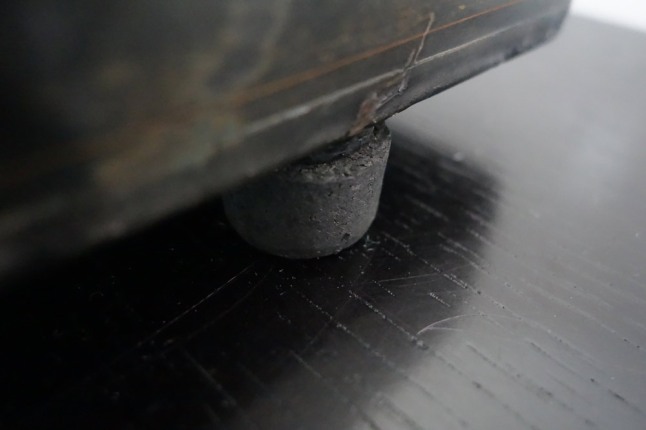
They look really good, but I want to get some rubber test tube stoppers as I think they will be more durable in the long run.
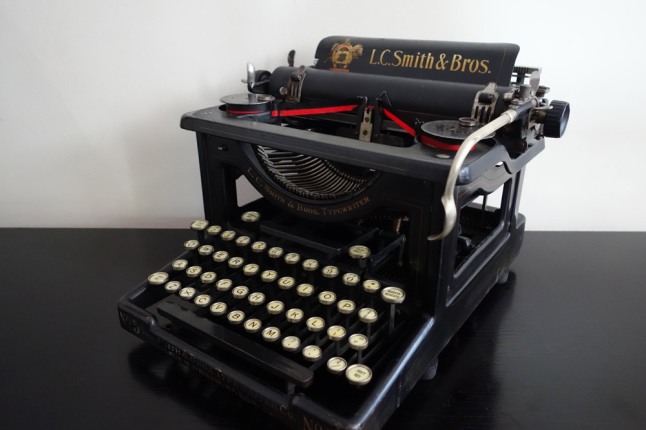
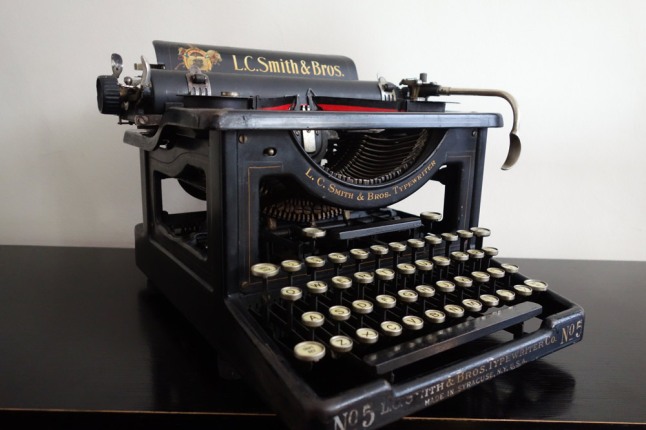
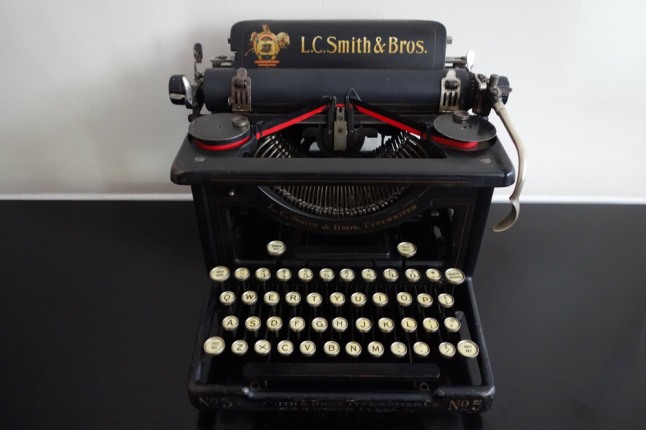

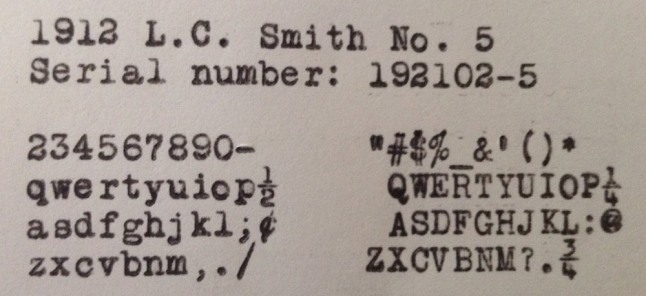
This SmithBro is so articulate! “QWERTYUIOP¼,” he said. So charming and well-spoken. And he is quite a handsome fellow now that’s he has showered and brushed his teeth. I should fix him up with my sister.

One Hundred Years of Aptitude
It is not true that people stop pursuing dreams because they grow old, they grow old because they stop pursuing dreams.
–Gabriel García Márquez
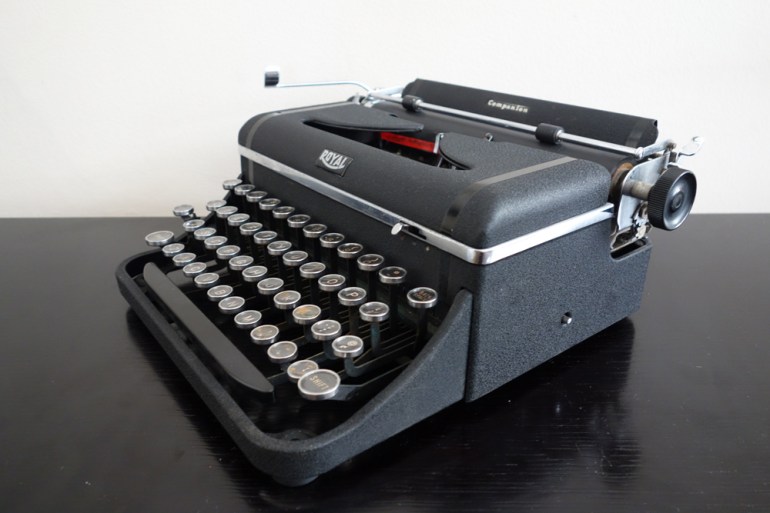
Tim’s Royals and Other Visitors
A couple weeks ago, Moe at my favorite junk shop asked me to take a look at her friend Tim’s typewriters. Tim is a retired newspaper reporter who has a taste for fine old typewriters.


