The blue 1960 Craigslist Lettera is a pretty happy typewriter now. It types nicely, very respectably. Cosmetically, though, it’s still in rough shape. I’d like to issue a formal apology to all birds – especially pigeons. What appeared to be bird poop on the Craigslist Lettera is probably oxidation (Bill M and T. Munk pointed that out in the post comments). And that stuff does not come off. The Lettera still looks like this:
Author: maryech

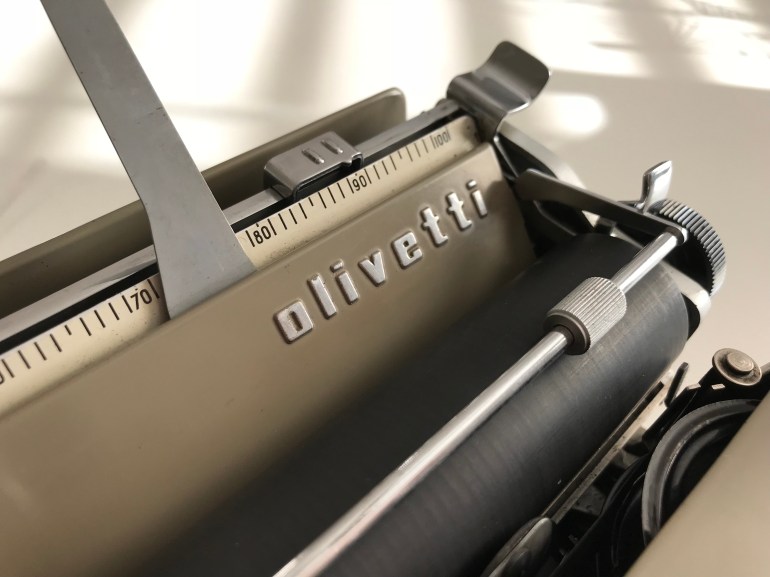
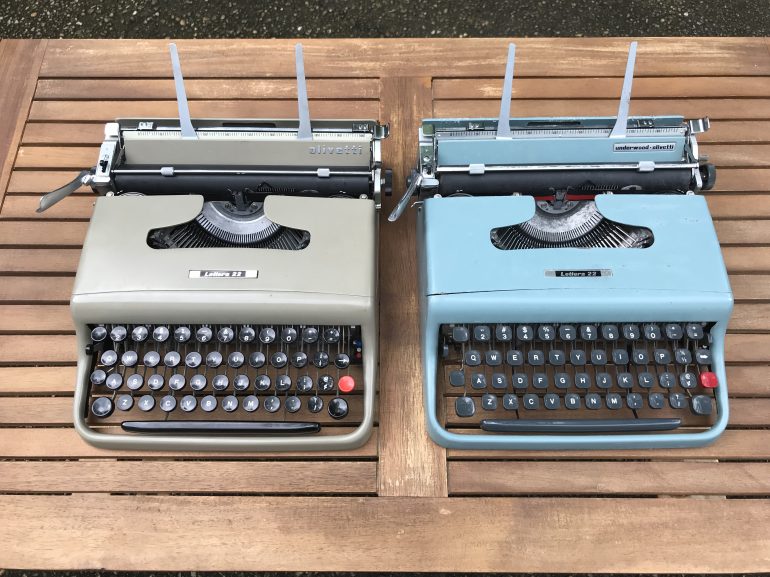
Old Lettera, New Lettera
I returned to Virginia with an hankering for a broken typewriter to clean and fix. Cleaning my sisters’ Quiet-Riter and Royal Administrator had whetted my appetite. I have a type: the junkier and more dysfunctional the typewriter, the better. They provide me with hours of fun (and gentle, comic frustration). Hey, there’s a meme for my taste in typewriters – albeit one that played out in 2017:

Southern States
This past fall, our family landed south of the Mason-Dixon line in the Old Dominion, the U.S. Commonwealth of Virginia (hey, I think I can go to Herman’s this year!) Typewriter-wise, I brought my little portables with me and left the big standards in California. I will be back and forth between east and west for the time being.
It’s been a while – a helluva year. My daily WTF meter broke just six months into 2017 because of overuse. The constant churn of events exhausted the poor thing and several of the gear teeth wore down and just broke off. I am debating whether I should take it apart and fix it. Do I really even need one? In any case, I checked out of the internet and the typosphere for a while. Like Francis Weed, I have taken up woodworking as distraction and therapy.

New on the shelf

The eagle has landed: classing up the new Virginia neighborhood with a debris box and a rat-branded moving container.
End of an Era
Back in California, Moe from Mozo’s Antique Search and Rescue closed down her San Mateo location and sold her building.

I get a bit choked up about it , remembering the good old days of Moe and Roia and all the fun typewriters:
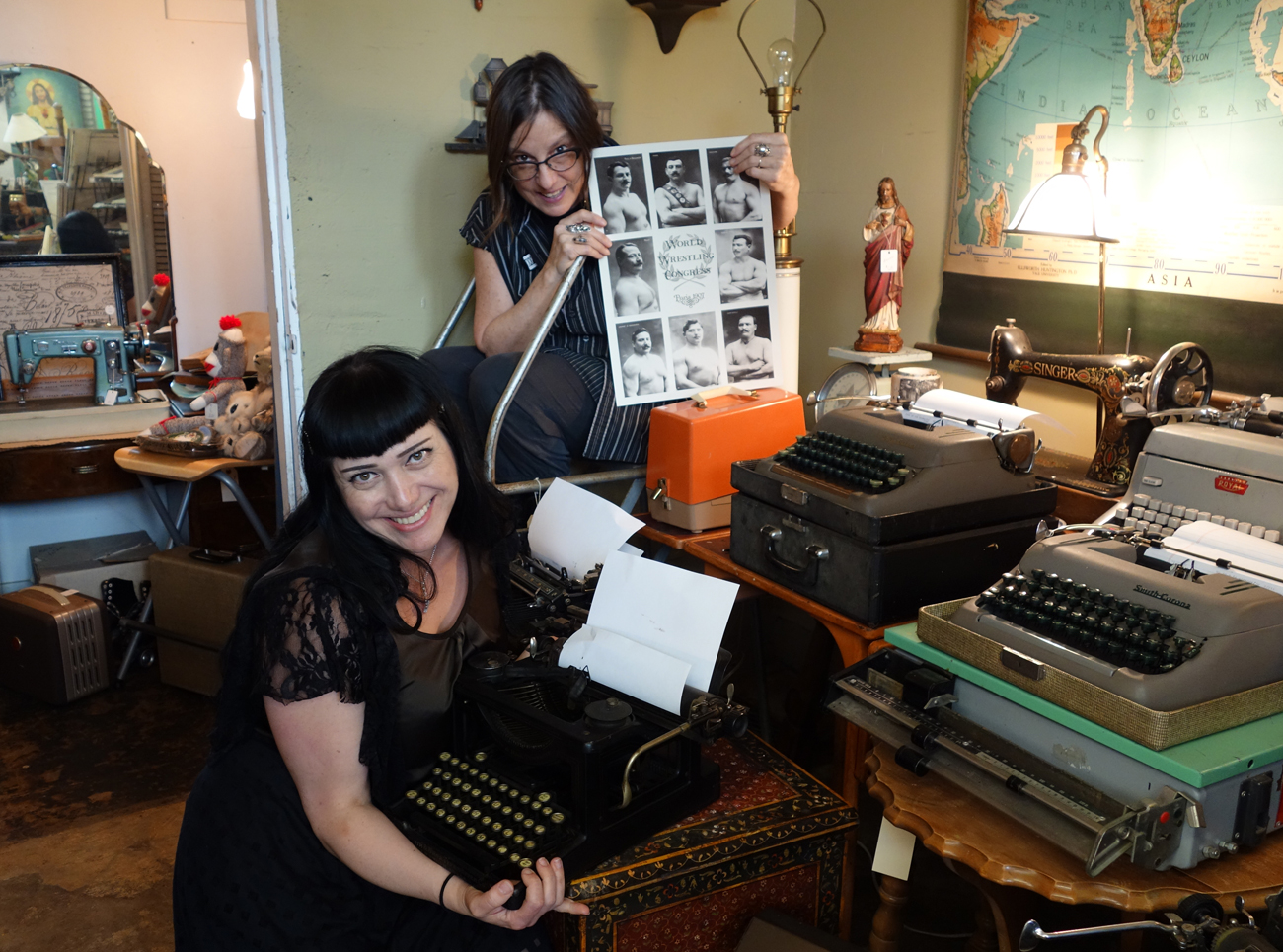
I wish I had that wrestlers poster
Before she left, Moe gave me this wonderful print which is currently hanging my bathroom in Virginia:

This is a picture of the Underwood exhibit at the 1915 Panama-Pacific International Exposition (PPIE) which was held in San Francisco. The exhibit featured a 14-ton functional Underwood 5 typewriter. ETCetera – Journal of the Early Typewriter Collectors’ Association had a good article in its Spring 2018 issue by Peter Weil about typewriters at the Louisiana Purchase Exposition and the PPIE.
In addition, the Shop at Flywheel Press closed its doors – I met so many beautiful typewriters there.

Like the passing of the elves from Middle Earth, it’s the end of an era.
Robust Update
The Olympia Robust has settled into her new gig at the Holocaust Museum in Richmond, Virginia. She rotates into the Dachau exhibit in the role of camp typewriter. She was featured in the June 2017 issue of the Virginia Holocaust Museum Newsletter, De Malyene. The museum is a good place for the Robust right now.

Just when I thought I was out…they pull me back in
After a year-long dry spell, I worked on three typewriters in the past week and found myself experiencing the pleasant, familiar sense of rightness and orderliness that typewriter cleaning brings me.
I was in Portland, OR last week doing family stuff. My sister showed up in town with a 1953 Remington Quiet-Riter that she had found in an antique shop in Columbia, TN. She wanted to get it typing and bring it to her neighborhood block party in Chicago this summer.

It was not typing – the typebars were gummed and rusted down. We got in trouble with my brother when he found us surreptitiously cleaning it on his kitchen floor, and we were banished to his garage workshop – which wasn’t a bad place for typewriter repair. It was stocked with solvents and a good radio tuned to KGON.
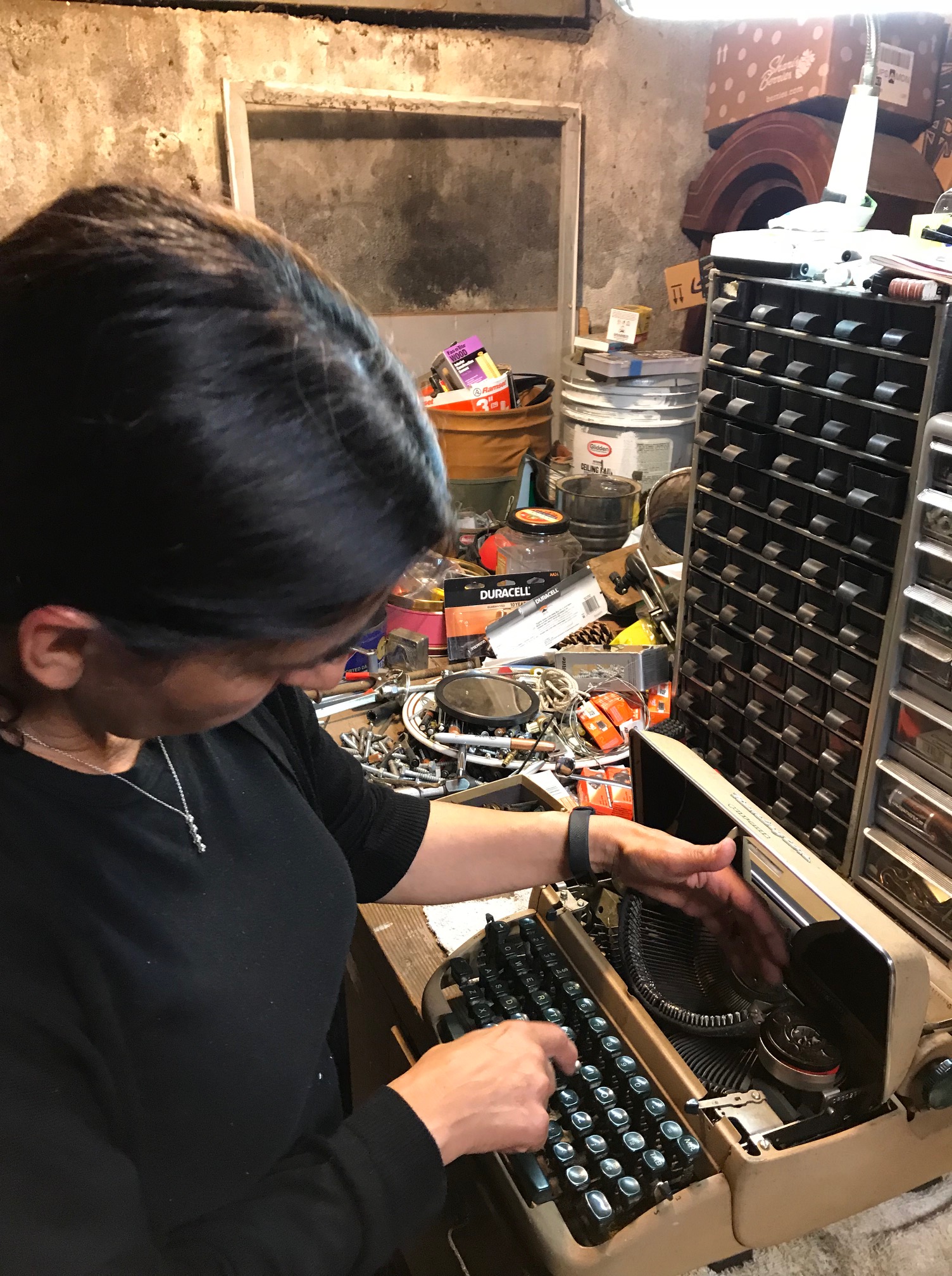
After a good internal cleaning and new ribbon, the Quiet-Riter was typing very nicely. The exterior is pocked with dots of rust, but it’s a happy typewriter on the inside.

I had to do some long-distance typewriter troubleshooting with my sister via text yesterday morning:
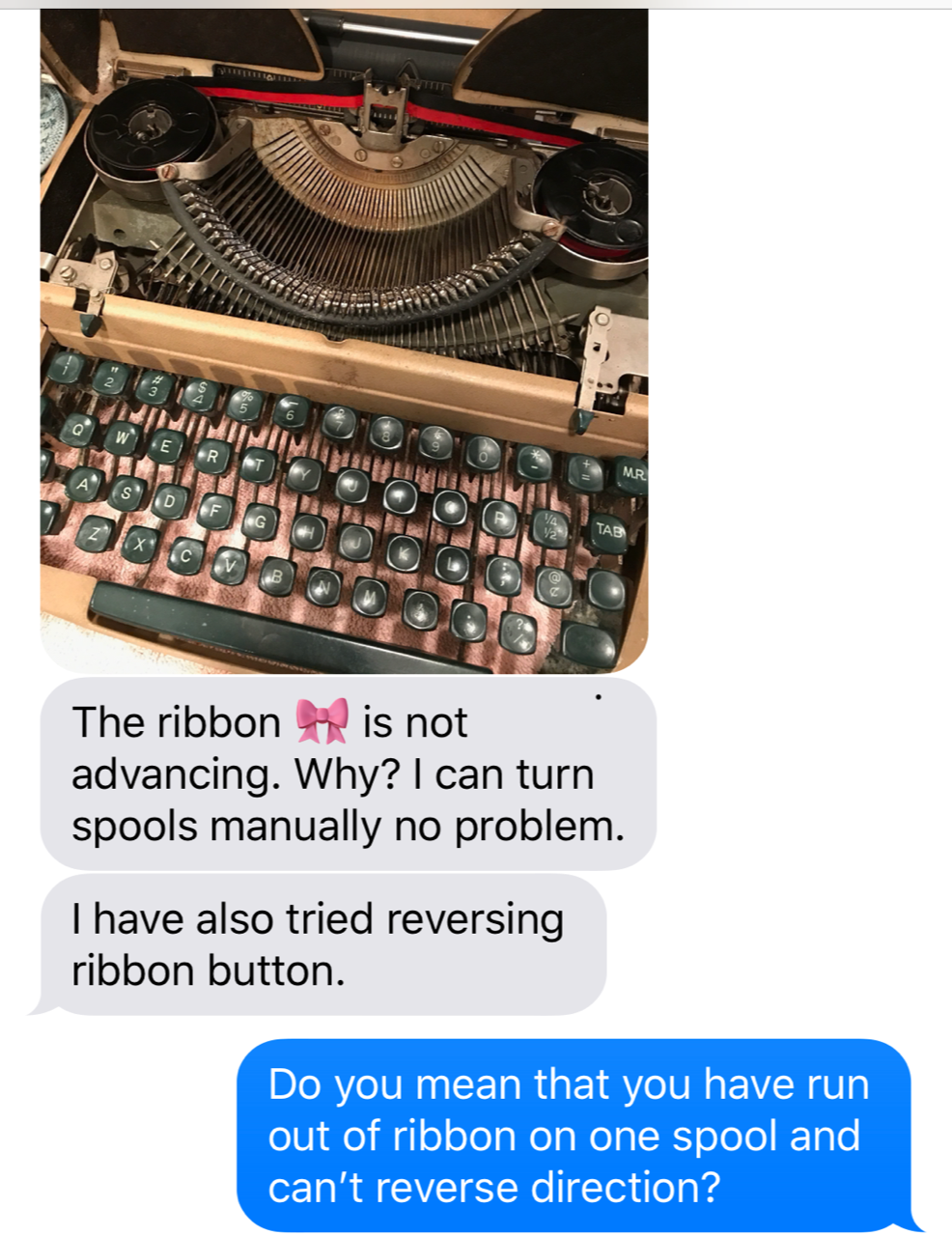
It turns out that her spools were not seated properly after she had fiddled with the ribbon – all fixed now.
I left Portland last week and headed to the SF Bay Area. I had burritos with another of my sisters in San Francisco and afterwards her daughter pulled out her non-functional typewriter. It had belonged to my niece’s grandfather.

What a weird Royal! This 1957 Royal Administrator was made in Mannheim, Germany. It is very similar to a Royal Diana except that it has a wide carriage.

The machine had been carefully stored (had the original case and dust cover), but the grease had congealed and stiffened and the Magic Margin, carriage, and typebars were not moving much. I took the typewriter home to San Mateo and cleaned the internal mechanics with mineral spirits.
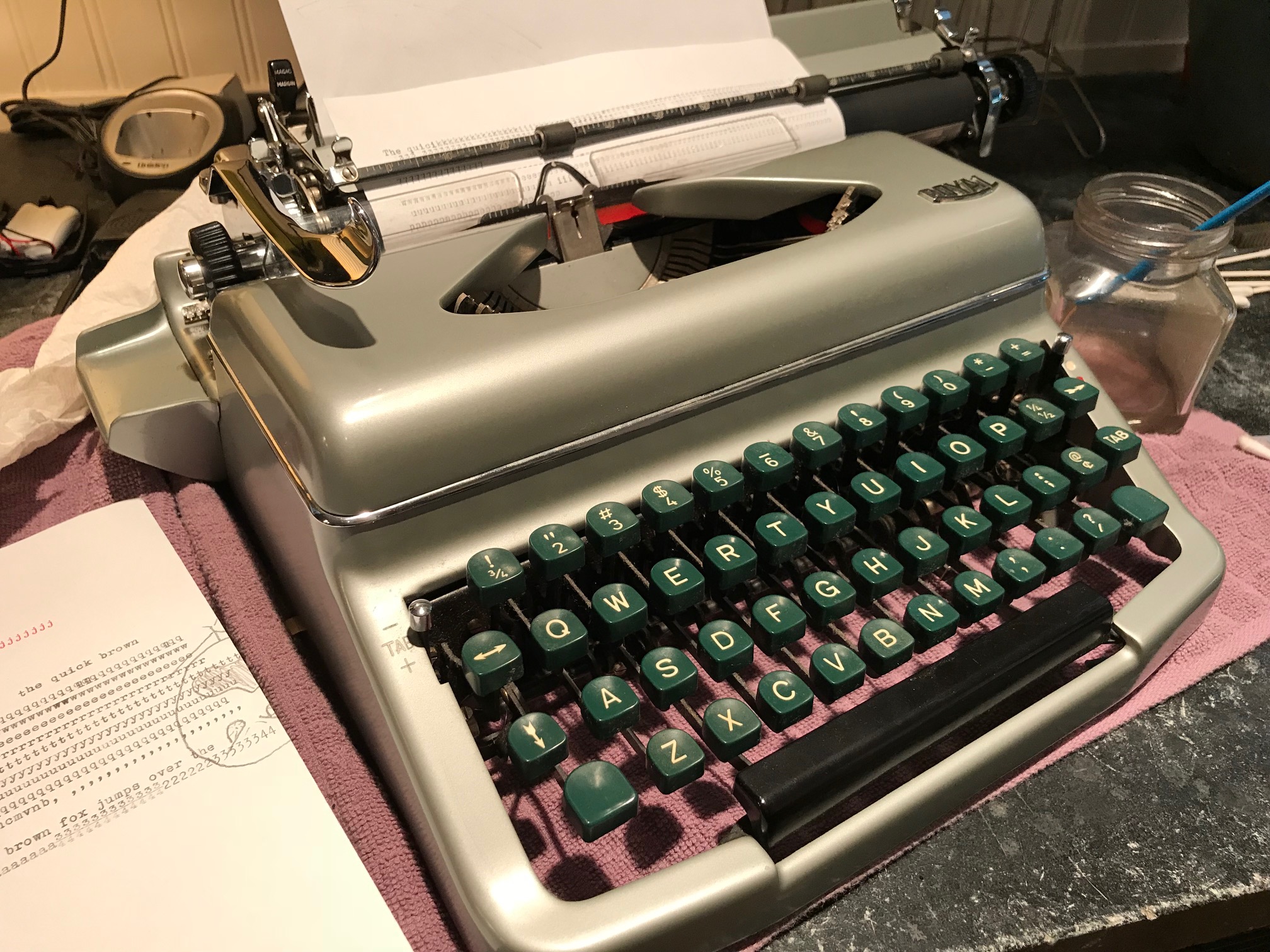
Once it was clean, I enjoyed its crisp, precise typing. It was pretty clanky sounding – perhaps the lack of insulation in the ribbon cover had something to do with the noise. The forward-tilting lid is very appealing.
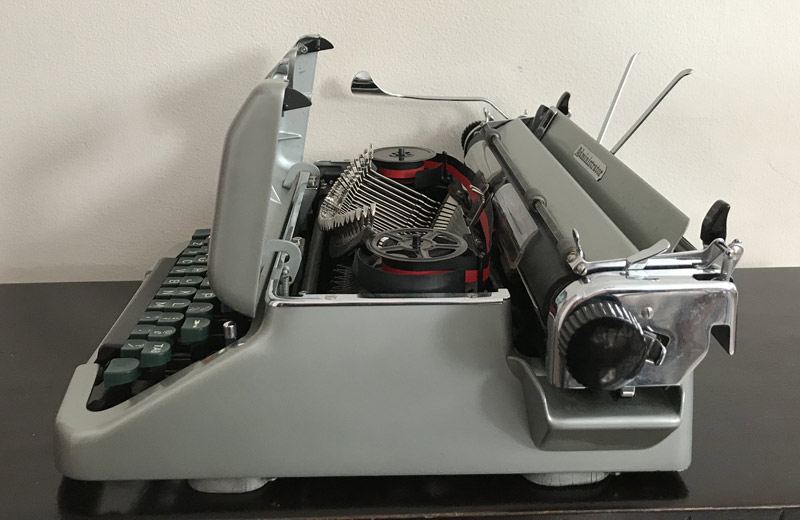
More pictures of the Royal Administrator are at Typewriter Database.
After finishing with the Administrator, I pulled out another typewriter, a 1957 Olympia SM3, from my front closet:
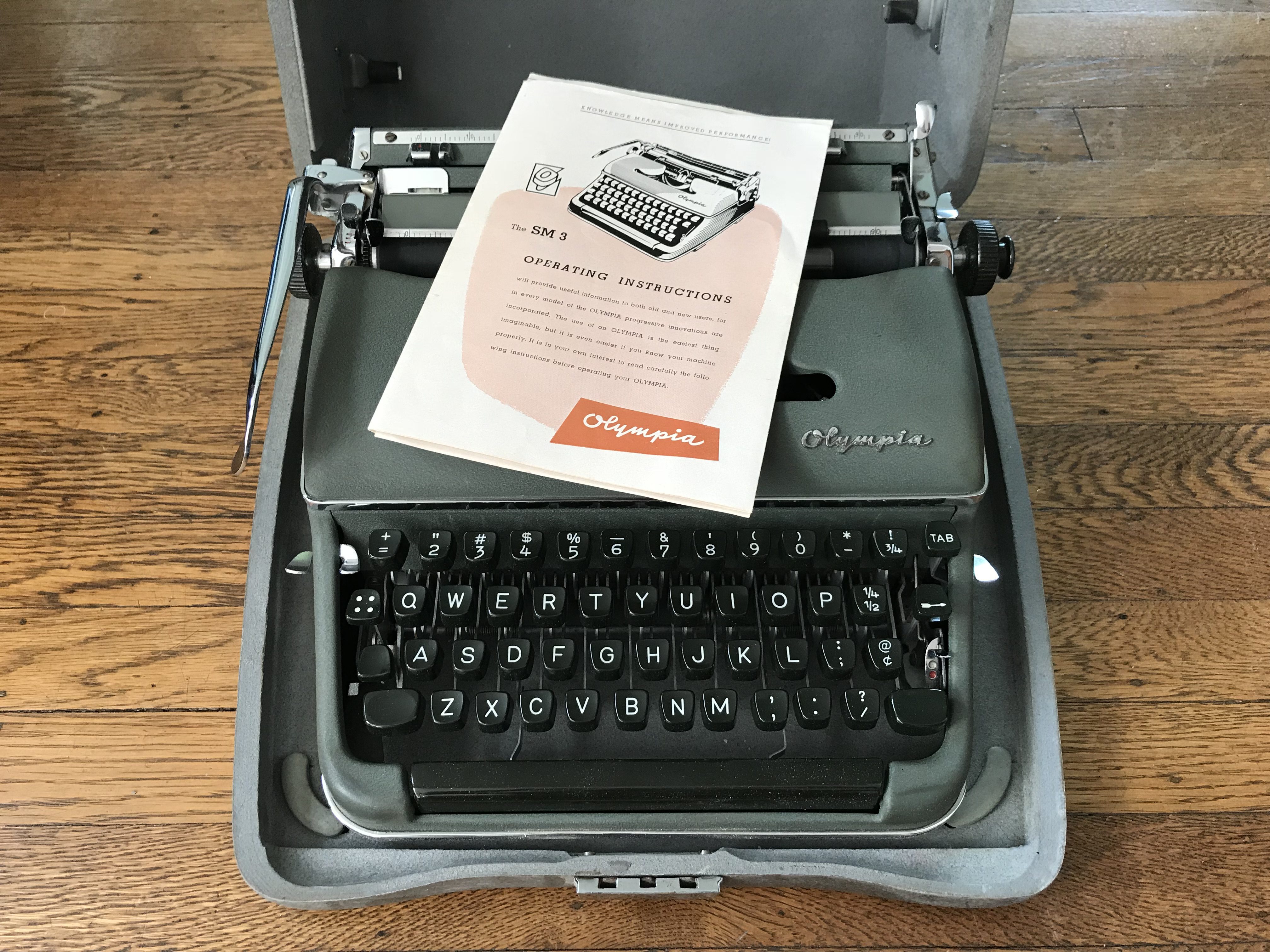
I had picked this up at Goodwill at the end of last summer when I was dropping off a huge load of old clothes and household items.
How could I resist?

Though there is corrosion on the case, the typewriter itself is pristine. I imagine that someone received this Olympia as a birthday present, used it a couple times, and tucked it away in its case where it sat for 61 years. In addition to the user manual, the original German-language factory inspection report was still in the case:

These two 1957 West German typewriters are a nice pair:

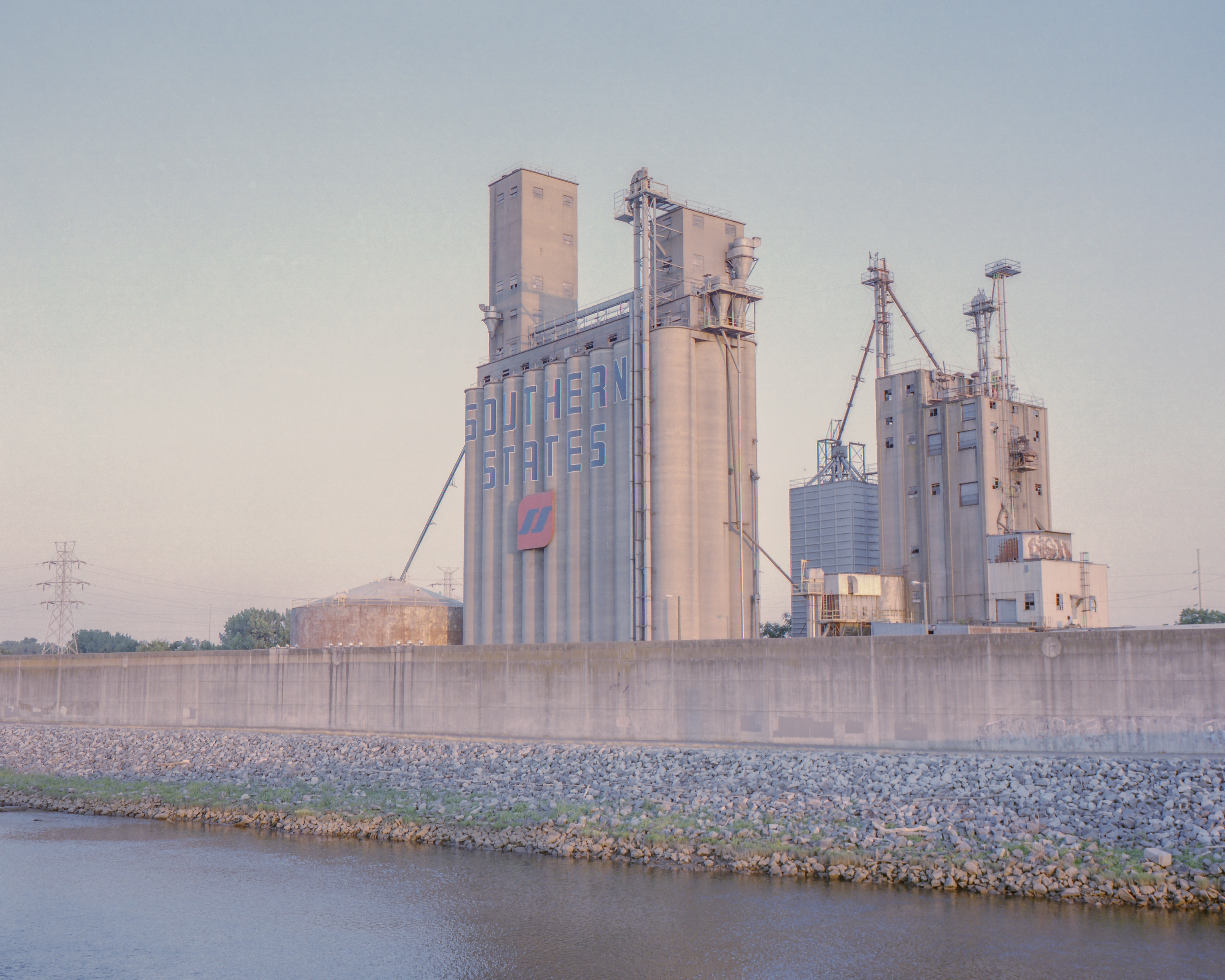
Southern States
I am back in Virginia for the time being, enjoying the strange, wet, tropical summer and its attendant thunderstorms. The weather here is badass.
Here’s a pretty picture from Virginia to end my post. My son took it last summer in Richmond, VA near where the Olympia Robust currently resides.

The Leprechaun: a Wee O’Lympia SM4
I looked at the calendar today and good gravy, it’s almost St. Patrick’s Day! The wheel in the sky keeps on turnin’ – I don’t know where I’ll be tomorrow.
I recently brought home a wee leprechaun, a green Olympia SM4. It’s one of Moe’s. Per Moe: it is broken and not typing and could I fix it for her friend’s daughter?
I brought the Olympia home and sat it on the kitchen counter work bench.
This SM4 looks just like an Olympia SM3 – the difference is the tab setting and clearing keys on either side of the space bar:

Random question of the day: what happened to the Olympia SM6? Did it ever exist? If not, why did Olympia skip from SM5 to SM7? Is it sort of a Windows 9 situation?
Back to business. Here’s the broken typewriter that doesn’t type:
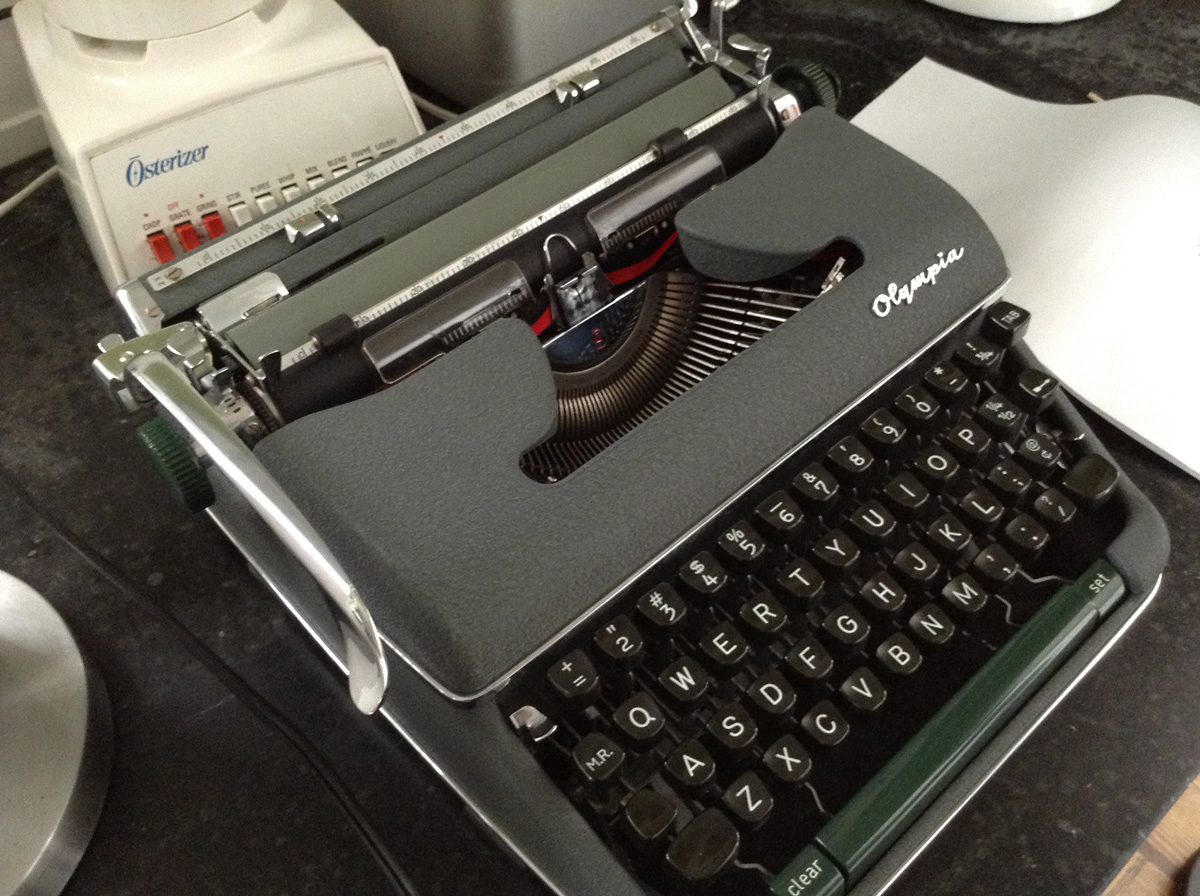
From the Wisdom of Blender:
If the typewriter types not, check ye the stencil setting.
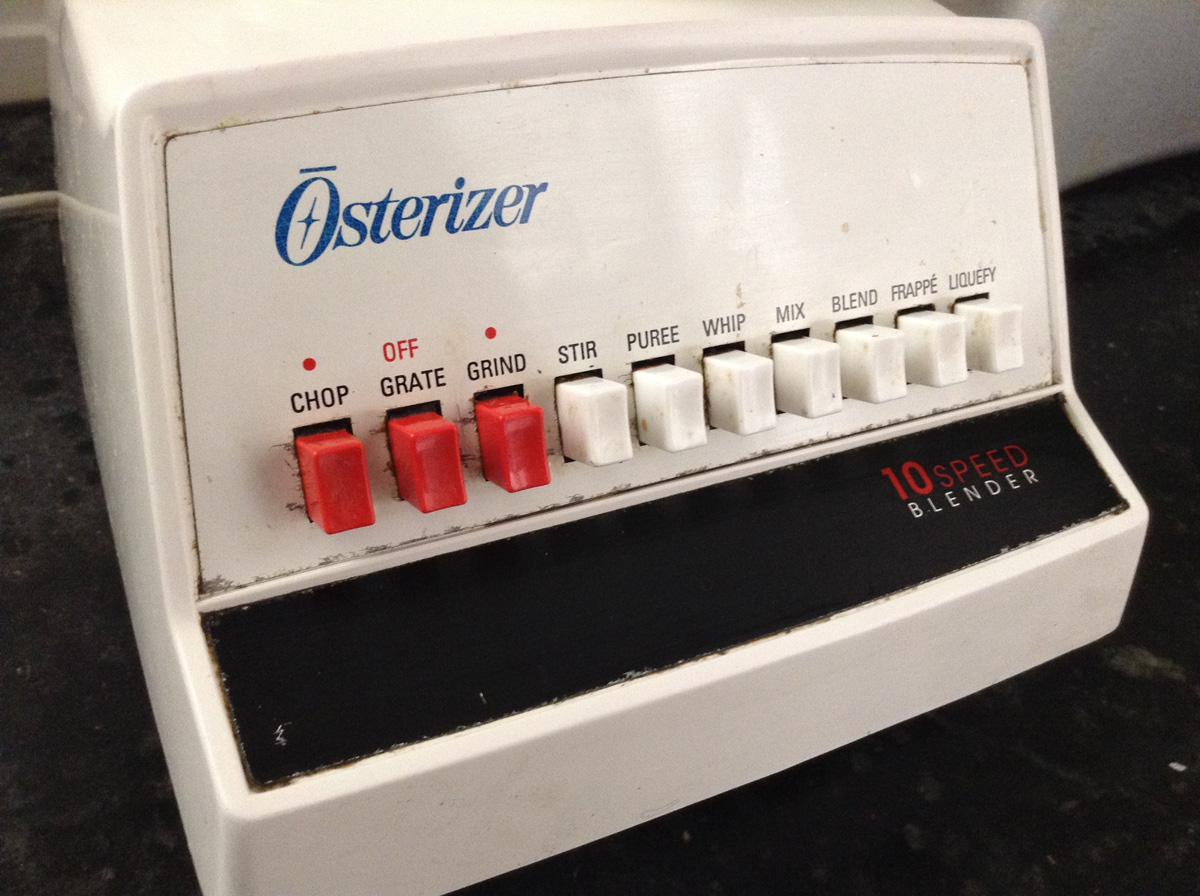
Broken:

Fixed:
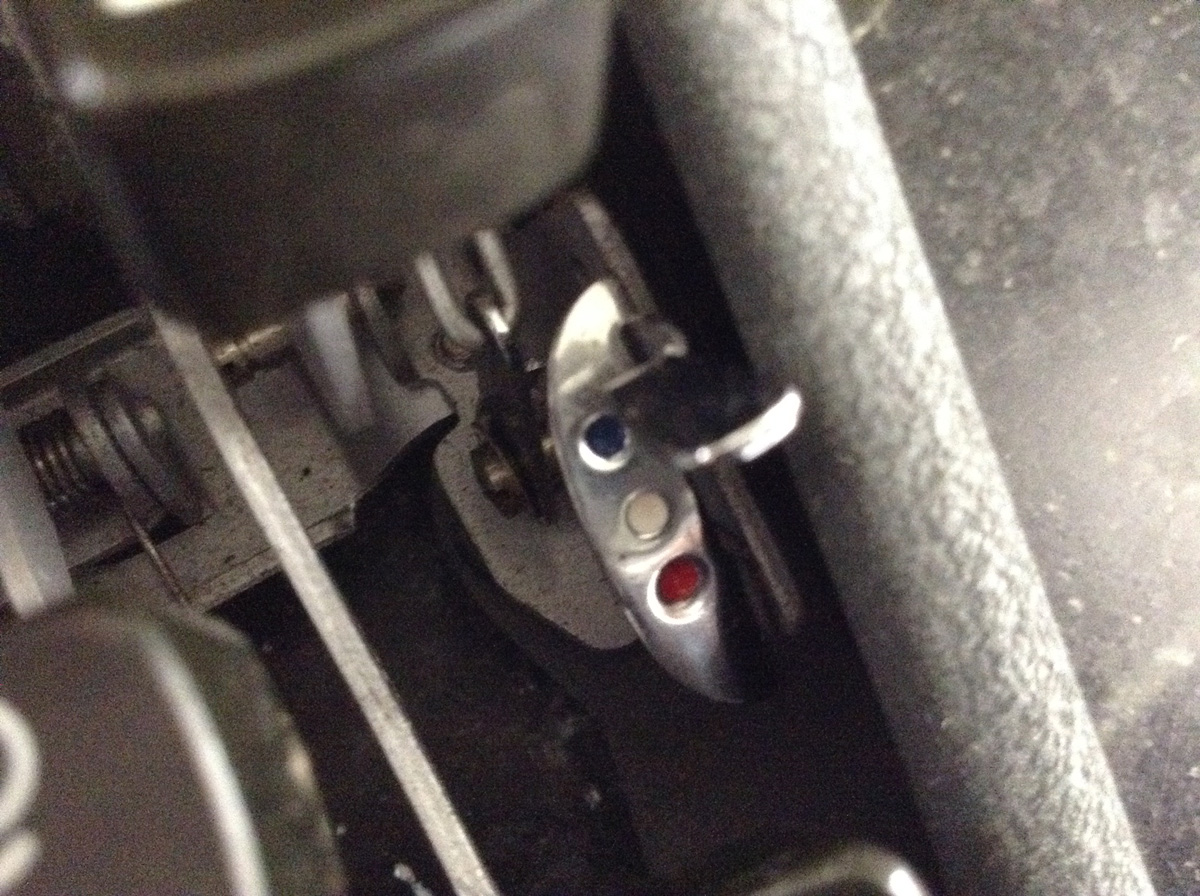
Its only other problem was that the tab “set” key next to the spacebar was depressed and nonfunctional.

I pondered this a bit and considered investigating around back to figure out why the tabbing mechanism wasn’t getting triggered. I thought the better of it since this wasn’t my typewriter and lack of tabs wasn’t going to impair its functionality in a deal-breaking way. I am sort of “Meh” on tabs anyway – to me they are not mission-critical. If I were typing spreadsheets, I’d be helpless without tabs, but this Olympia here will probably spend the rest of its life typing love letters and thank you notes.
I actually have a reference manual on hand: The Olympia SM 1,2,3,4,5, and 7 Typewriter Repair Bible.
This is holy writ compiled by Rev. T. Munk and recently published. He has a whole slew of repair manuals including The Manual Typewriter Repair Bible.
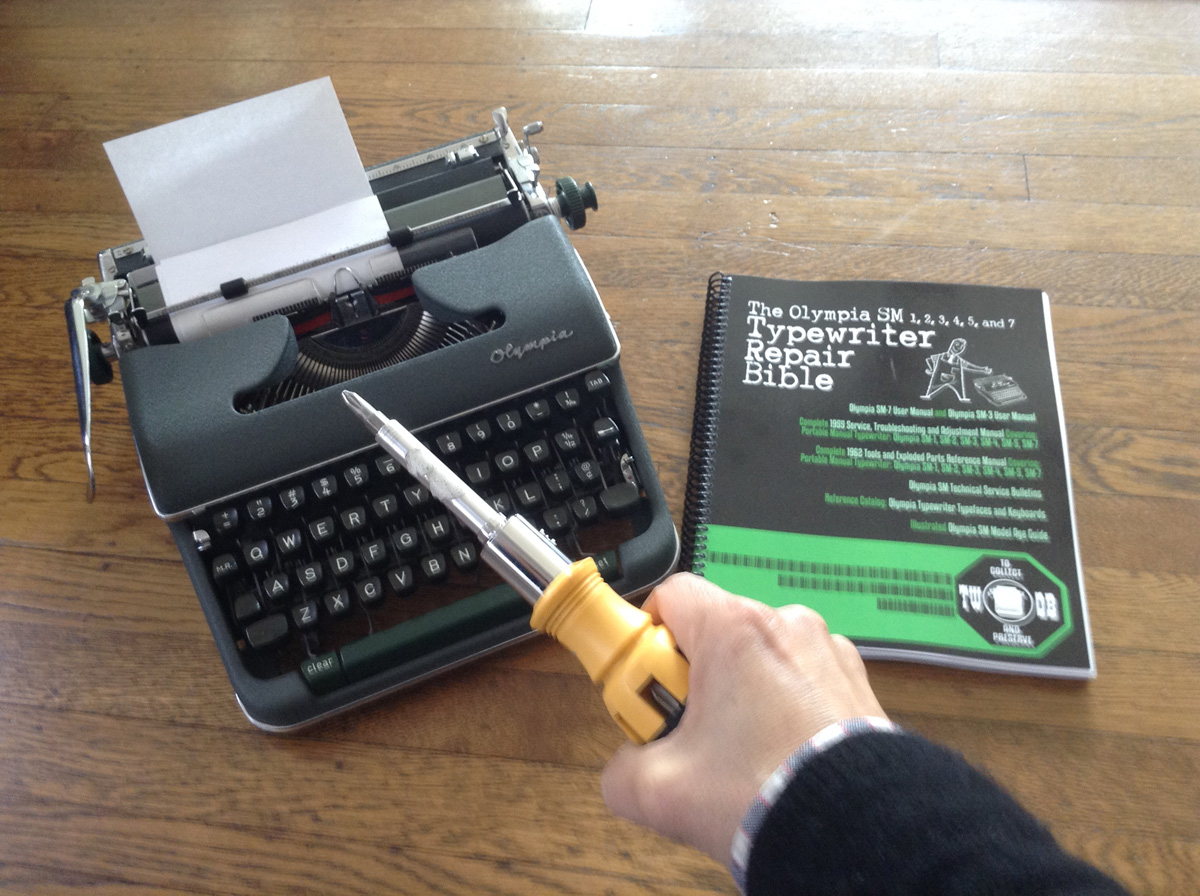
A couple of them have arrived at my house:

I’ve already gotten the Olympia manual all dirty.
These are spiral bound and lay flat while I am working. I like that.
They are a compilation of repair, adjustments, parts and tools manuals as well as odds and ends like this:

Maybe I should get an asbestos board for the kitchen counter.
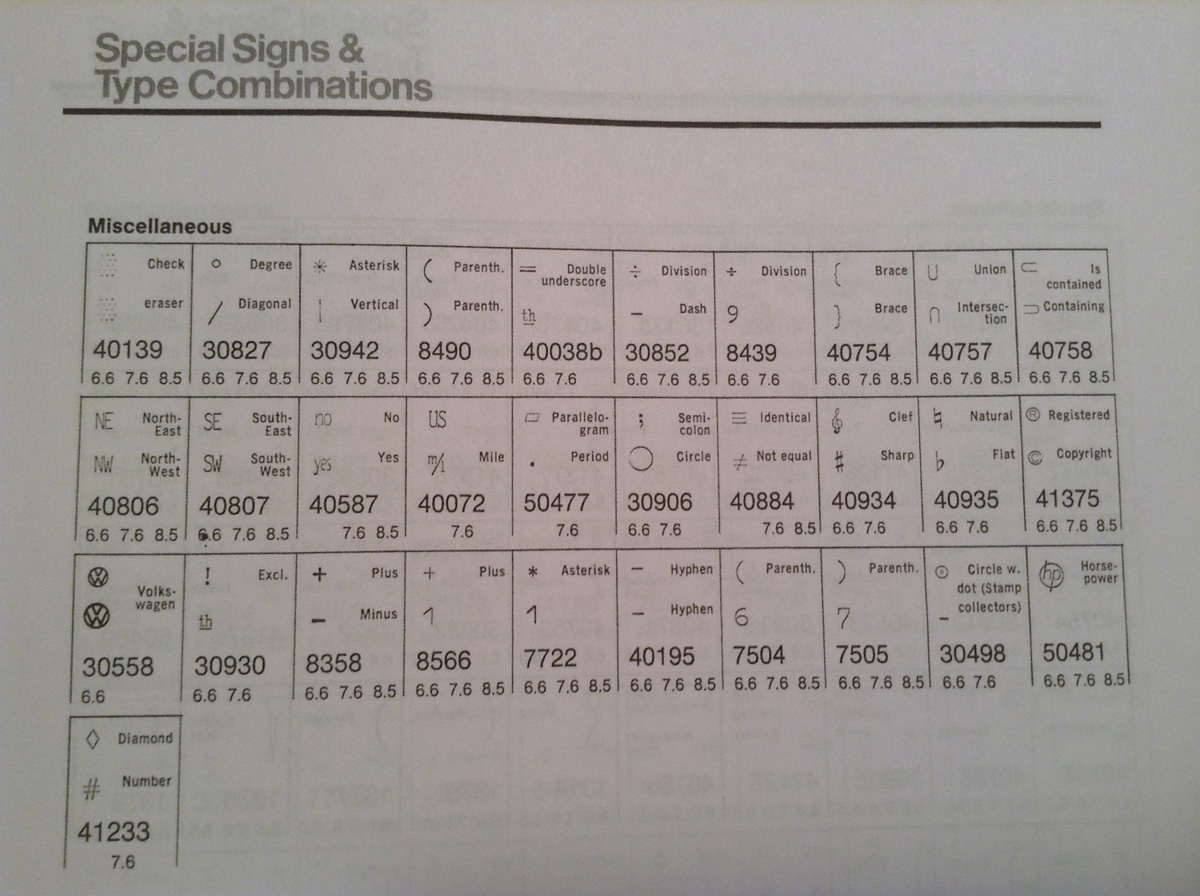
I particularly love the manuals’ type and special characters sections. Here’s a pleasantly confusing mashup typeface I’d like to own:

I also want to find a typewriter with a Volkswagen symbol and horsepower symbol (who knew it looked just like the Hewlett-Packard’s logo?):
Spring has sprung. I took the wee green sprite out in the garden:

Though it doesn’t get very cold here in California, there is a definite change in the air here when spring hits. I found a beautiful old Irish poem about spring ( “errach”) from the Book of Leinster, and in honor of St. Paddy’s Day, the Olympia typed it out. My Middle Irish is a bit rusty, but I do like this translation.

I imagine that this is how someone in 12th century Ireland (or Buffalo) would experience the transition of winter to spring.

Brick House
I have been on the road a lot this winter and when I got back in town, I trekked over to Mozo’s. Moe had a typewriter with problems that needed attention.

This one had been sitting in Moe’s shop since the summer. A lady had bought it recently and she wondered if I could get it to work. The big piece of tape over the “erwoo” of the decal really bothered me. The decal was in terrible shape, but the tape made it worse.
I never get tired of these old Underwoods – built like a brick house. They’re heavy-duty beauties. This typewriter was an Underwood 6, very similar to the Underwood 5s that I have worked on.
The problem with this Underwood was that the carriage tipped from side to side and would get stuck in strange and screechy positions. Perhaps a loose or missing screw or two?
I brought the Underwood home and introduced it to Blender on my kitchen counter work bench.
I played around with it and discovered what was stopping the carriage.

That little arm with a hole in it was hitting the frame.
Thank heavens for Typewriter Database and the detail photography that members submit. John M.’s Underwood 6 had a closeup of the area where the little arm hung and I was able to figure out the little arm fit into a screw pin on the side.
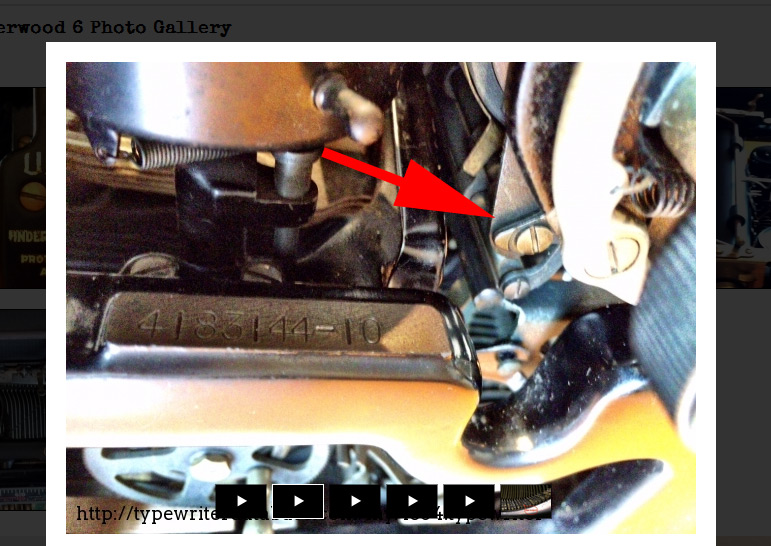
The carriage was very loose and appeared not to be seated properly. I wiggled it bit from side to side and the whole darn thing popped up and out. Well, hell. I didn’t mean to do that, but there you are.

Note Blender’s barely concealed schadenfreude.
The upside was that with the carriage removed, I could clean the internal mechanics carefully and examine the pin area.

There are two springy arms on either side of the carriage that I was having problems understanding.

Fortunately, I remembered a YouTube video of a guy tearing apart an old Underwood, so I got a bowl of cereal and sat down to watch.
Some members of our community may be horrified by the joyful abandon with which Dusty Guy dismantles this typewriter. However, his video series on the Underwood is full of useful details. After watching this video, I understood the springy arms and how the carriage sits on them.
Once everything was cleaned up inside, I attempted to get the carriage back on. I had to temporarily take out the motion blocks on both sides so that I could get the carriage back in and seated properly.

I had to dismantle the right carriage release to get the little arm back in the pin screw.

After the little arm was re-secured with the pin screw, the carriage did not wobble like it had.
I threw in a test ribbon and took a deep breath.
Yes, it was typing. But weirdly. Looks like bichrome mixing colors and…all caps.
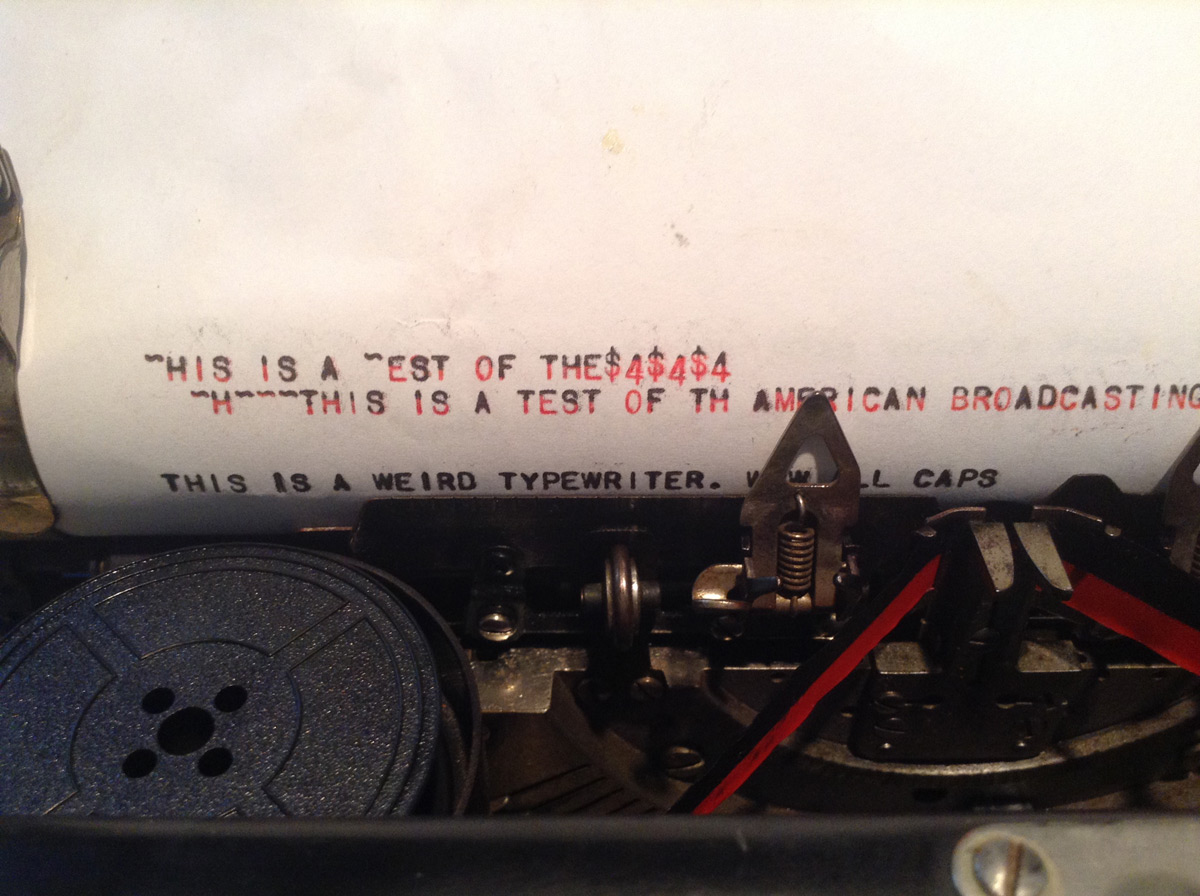
I haven’t had personal experience with one of these telegraph typewriters. Here is an interesting article on the Cambridge Typewriters blog about an Underwood #3 telegraph typewriter. I read ETCetera magazine’s June 2013 article by Peter Weil, “Ephemera” about typewriters and telegraphs. He writes:
The term “mill’ is used to describe a typewriter that is used to create typed messages for the purpose of entering the message into a telegraph system or to convert a message received telegraphically into a typed hard copy message.


The typewriter has a degree character as well as a “Do” character. A commenter on my blog said:
‘Do’ is short for ditto, now most often represented by a double-quote. Used most often in columns of dates that repeat.
Also of note, Mark. P’s Western Union Underwood has this date, “Aug 18, 1903”, stamped into the typebar rest – and so does mine:

And there is a Reddit poster who noted the same thing on his Underwood 5 Mill.
Do all old Underwoods have “Aug 18 1903” stamped at the end of the typebar rest – or just these telegraph typewriters?
Well, what a neat surprise.

I took the Underwood 6 back to Moe’s shop with care and feeding directions attached.

Moe asked me to work on an Underwood 5 she just got, but I told her that there was another typewriter I needed to work on before I could start the Underwood 5.
You see, I did a service check at The Shop at Flywheel Press last week. They were having their annual Valentine’s Day Love on the Run community event the next day where they bring out typewriters for people to write love letters on. All the typewriters needed to be in tip-top shape for the event. I went through each, re-threading ribbons, unlatching carriage locks and disabling stencil settings. They were all in very good shape despite constant use at kid camps.

Jenn at the shop showed me a new acquisition that she had found in a garage. Oh my goodness.
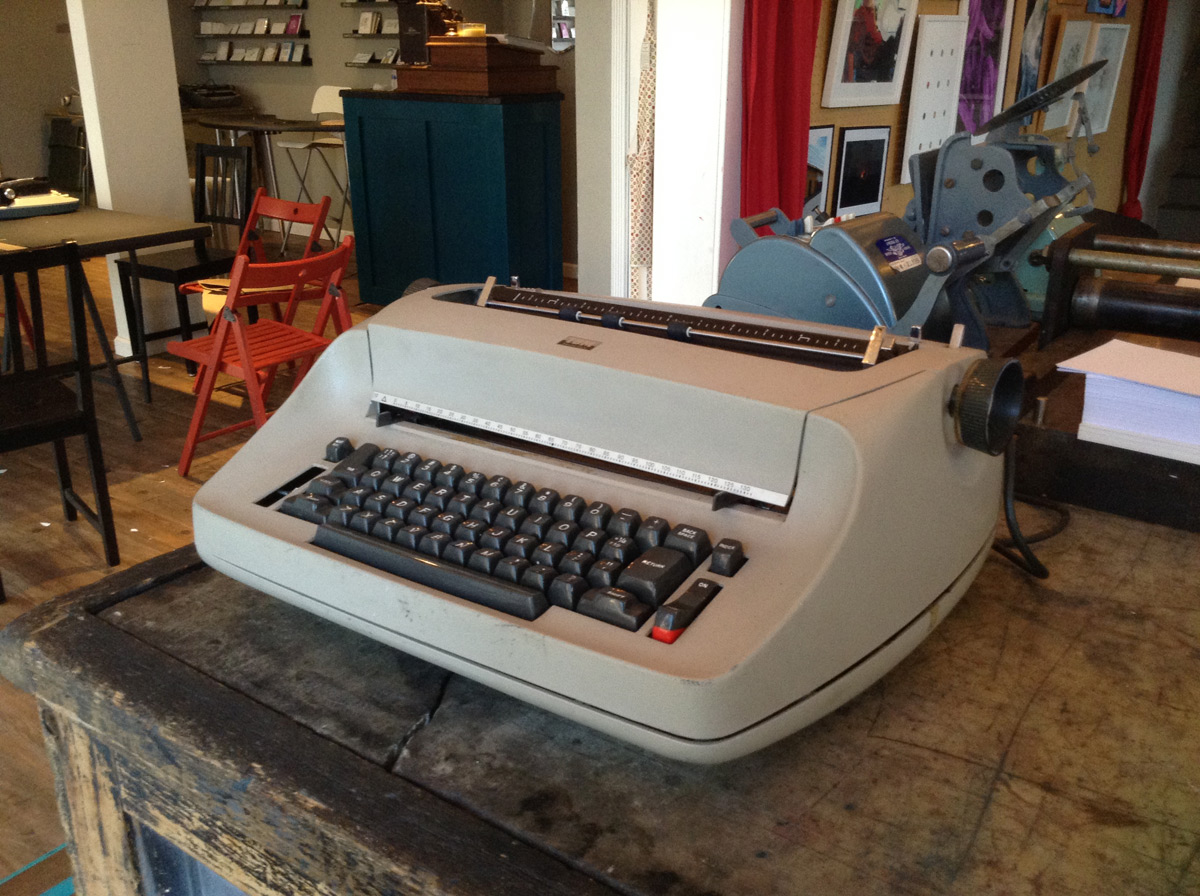
It powers on but doesn’t type. I wonder if everything is there.

I have always wanted to try my hand at a Selectric, and now this has fallen out of the sky. Charmed life. Now that I am finished with the Underwood 6 mill typewriter, I am going to play with this Selectric a little. I hope I can get it to run a bit.
Valentine’s Day was yesterday, so I leave you with a tender love song from the Underwood 6:


The Really Big Typewriter and a Send Off
My blog has been on hiatus for the last few months while my family makes a slow-motion cross-country move to Northern Virginia. I am focused like a laser beam on tasks related to the move and new house and have been trying to avoid distractions and temptations (typewriters).
The Virginia house is a lot like a really big typewriter. It has lots of moving parts and I am learning something new each and every day.
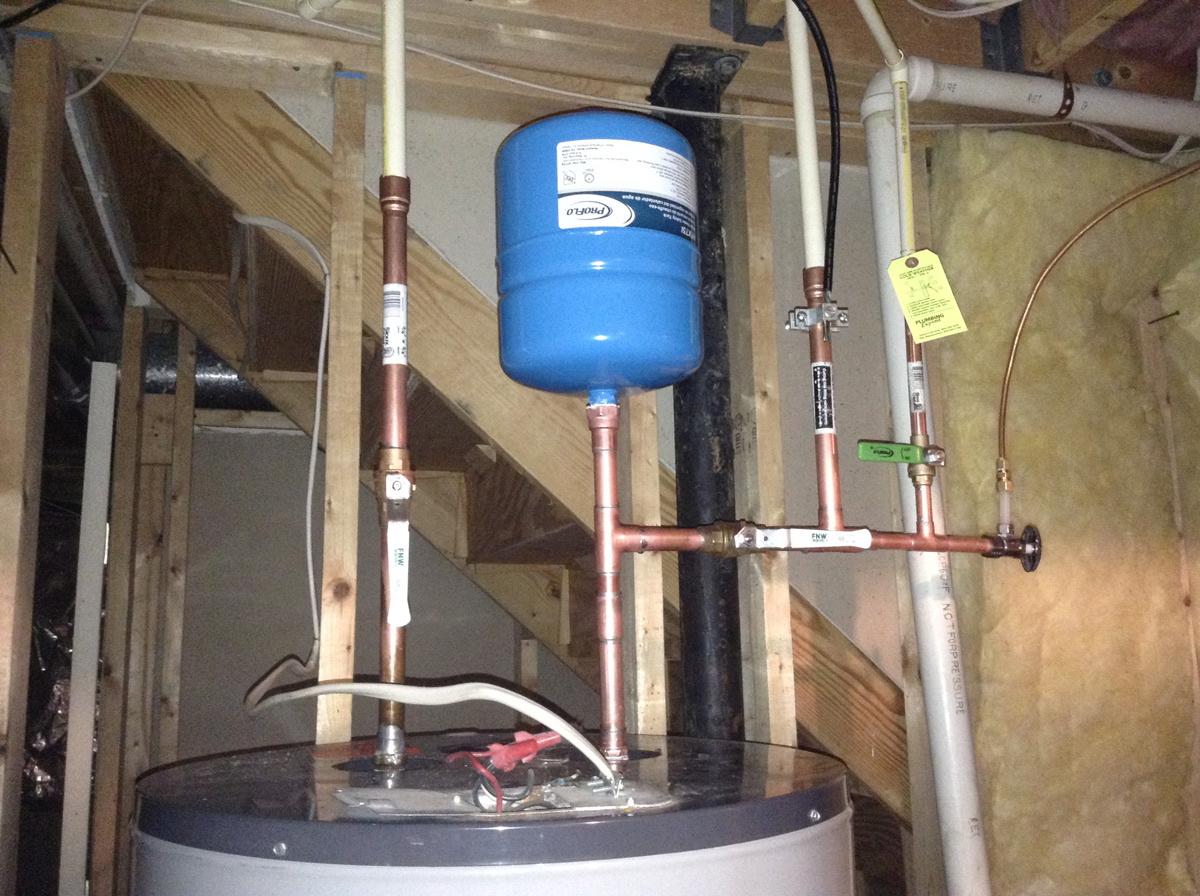


I have been shuttling back and forth between California and Virginia for the past three months, working on the Virginia house. I really don’t want to be That Lady, but there are some updates and modifications we’d like to make before we bring in our familiar junk and make ourselves at home. I am home-making.
The Virginia house is full of period details from the 1990s that I am trying to tone down: acres of high-gloss honey oak and brass accents. This enormous ceiling fan that came with the house is mesmerizing. It’s like a rare plant of the Amazon that blooms once every hundred years and emits a corpse-like scent. It’s so weird, it may need to stay.

So I am out here in Virginia, trying make this house home-ly for our family – a comfortable setting for all our weird junk. My skills are limited to demolition, insulation hanging and painting. I like to paint and my favorite medium is rattle-can Rust-Oleum:


I am trying to make two rooms out of one. Sometimes I feel like Gob Bluth: “I’ve made a huge mistake.”
The Olympia Robust joined me on this trip as a carry-on and kept me company in the garage while the floors were being refinished.

Fire extinguisher at the ready in case the Robust overheats
The Robust appears to have spent some time rethinking the past. It seems to have experienced some sort of spiritual conversion:


We are all on a journey, and our paths often lead to unplanned destinations. Yesterday the Robust journeyed to Richmond, VA where it will be rotated into exhibits at the Virginia Holocaust Museum.
I drove down to Richmond, VA with the Olympia Robust as co-pilot. I have not been there in 30 years and was amazed at the city’s funky transformation.


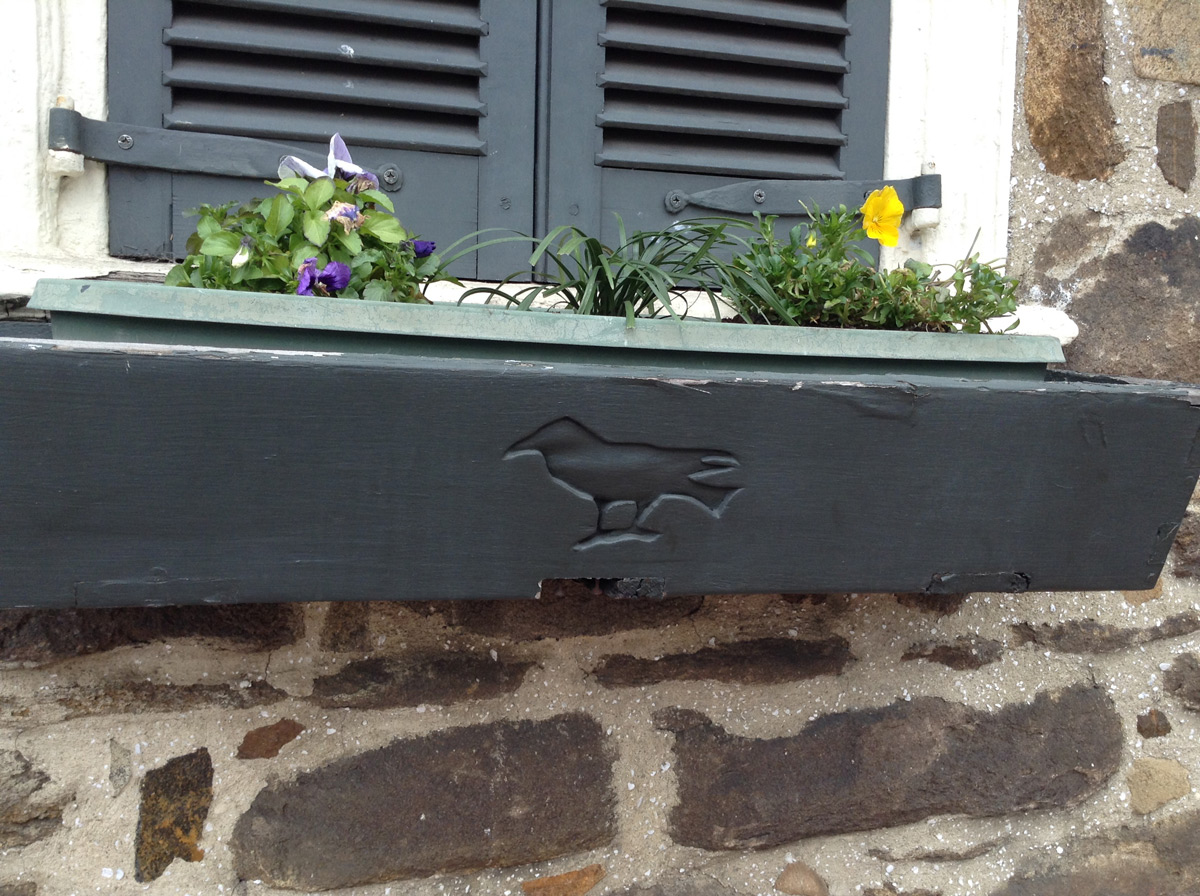
This is a window box at the Poe Museum featuring my favorite type of bird, a corvid:
The Virginia Holocaust Museum is located near the waterfront in an old part of town:

Weirdly (and I didn’t plan this) I dropped off the Robust at the museum on International Holocaust Remembrance Day which takes place on January 27—the anniversary of the liberation of Auschwitz-Birkenau.
I met with the museum’s Assistant Curator, Angela, and we brought the Robust to the museum’s collections workspace where it will be processed. I filled out the paperwork and kissed the Robust fondly goodbye.

After the drop-off, I met my son and his girlfriend for lunch and reminisced about the good times with the Robust and celebrated the fact that the typewriter was now in a good place.
I drove back to Northern Virginia and sang loudly to the radio.
Farewell, re-born Robust! Before we parted and the Robust embarked on its new life, it typed out this:

The Royal Happy Halloween (HH)
It’s October and here in the US that means Halloween. I’m not much for the scary, gory stuff, but I do like a cheerful jack-o-lantern or two. And I like all the candy that I steal from my daughter’s trick-or-treat bag.
My neighbor’s Pac-Man ghosts are pretty swell.

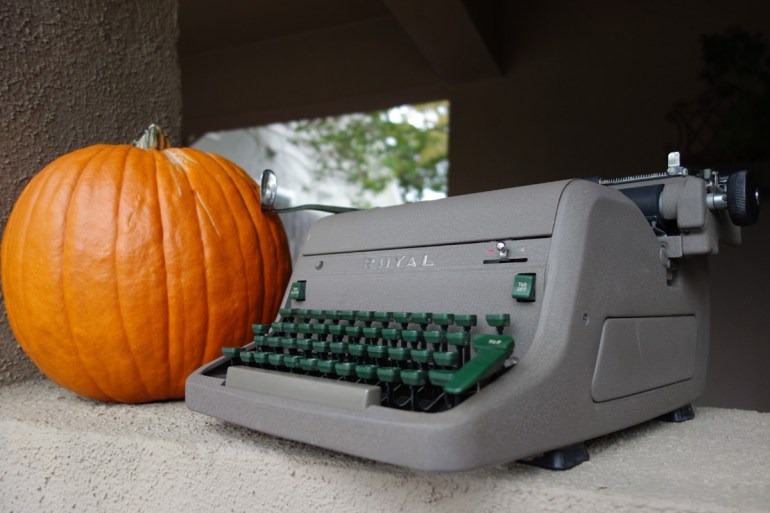
And now as the leaves have started to fall, Moe from Mozo’s gave me a call. A friend of Moe’s had a Royal HH that needed a look-see. I brought the HH home and took it out to the back patio to investigate.
1952 Royal HH
HHE-4815786

By serial number this typewriter is from 1952 – the first year the Royal HH was manufactured. The serial number is under the carriage on the right side. You can see it if you pull the carriage way, way over to the left:

It wasn’t too bad: a little gummy, a little dirty on the inside. Its worst problem was that it was cursed with one of those awful black and white correctable ribbons. The horror!

The first thing I did was cut that thing out. So much better:

I blew the inside out carefully with my Datavac Duster:

Despite being a nondescript muddy gray, this HH has wonderful style – the lines are very appealing.
I assembled my supplies for cleaning:

- Old rags
- Mineral spirits in a jar for scrubbing the slugs and segment
- Soft Scrub for cleaning the platen
- Goo Gone for cleaning the key tops
- a stiff tooth brush for slug scrubbing
- a paint brush for applying mineral spirits
- Q-tips to cleaning sticky eraser crumbs and gunk
- a bamboo skewer for getting into tight spots
- a fresh ribbon to rewind onto the old spools
After draping the shell carefully with rags, I scrubbed the type slugs and segment with mineral spirits. After a first cleaning pass, the typebars were all swinging easily.
I then wiped out the eraser crumbs, gunky fluff, and correcting tape dandruff with a lightly damp rag and Q-tips. I vigorously scrubbed the platen with Soft Scrub to remove embedded white of the correcting tape.

The keytops had the frost often seen on Royals of this vintage. A lot of people call it mold or fungus, but I think it’s a chemical precipitate that affects plastics of the era. That sounds xtra-science-y.


I wiped the key tops down with Goo Gone and the white coating came off.


The old metal spools are the distinctive Royal style. I wound new red and black ribbon onto the old spools and tested.

Lovely! When I first started typing, the left margin was a little “soft”, returning irregularly to the left. I find that Royals often exhibit this behavior. Fortunately, the erratic left margin seemed to work itself out with exercise.
The Royal HH has a “carriage control” knob. Here is the description of carriage control from the Royal HH manual:

I played with it, turning it up and down and felt no difference. Perhaps the machine needed more cleaning to appreciate the subtleties of the control.
T. Munk posted recently about a similar feature on Royal portables of the early 50s.
Moving on, here’s a picture of Herb Caen, a well-known San Francisco columnist who swore by his “Loyal Royal”.

San Francisco Chronicle newspaper columnist Herb Caen in his office at 901 Mission Street in San Francisco May 1994. Photograph by Nancy Wong (Own work) [CC BY-SA 4.0], via Wikimedia Commons

“Loyal Royal,” typewriter of Herb Caen, longstanding columnist of the San Francisco Chronicle, on display in the lobby of the Chronicle Building on 5th Street in San Francisco, CA. By Uyvsdi (Own work) [Public domain or Public domain], via Wikimedia Commons

If this HH had had a dirtier shell, I would have pulled out the Scrubbing Bubbles and a tooth brush and cleaned the crinkle paint exterior. However, the HH was pretty clean to start with. I only needed to wipe down the outside with a damp cloth. Here she is, sitting pretty on my front bench.
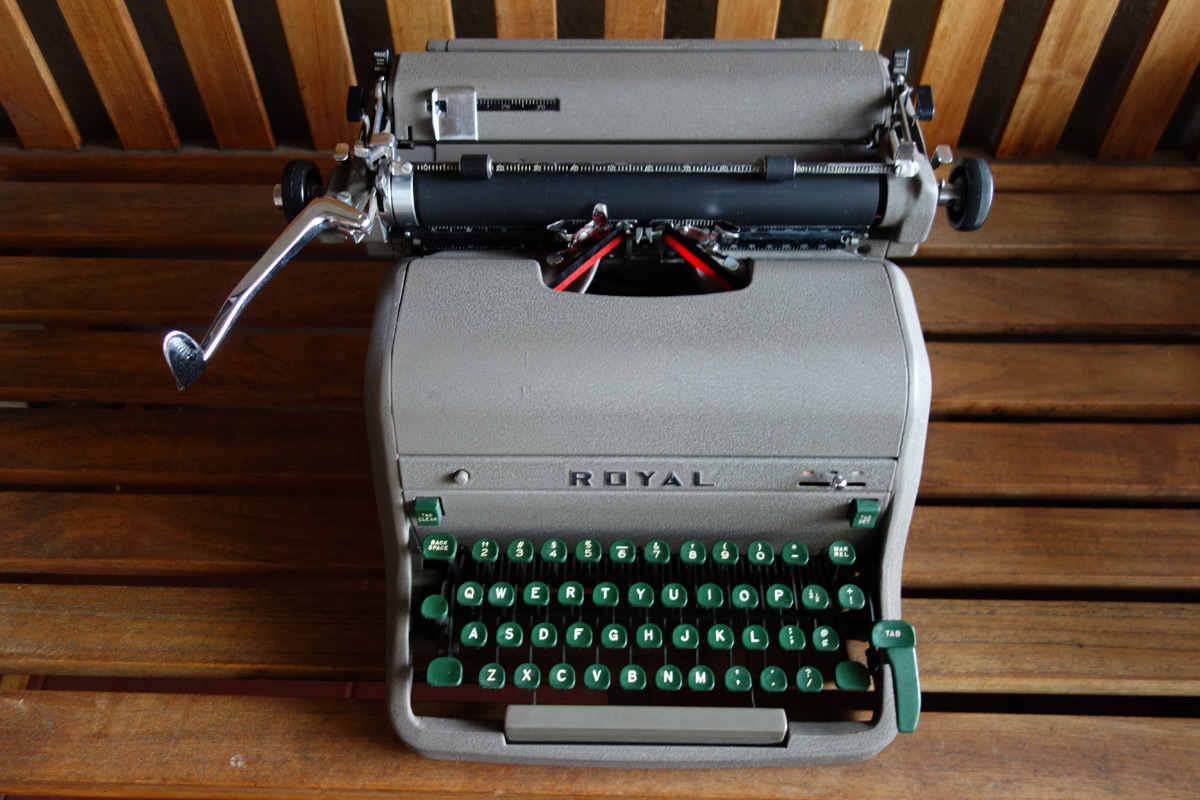
I am going to call this model a Royal Happy Halloween from now on. I have heard tell that the Royal HH was named for Henry Hart who patented the Magic Margin for Royal in 1938. HH could also stand for Hello Handsome, Head Honcho, Heigh Ho, Hip Hop, Holy Hell, Happy Hunting and more. Happy Halloween seems appropriate for this time of year.
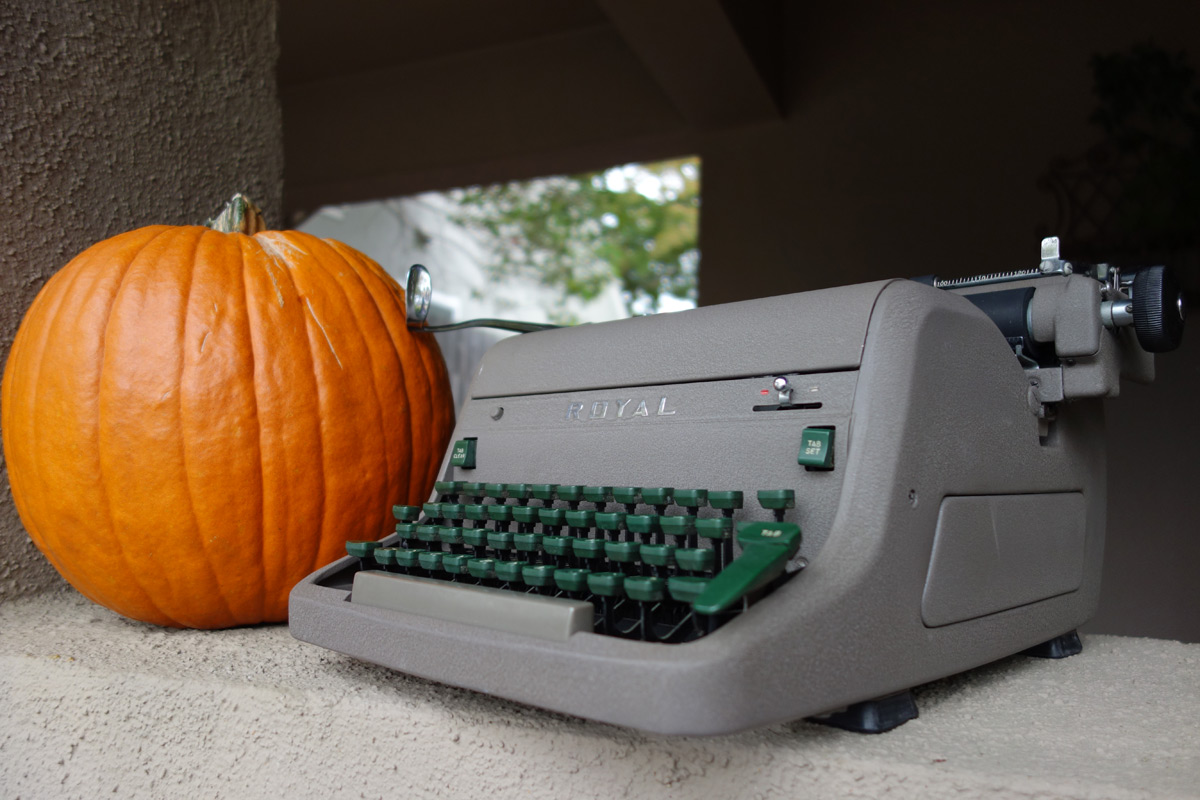
I took the Royal HH back to Moe’s with care and feeding instructions. I am sure that the lady who owns it will now be able to hammer out The Great American Novel. What a sweet machine.
Postscript
I got an email from Jenn at the Shop at Flywheel Press and she just got a new typewriter for the Shop. It had belonged to a friend who moved to Hawaii and couldn’t afford to bring the typewriter along, so she gave it to Jenn. It wasn’t typing and Jenn thought maybe it had a carriage lock engaged. I went over to scope out the situation.
When I arrived at the Shop, Jenn was conducting a kids camp. I could hear the happy tappity-tap of typewriters as I walked in. Heart-warming!

Here’s the new girl. Really, another HH! I call this one a Royal Hardly Hawaiian (since it didn’t make it off the mainland).
After poking at it a minute or two, I determined that the margins had been set close together so the carriage couldn’t move. Damn you and your mysterious hidden workings, Magic Margin!
I got the margins in order and strung a new ribbon on her, and soon she was typing away happily. I’ll be back to give her a good clean and enter her into TWDB.
I strolled around the Shop and checked the other typewriters. One or two had ribbon issues which were soon remedied, but all were typing. My cheesy fixes like the duct-tape clevis repair and the paperclip spool spindle ARE STILL FINE despite all the little kids hammering on these typewriters.
Looking good, ladies. Til next we meet.

Pleasing Symmetry
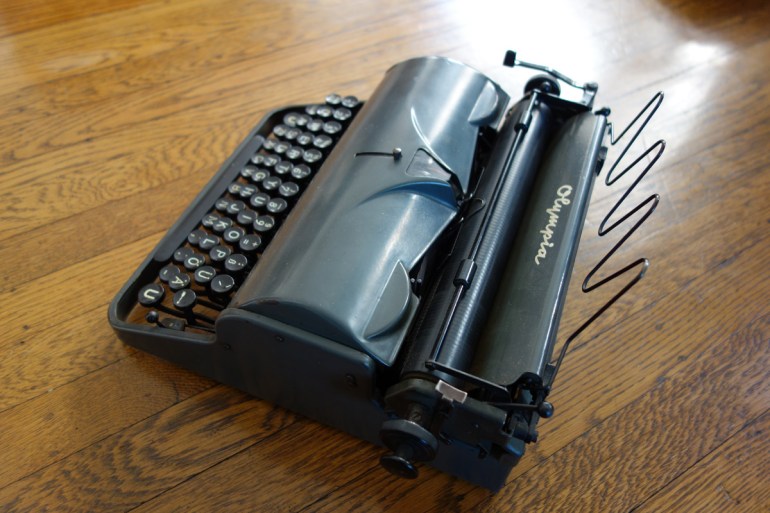
The Olympia Robust had been on my mind ever since it first arrived at Moe’s shop. I took some photographs of it in situ for Typewriter Database:
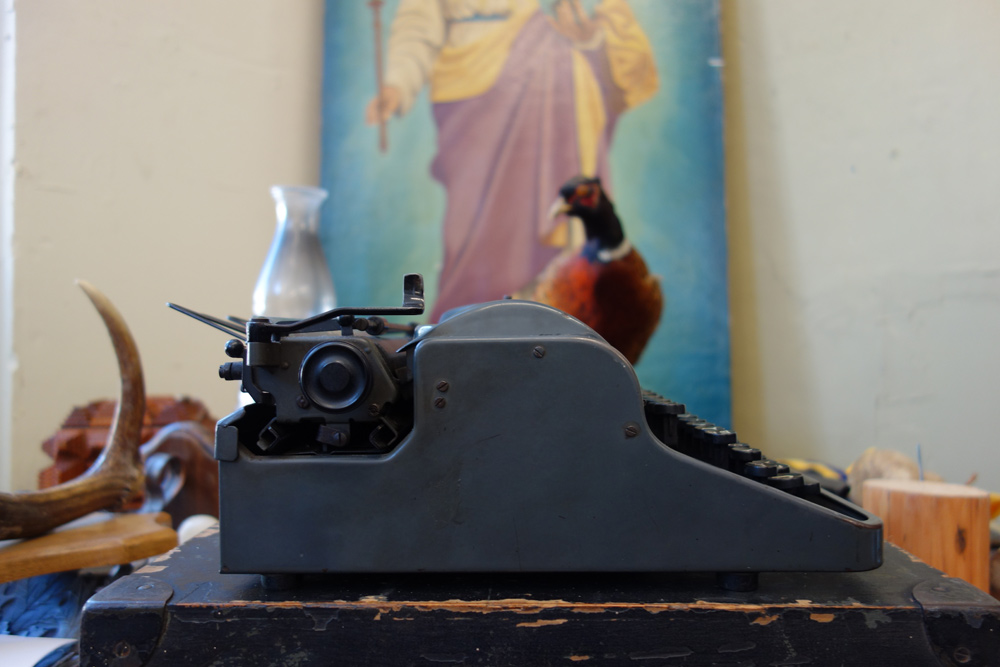
Deer antler, tramp art, oil lamp, Jesus, stuffed pheasant…Olympia Robust.
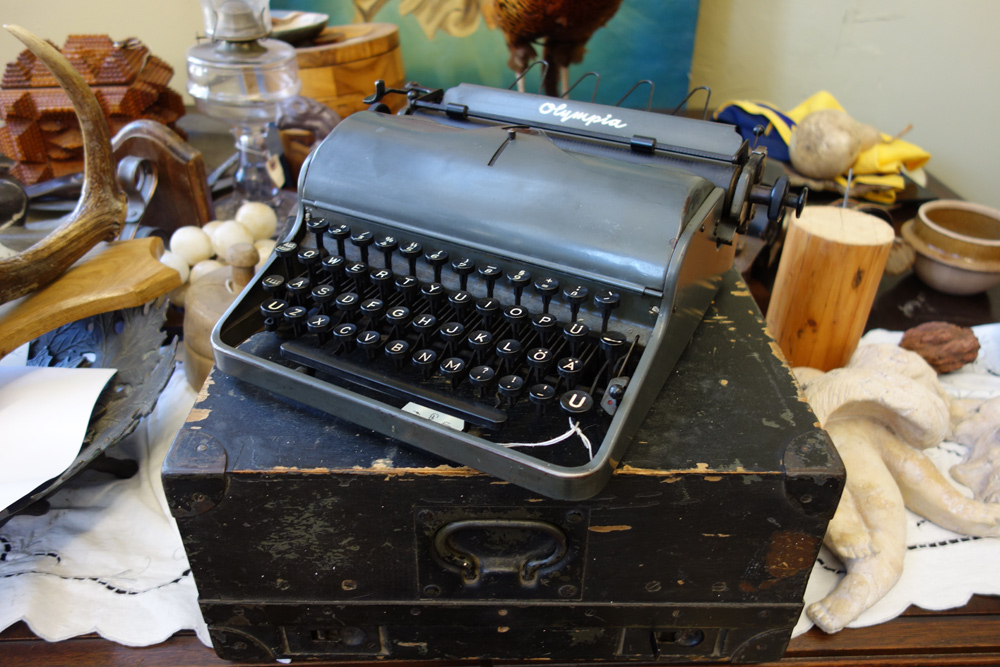
It bothered me to leave the typewriter at Moe’s shop. Not only was it at risk of getting damaged, but I worried it may be collected for weird reasons. The more I ruminated on it, the more convinced I became that the typewriter should not go to a private collector.
So I took it into protective custody and brought it to my place for the time being. Moe was relieved about that. She was worried about it getting stepped on.
I am offering temporary shelter to the Olympia Robust – it can’t stay in my home too long. I’m concerned that it might catch what the Praxis has.
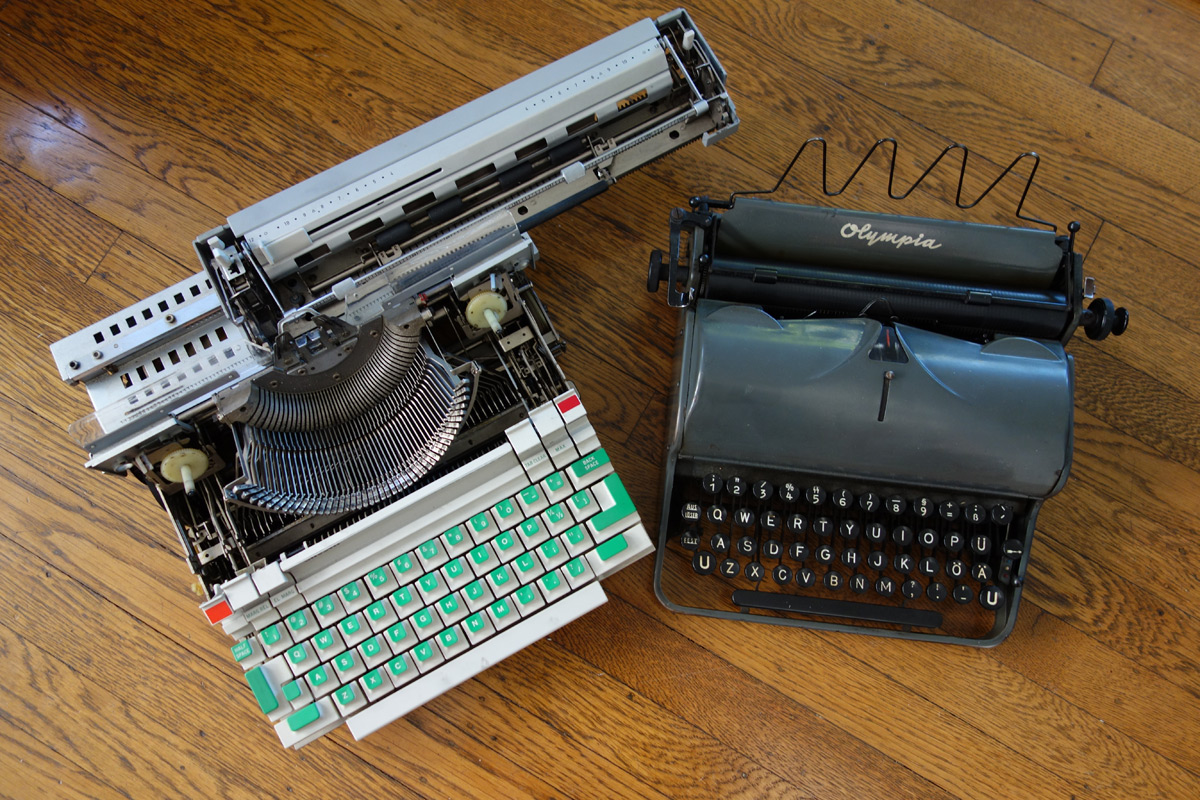
I went in search of a permanent home for the Robust. The internet did not disappoint. After a little digging, I found a Holocaust museum in Richmond, Virginia that was requesting donations of objects from the period.

What I liked about this museum:
- extensive community education program
- open 7 days a week
- FREE admission
- great Yelp reviews
I got in touch with Tim, the director of collections at the Virginia Holocaust Museum. He and the assistant curator agreed that the Olympia Robust would be a good addition to the collection for rotation into the exhibits.
As part of the museum’s collection, the Olympia Robust will be available to anyone who may want to examine it (typewriter types, history buffs, ordinary curious people). Tim says that the museum is developing a searchable online archive of objects in their collection that the Robust will become a part of.
I’m flying out to the DC area in December and will take the Robust as carry-on luggage. Once in DC, I plan to drive the typewriter down to Richmond for the hand-off.
This turned out really well. This particular typewriter’s story has a pleasing narrative symmetry – or at least a very satisfying balance in beginning and end. While I don’t think inanimate objects can experience karmic retribution, the sprinkling of poetic justice and side of situational irony gives me a chuckle. This typewriter, made in its past life for the SS, will now be used as a tool for education and as prevention against future atrocity. It really does make me laugh (righteously, of course).
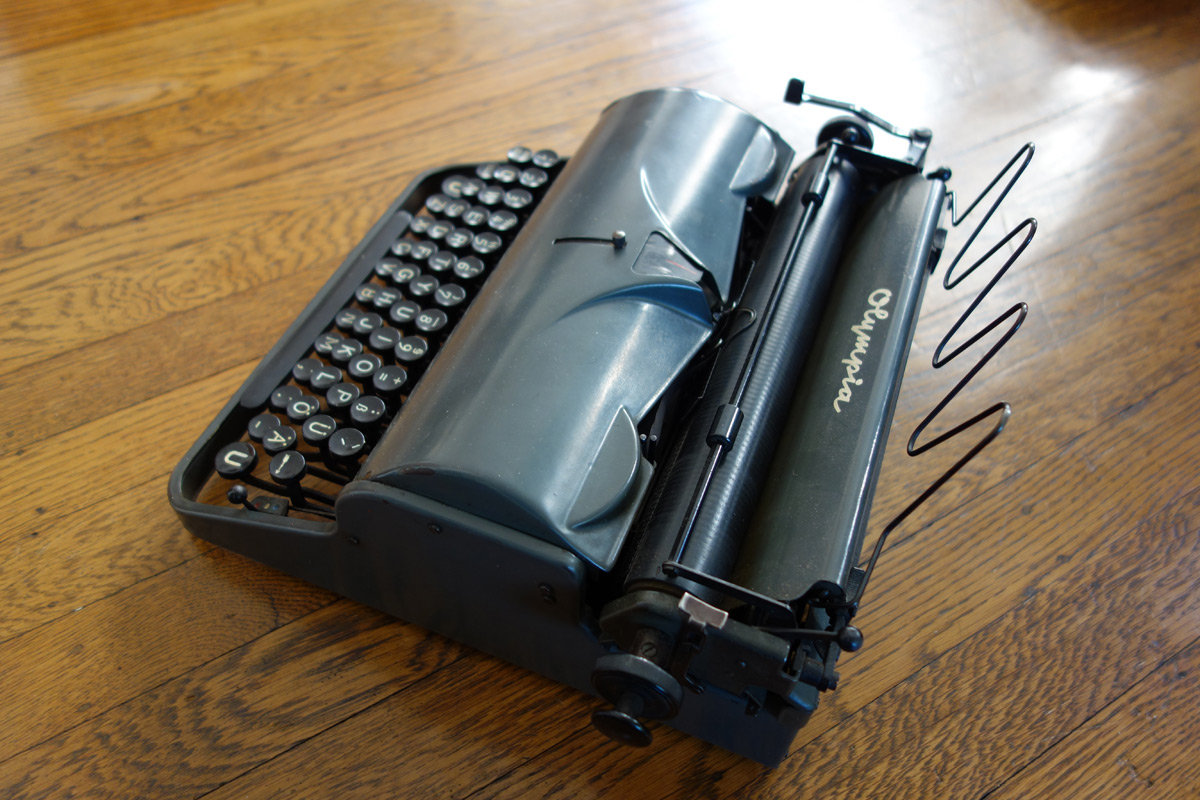

Difficult History: Olympia Robust
I have been wrassling this week with an Olivetti Praxis 48 that I have fixed once already. I bought it off of Craigslist last year, fixed it and gave it to the Arduino Kid (son of Roia who works at Mozo’s shop down the street)

Roia and Dog. This dog has one eye that pops like Marty Feldman’s.
I brought the Praxis home last week with its jammed carriage:

The Chewbacca mug mistook the Praxis for the Millennium Falcon and came over to see if he could recalibrate the hyperdrive motivator.
I removed some loose hinge pieces that were dangling inside, plugged it in and it worked. For a couple minutes. Then it was jammed again.

And that led to:

So I was sweating and swearing at this technological marvel when I got a phone call from Moe at Mozo’s. She got some new typewriters including a really cool Olympia that I just had to check out. So I walked over to the shop.
Lord.

In pride of place next to the Tonka Winnebago
On the floor, Moe? Really? With case open for stepping on?
And of course, it was One of Those.

Moe didn’t know. I pulled her over and showed her the SS key.
1943 Olympia Robust
serial number 470745
The typewriter is functional. The carriage feels a little loose and the typed imprint on the right side is a little light, but it’s typing.


The case is wooden, a faded blackish-green with a German instruction sheet pasted within it.

The typewriter has a QWERTY keyboard and German characters. My guess is that this was a US soldier’s war booty and that when he returned from overseas, he had the Y and Z placement switched.

The “front panel slide” (“schieber im Frontblech”) is mysterious. I can’t figure out what it’s supposed to do though it does obscure what has been typed. Would the slider have protected the delicate mechanics out in the field?

A lot of people have mixed feelings about these SS rune WWII typewriters. There have been lively discussions in typewriter forums about the ethics of owning an SS rune typewriter. I wish I could say something deep and meaningful about artifacts of difficult history, but I am coming up short.
I wish my father were still alive; I’d love to get his take on this typewriter. Born in 1918 at the end of the first world war, he was a US Army serviceman during the second world war. He was an expert typist and bookkeeper, skills that did not go unnoticed by his superiors, and he diligently typed and kept the books through the war. I imagine he would have studied this Olympia Robust with great interest. It is the machine of his German SS counterpart, possibly a wartime clerk like himself, who used it to type up requisition forms for canned peaches – or status reports from death camps. We don’t know.
My father had a taste for the absurd and he framed his WWII service portrait in a WWI German commemorative frame he somehow came across. It says around the frame: “Zur Erinnerung an die grosse Zeit – 1914-1915” (Memento of an Important Time, 1914-1915)

I feel my father would have regarded this typewriter as a reminder of how war is absurd and monstrous – and full of the workaday. It’s really hard to orchestrate organized, large-scale evil-doing without clerks and paper pushers. You need a good typewriter too.
We Americans like to think of ourselves as “the good guys” though we are not as morally superior as we’d like to think. US history has some very dark chapters, and that difficult history should make us a bit uncomfortable. That discomfort should prod us toward a better future.
This Olympia Robust typewriter is a piece of difficult history, an object from a dangerous time and place. I really wouldn’t want the Robust to go to someone who acquires it as a fetish – an object of dark magical power. I’m hoping that it will find a home with someone who appreciates the significance of its history in a matter-of-fact way and who will preserve it and share it as a reminder of a terrible time in the world. Cue Santayana: those who do not remember the past are condemned to repeat it.

I’m with the Band: Confessions of a Procrastinator
It’s Labor Day holiday in the US, the day we celebrate the American worker and give Summer a long, wet, beery goodbye kiss and think back over all the fun we’ve had during the past three months. Tomorrow we’ll put away the white slacks and flip flops and get back to school and business.
It was in a nostalgic end-of-the-summer mood that I re-read some of my past typewriter blog posts, and I had to laugh at the tone. My typewriter repair posts can seem like self-congratulatory, unstoppable marches to victory. It’s never that way.
It is time to spread out the dirty laundry of my to-do list. Now that summer is over, I need to get serious. I really don’t know how this happened. I have somehow accumulated a collection of partially dismantled typewriters that desperately need help. Here they are, begging for my attention.

Neglected while I was off gallivanting with the Boys of Summer
Paul the 1959 Royal FP
The good-natured, hard-working 1959 Royal FP is in terrific typing condition – it may skip for some people, but that’s their problem. I have removed some of the panels for sandblasting and powder coating. I ordered pink powder coat paint for the top cover, paper table and front panel – and then I lost my nerve. Did I truly want to pinkify a dignified old FP?

Ringo the 1913 Oliver 5
Everyone’s favorite – the sweet and unassuming 1913 Oliver 5 came as a matched set. Good Neighbor Brian has Ringo’s twin, but I kept Ringo because he’s in pretty bad condition with lots of rust. I took off his carriage and haven’t gone any further.

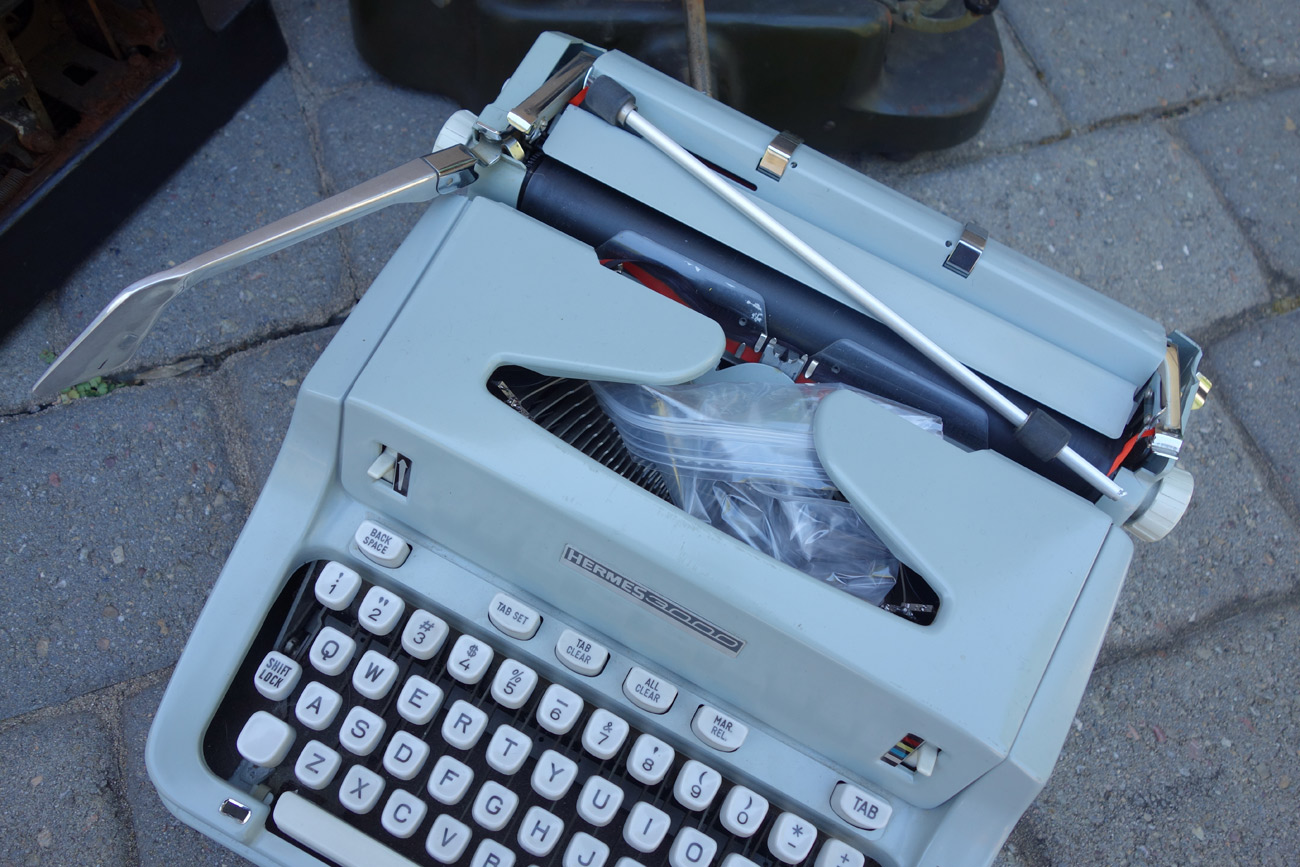
John the 1970 Hermes 3000
A complex bundle of ego with smartypants tendencies, the 1970 cursive Hermes 3000 suffered a catastrophic fall at Moe’s shop. The carriage was mashed into the body and now won’t move.
George the 1922 L. C. Smith & Bros. No. 8
The 1922 LC Smith & Bros 8 has been living in my garage for the past eight months. He seeks to rise above and to achieve a higher level of rust-free consciousness.

The Fifth Beatle: Underwood Portable
There’s also Pete from Idaho, a three-bank Underwood portable with a few pieces that need to find their proper place.

And then there’s the typewriters that need minor fixes:
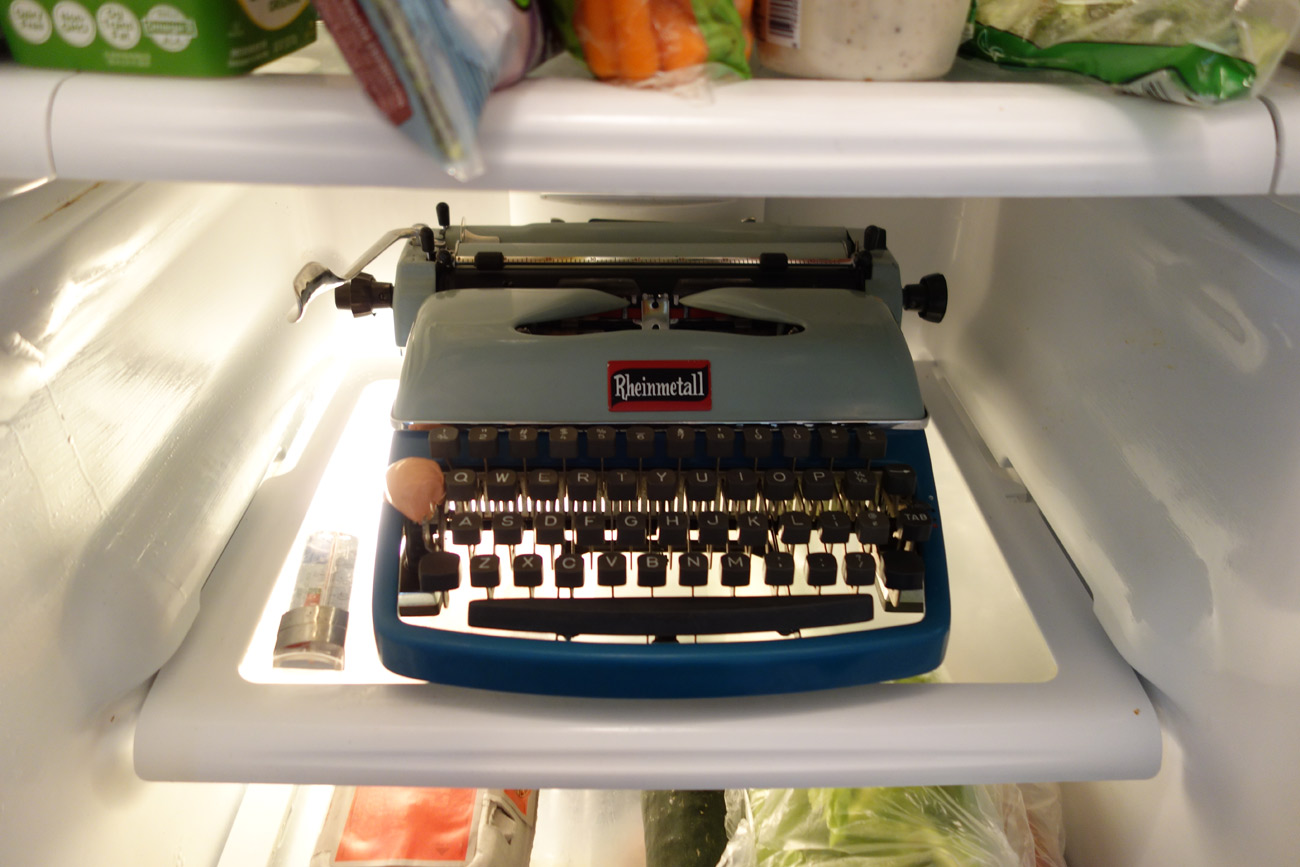
You may ask why is there a Rheinmetall KsT in my fridge with a blob of Silly Putty on the shift lock key (this sentence sounds like typewriter-related Mad Libs). It’s a long story, but it doesn’t have a happy ending yet.
I think that I’ll start with the Hermes 3000. Come here, Sweetie:
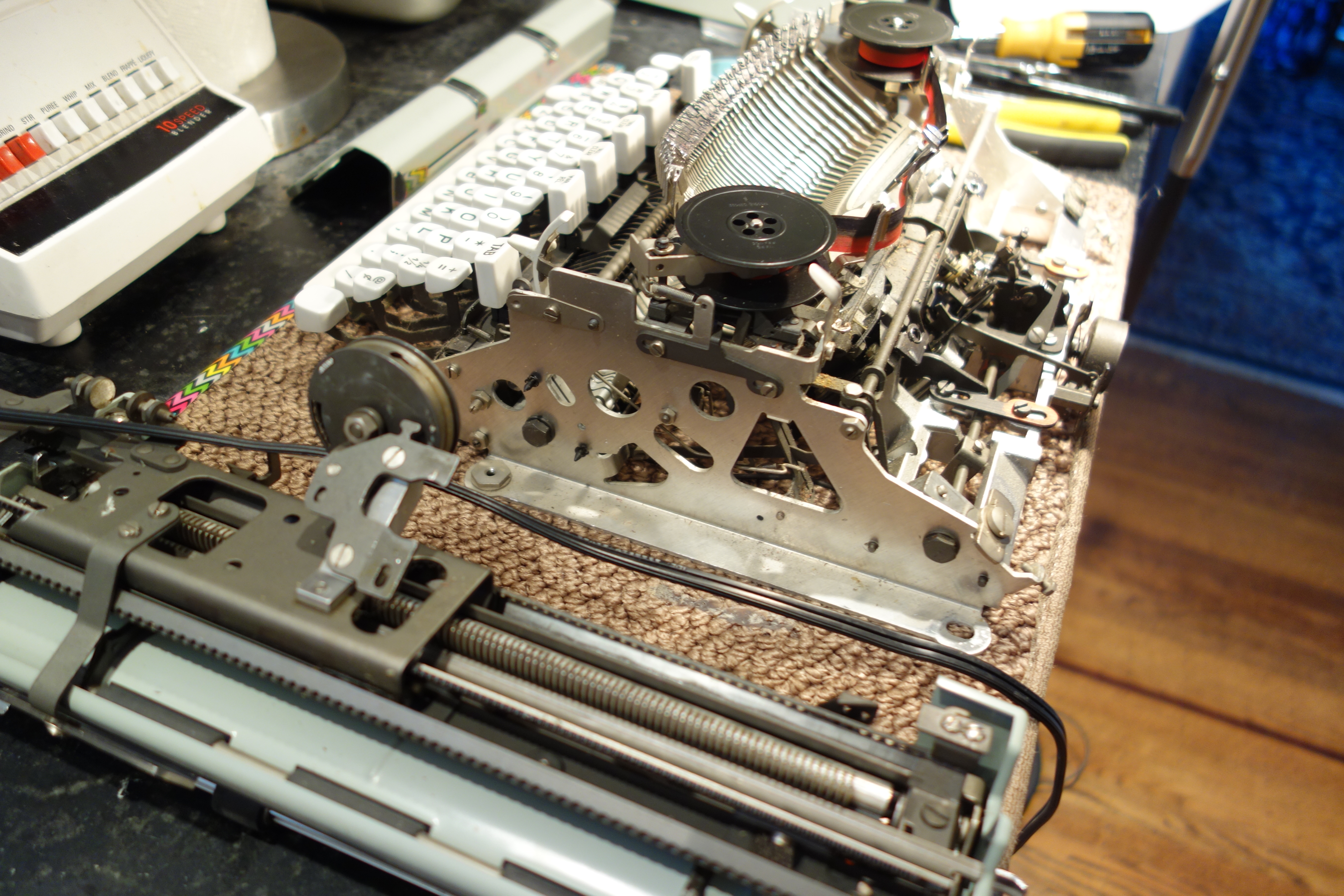
Blender impassively watches the countertop dissection of the Hermes 3000.
Farewell, Summer!
Save
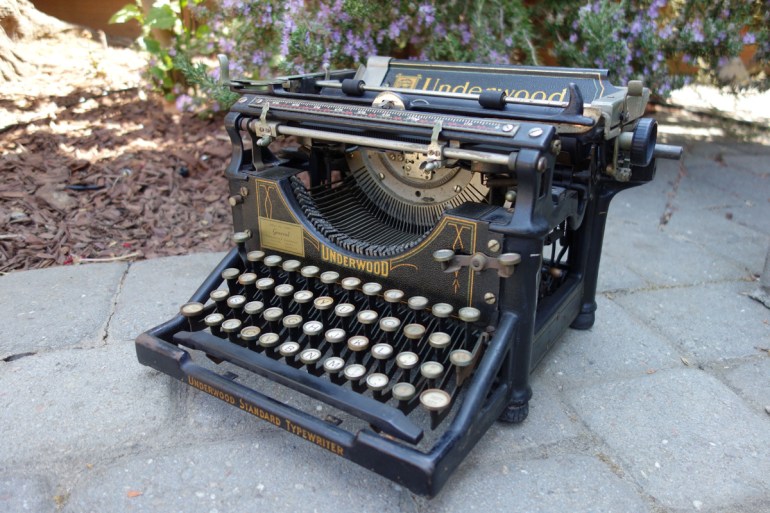
The Underwood Five
Sonny Boy was home briefly from college.

Weird Stuff
“There is no exquisite beauty… without some strangeness in the proportion.”
― Edgar Allan Poe
I have been on the road a lot this summer due to family obligations. Last week, I was up and down the length of New Mexico visiting elderly relatives and taking in the strange and beautiful sights of the Land of Enchantment. I gave Joe VC a silent salute as I passed through Albuquerque.
White Sands, NM is a pretty weird place:

You may be on the moon or in the middle of Antarctica. It was 106°. It was beautiful.
I spotted one typewriter in the wilds of New Mexico. It was crouched in the corner of my cousin’s guestroom north of Santa Fe, ready to spring. Like photos of Bigfoot, this one is a little blurry:
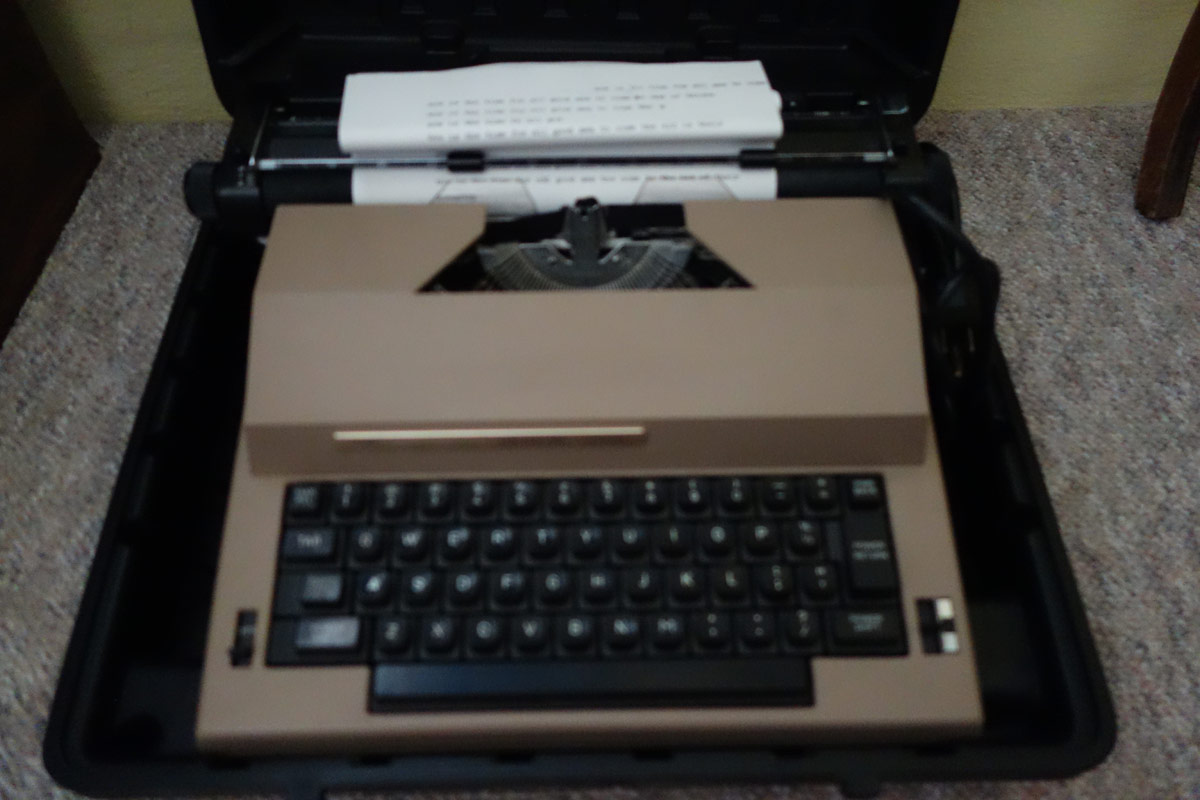
In this photo, you can make out the markings: “Sears – The Electric 2”:

Moe at Mozo’s asked me to drop in after I returned from New Mexico. She had a beautiful little Royal P that she wanted me to admire. It’s a beauty from 1927 with serial number P37918. It types like a son of a gun.

I took a moment to also admire a Barcelona-made Underwood-Olivetti Studio 44 that came in while I was gone. I think it’s from 1961 with serial number 332001. The Studio 44s at Typewriter Database with lower serial numbers seem to be labeled “Underwood-Olivetti” rather than “Olivetti-Underwood”. Funny, that.
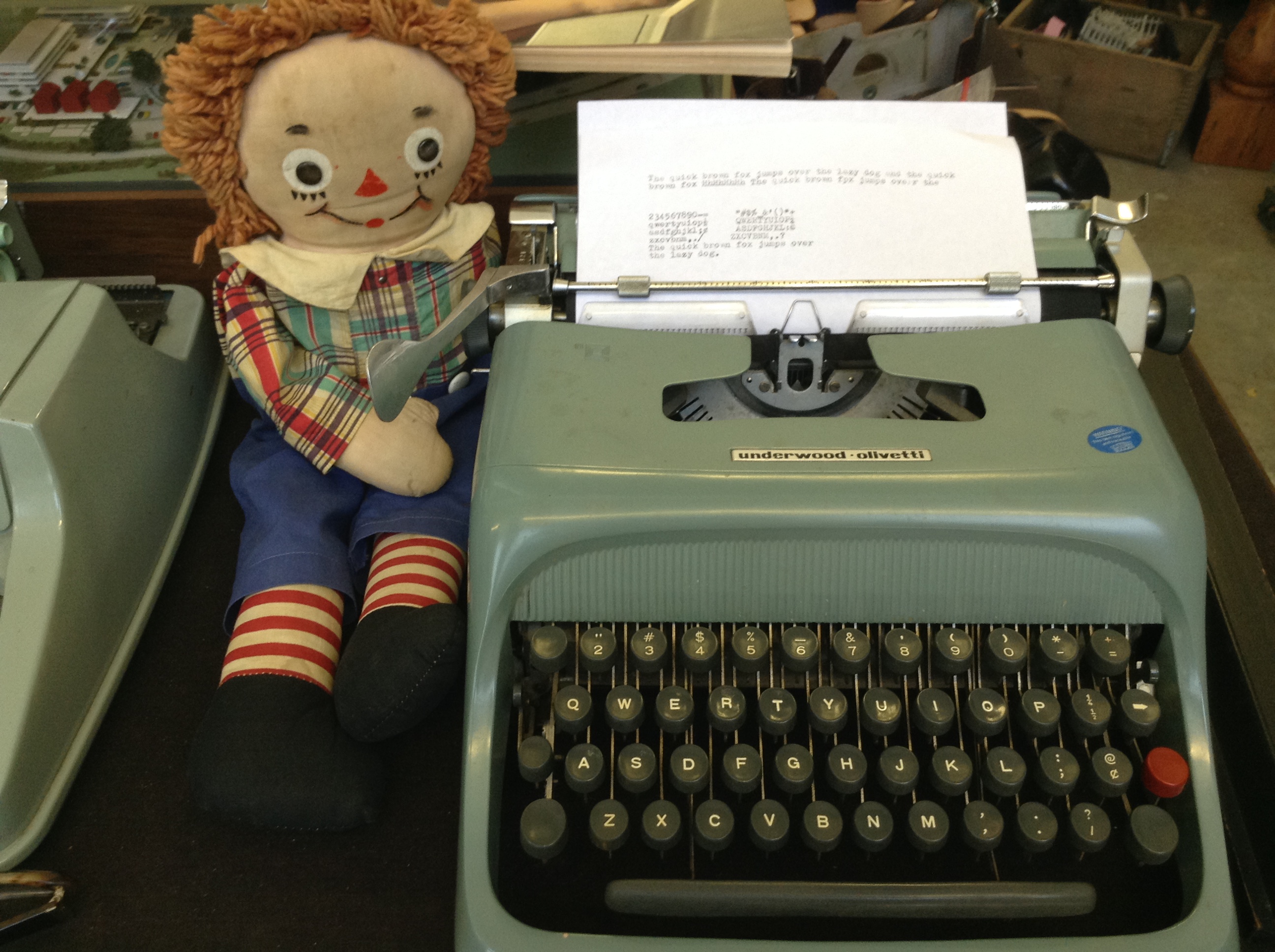
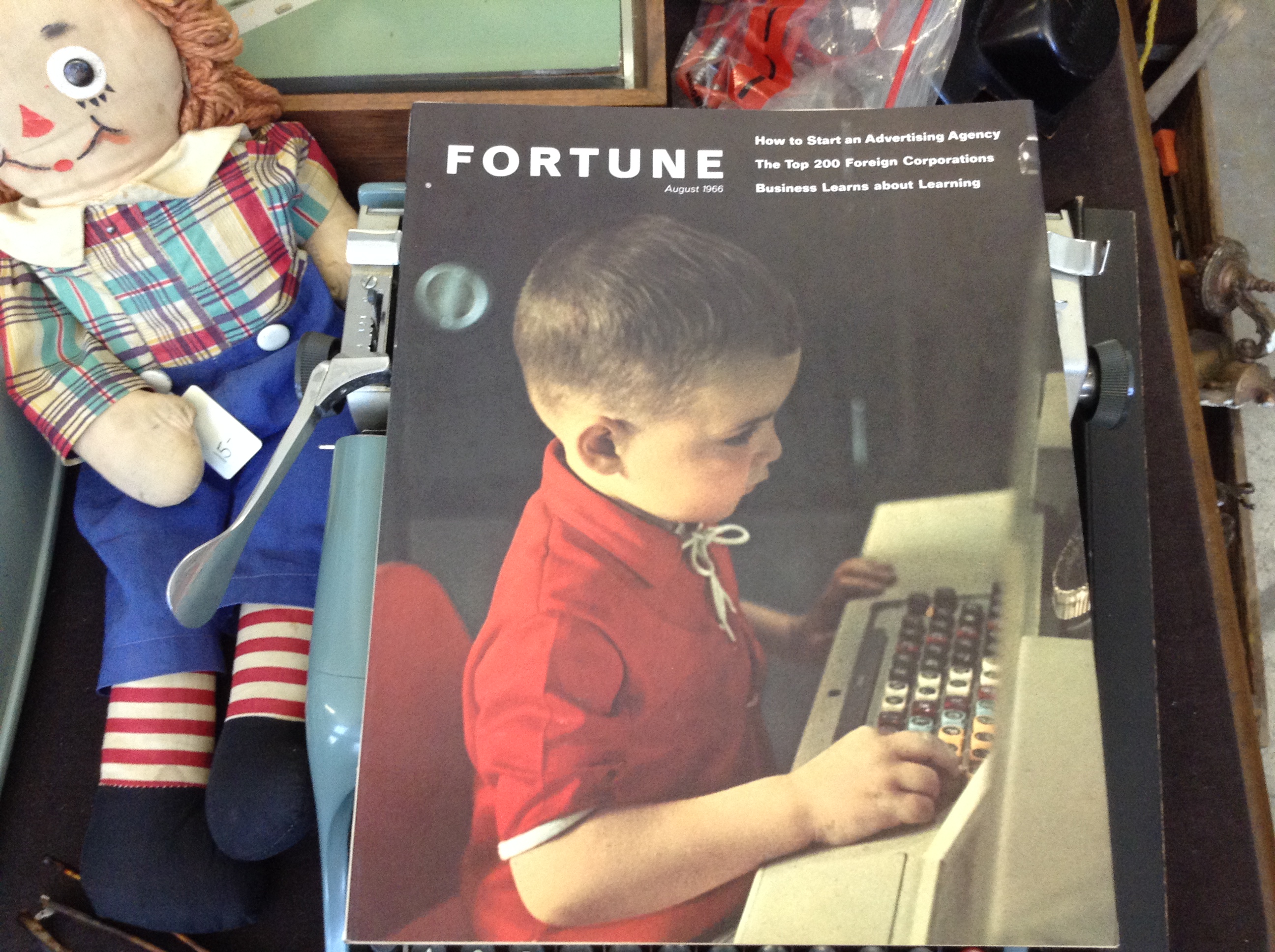
Next to the Studio 44 was a 1966 Fortune magazine with a little kid on the cover diligently hacking the mainframe:
Moe also has a new Underwood 6 that is a bit messed up. The carriage gets stuck in strange ways. It may be just dirty – maybe some tab interference too. I will bring this one home in a couple weeks after I finish my travels for the summer.
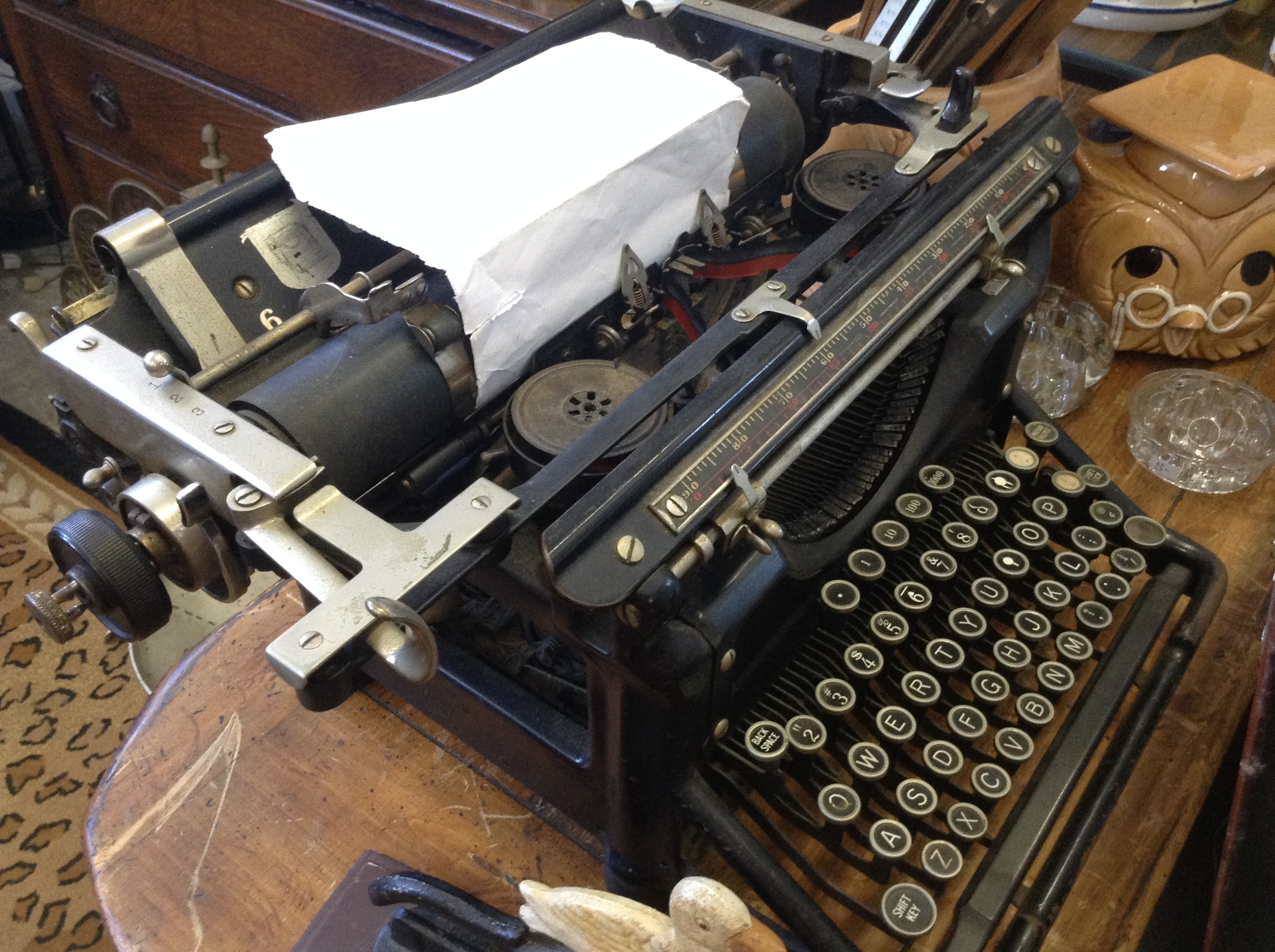
This Underwood 6 has a strange key:
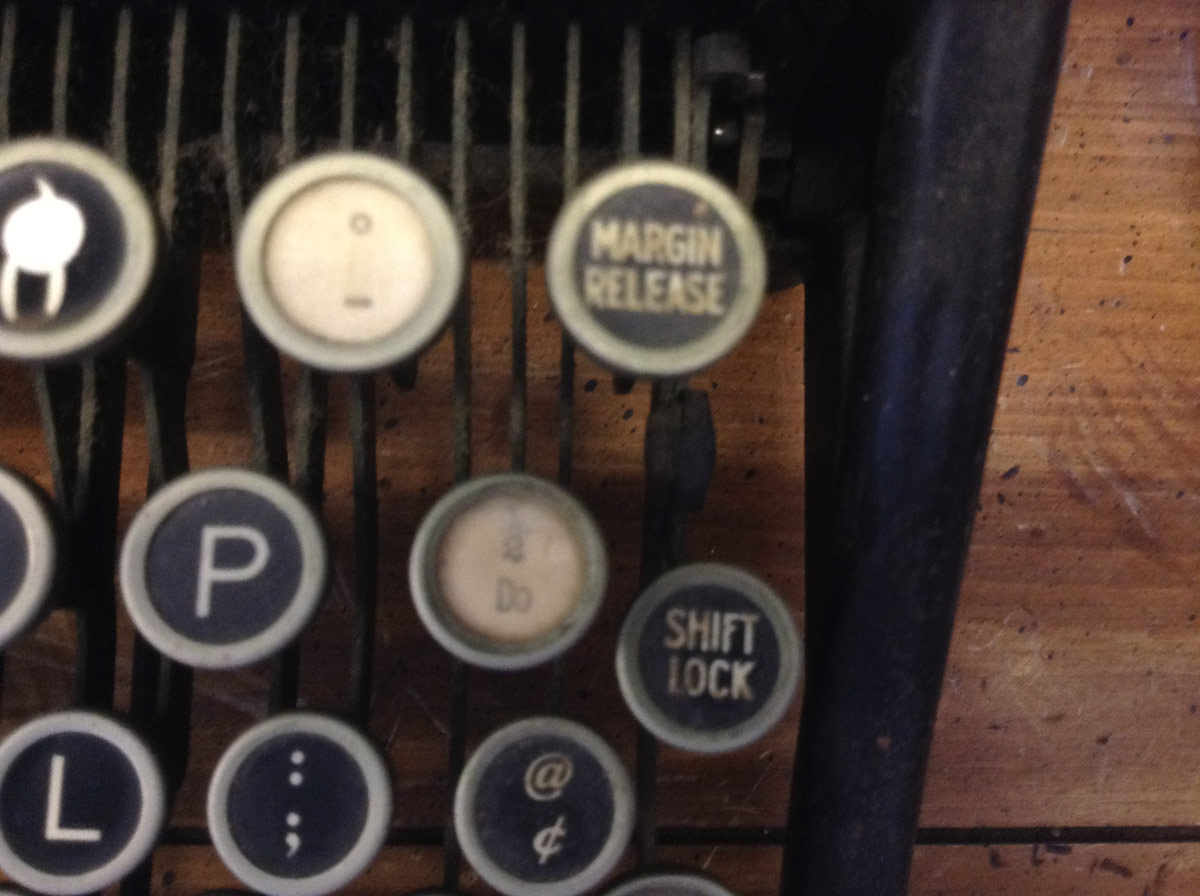
Does anyone know what “DO” stands for? The typewriter also has a degree symbol.
Roia from Mozo’s created an eerie tableau from a doll head while I was gone:

Moe also proudly showed me some strange bird-headed acquisitions:

Moe says that she can’t look at them too long because her heart fills to overflowing with their strangeness. She sneaks peeks at them now and then. Apparently they are Jenny Lind figurines from the 1850s. Jenny Lind was a famous opera singer known as the “Swedish Nightingale”. Still weird.
And here’s another weird thing Moe showed off:
We did not leave Mozo’s empty-handed. My daughter brought home an Anglo concertina from Moe’s and has been making lots of noise with it:

I can’t look at that concertina without thinking of Joan playing the accordion for her husband’s colleagues.
Lastly, I leave you with a random weird typewriter thing for the day. I saw this on Instagram while I was procrastinating and not doing work like I was supposed to.
https://www.instagram.com/p/BFGTFllw_ga/
I wouldn’t stand under that art installation. I did some quick Googling. This is called “Chor der Heuschrecken” (Chorus of the Locusts) by Rebecca Horn, 1991. I wonder if it is still on view in Hamburg.
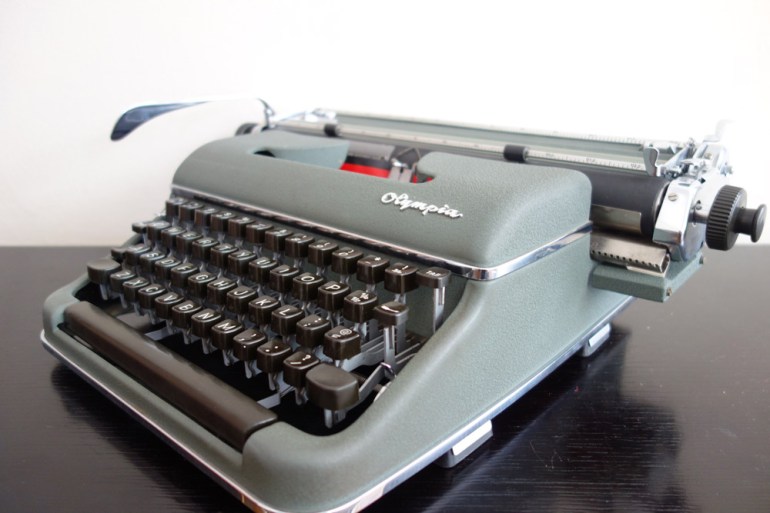
Oly Oly O!
The Shop at Flywheel Press has a beautiful wide carriage 1955 Olympia SM3 that has always fascinated me. A wonderful typewriter, it had extremely bad alignment issues, and I wondered: could I fix it? I had cleaned it previously but shied away from trying to adjust the alignment. On my last trip to The Shop, I noticed that its spacebar was intermittently unresponsive. I decided to bring the Olympia home and see if I could fix the alignment and the space bar.

Fortunately I had recently found Richard Polt’s “Tweaking Your Olympia SM” from the September 2011 issue of ETCetera, so I knew what to do about the space bar.
I flipped the machine on its back and using two pairs of needlenose pliers, “formed” the little “L” shaped piece, squeezing it to make a tighter angle. I tested. The spacebar was much more responsive.
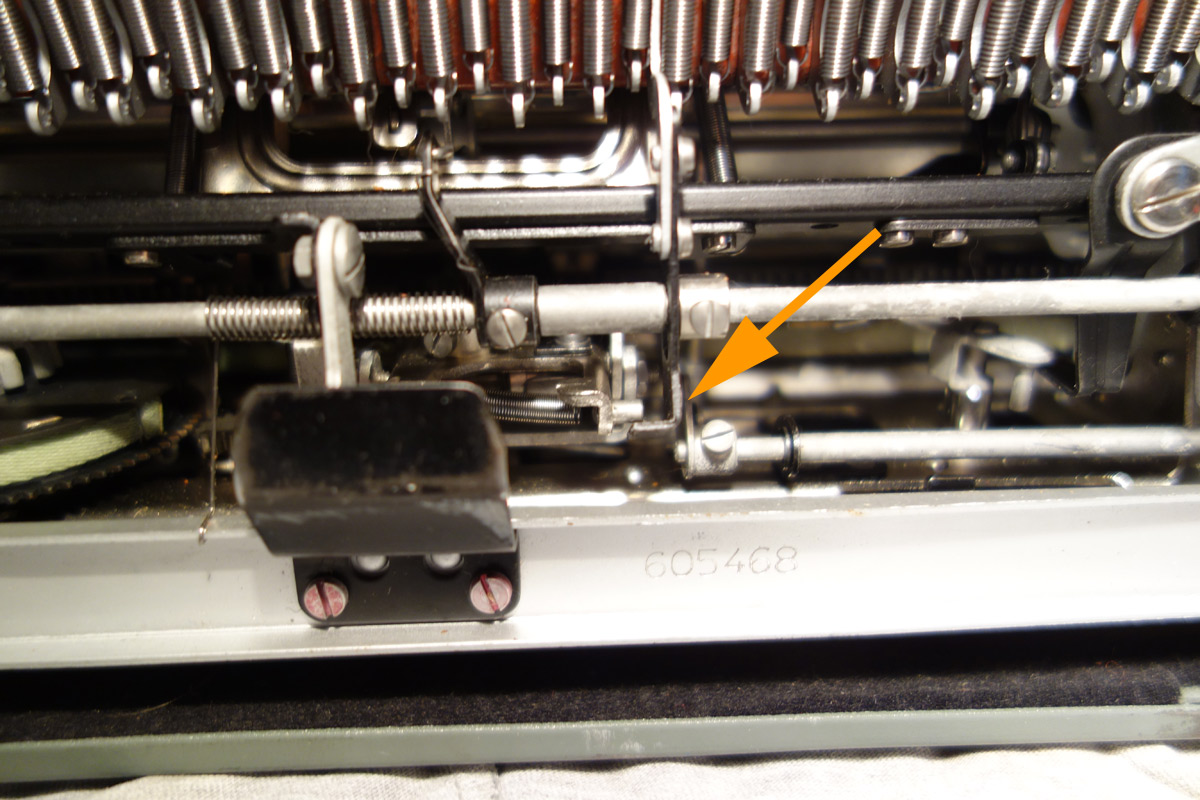
So the next problem was the terrible alignment – as you can see, the upper and lowercase letters were misaligned and the lowercase descenders were faint:

I did some research first, and fortunately alignment fixes are well documented:
- Ted Munk’s Adjusting Vertical Typeface Alignment (Carriage-Shift Typewriters)
- Tony Mindling’s Olympia SM5 Adjustments
- Rob Bowker’s lowercase alignment fix on an Olympia SM4
I saw the four adjustments screws (two on either side) that Ted Munk mentioned, but the lowercase adjustment screws were buried deep within the machine. I would definitely need to remove the cover plates to get at the lowercase adjustment screws.
I read through Tony Mindling’s fix and Rob Bowker’s post, and thought that maybe I didn’t need to remove the typewriter from its shell. Adjustment screws under the carriage at either end were easily accessible:

I took off the end plates on my wide carriage Olympia so that I could nudge the rails further apart after loosening the “Rob Bowker screw”. In theory, increasing the distance between the rails will cause the carriage to sit lower – and that will allow the slugs to hit the platen at the correct angle and that will result in better printed text. Right?

This is where is all gets a little foggy for me. I can’t remember exactly what I did and didn’t do. I kept getting interrupted in the middle of this project and lost track of my changes. I know I loosened the “Rob Bowker screw” and nudged the carriage rails further apart. I *think* I loosened the lowercase adjustment plate and slid it backwards and forwards and tested various positions.
In any case, the upper/lowercase alignment was still way out of kilter and the descenders were still very faded.
I decided to peel off the cover plates to see if I could access the lowercase adjustment screws.

It wasn’t bad – the ribbon cover pops right off and after removing the front and back plates, the typewriter lifted out of the main shell.
I found the lowercase adjustment screws directly under the ribbon spools. Fortunately I was able to get a ¼” wrench in the side to loosened the lock nuts on either side.

And then I experimented with tightening and loosening the adjustment screws. I wasn’t getting anywhere. Printed text was still misaligned and had faded descenders.
I went back to the carriage rails. Hmm. I loosened the lowercase(?) slide plate screws on each side and moved the plates forward so that they looked like Tony Mindling’s pictures.
They started like this:

And they ended up like this:
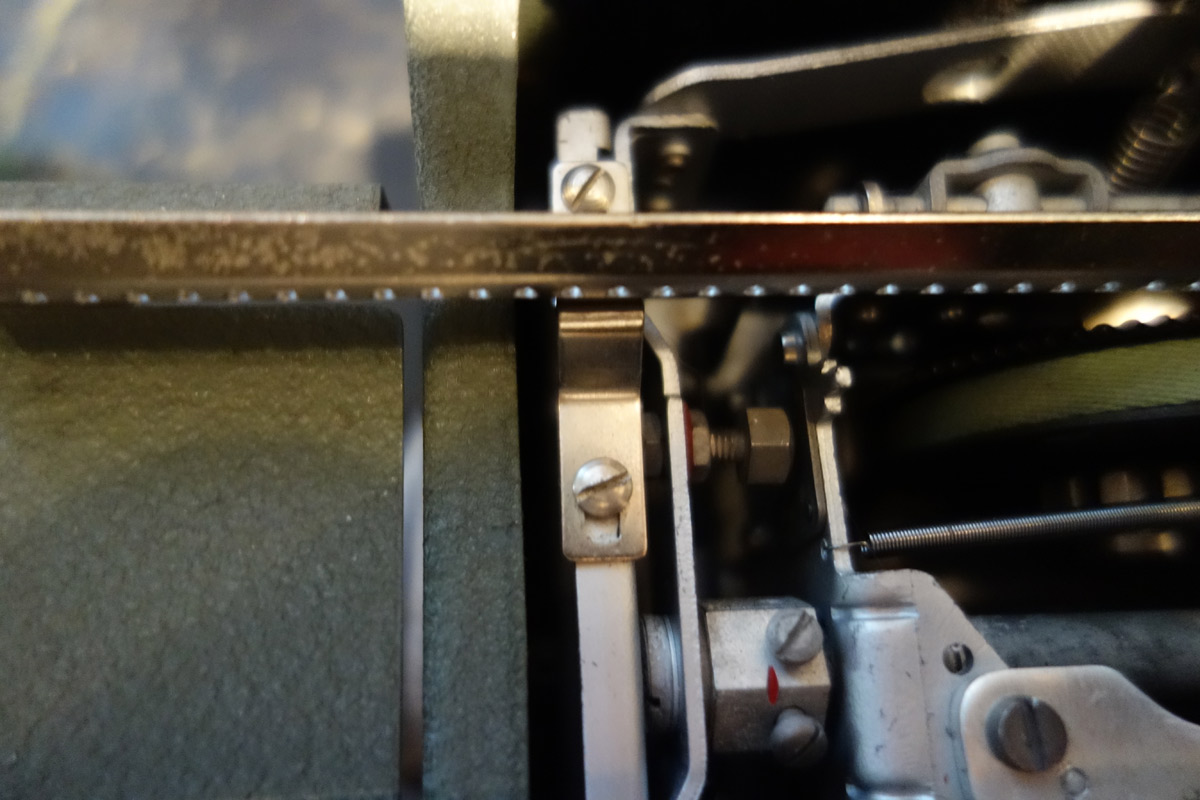
I tested. Finally.

The descenders were finally nice and dark. Alignment of upper and lowercase letters was still screwy, but this time the lowercase letters were too high.
I went back to the lowercase adjustment screws under the ribbon spools on both sides and gradually brought the lowercase letters into alignment.


It was time to put the Olympia back in its shell. I don’t like to leave typewriters dismantled, as I worry that I may forget how to put things back together. I take detailed photos in the dismantling process, but still, I like to move quickly while it’s all fresh.
The rubber bushing between the typewriter and the shell were disintegrating. It was a matter of time before they went completely and caused problems. Here’s a detailed post on bushing replacement from Clickthing.

When I returned the Olympia to its shell, I peeled out the gooey remnants and slipped in new rubber washers.
All the plates back on, I did a little test typing.

What the #$@&%*! ??? What happened to my uppercase alignment???
I put the typewriter in shift-lock and tested typing – and it got stuck in shifted position. I couldn’t unlock shifting. I flipped the machine over and found the culprit. My brand new bushing on the front left was blocking the shift and shift lock levers:
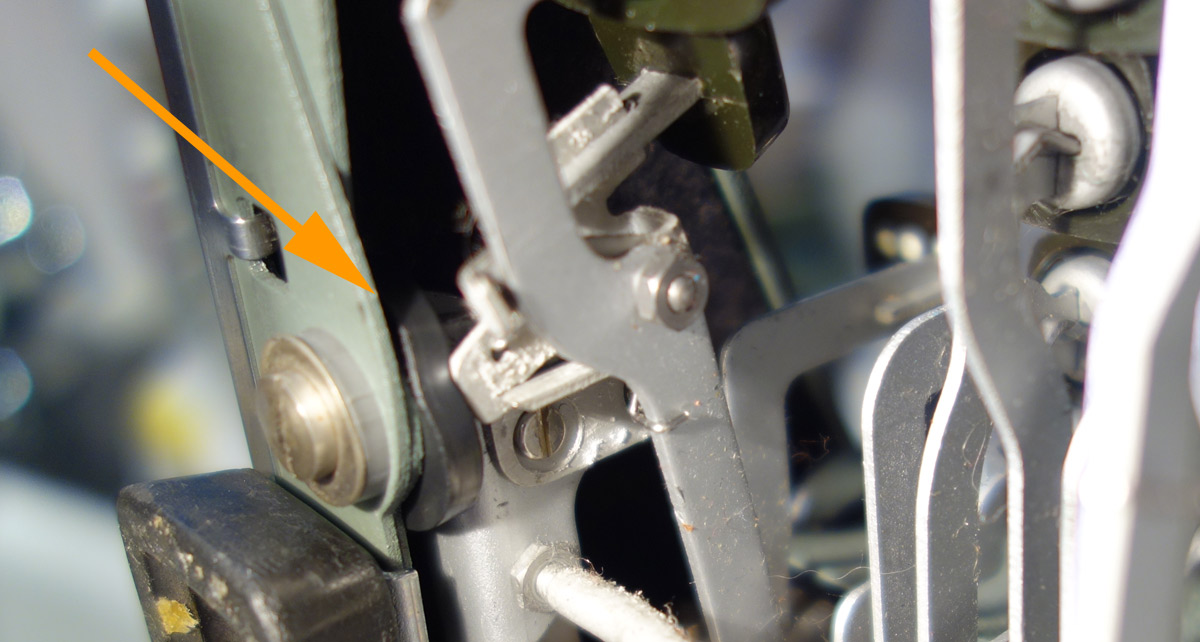
I carefully sawed off the interfering rubber edge – the shift levers were free. I did some testing:
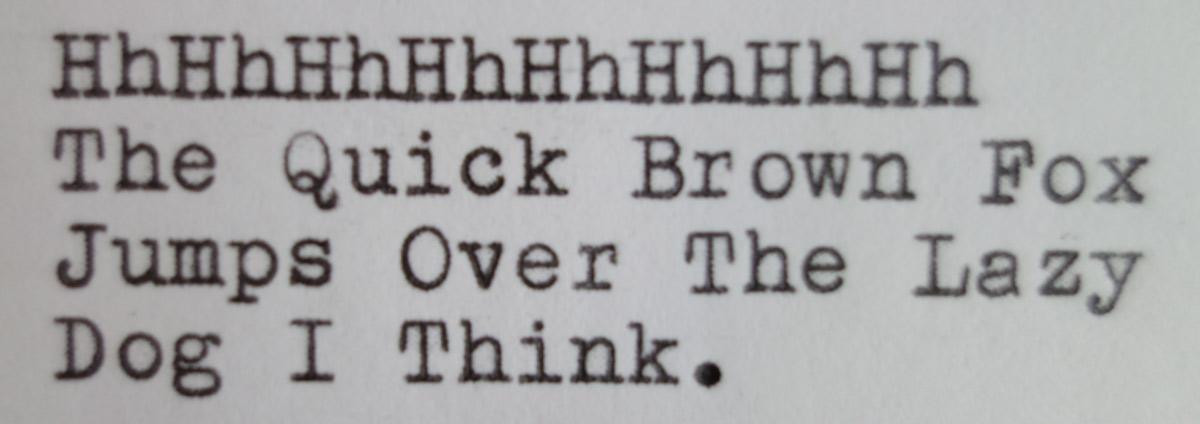
Not perfectly perfect, but so much better than it was before.
In conclusion: I have nicely aligned text that is uniformly dark. I am still not quite sure how I got to this point, but I never would have been able to do this without helpful typospherian blogs. If I have incorrectly identified adjustment areas, let me know.


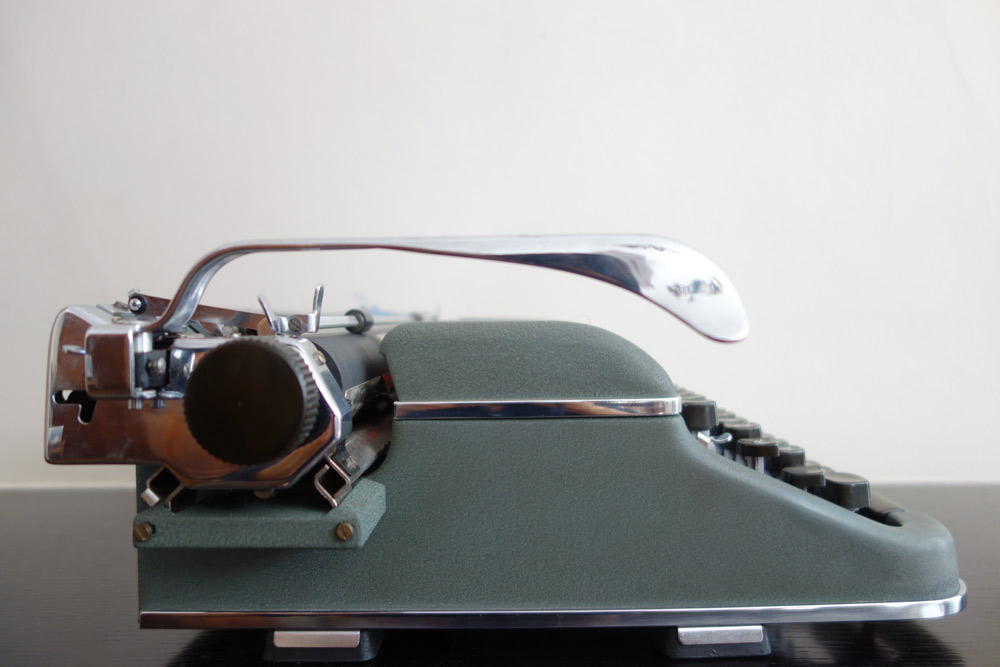
As I am a child of the Pacific Northwest, Olympia typewriters always remind me of Olympia Beer, made with the naturally pure artesian brewing water of Tumwater, Washington.
Olympia Beer had a nice jingle back in the day that went something like this:
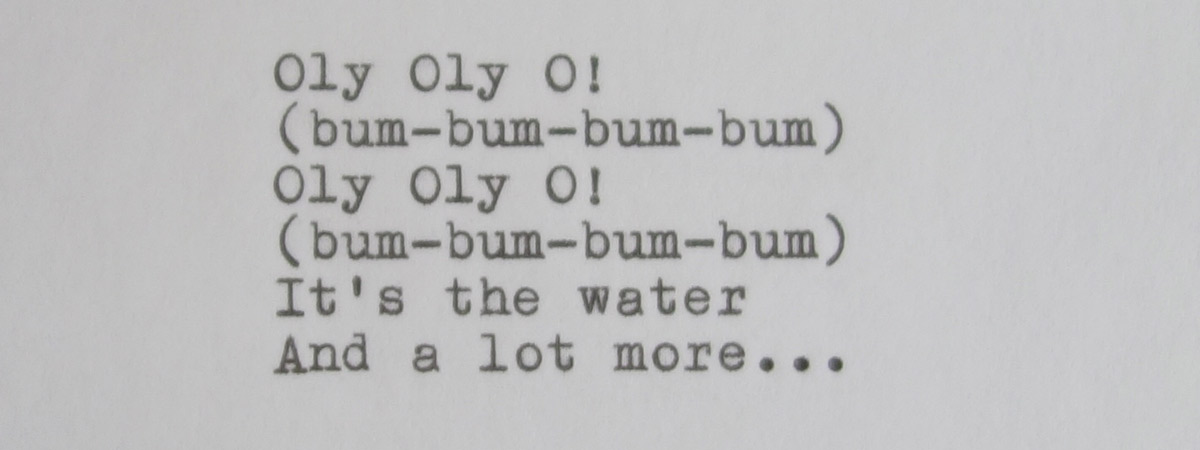
This is possibly one of the gentlest and sweetest beer commercials ever made. Why don’t they make beer commercials like this anymore? Bonus: it features Teri Garr:
I can’t resist sharing another beer commercial from my childhood – this one made by Olympia’s Northwest competitor, Rainier. It features the soundtrack of my soggy Oregonian upbringing: windshield wipers.
Save

Cleaning Becomes Electra
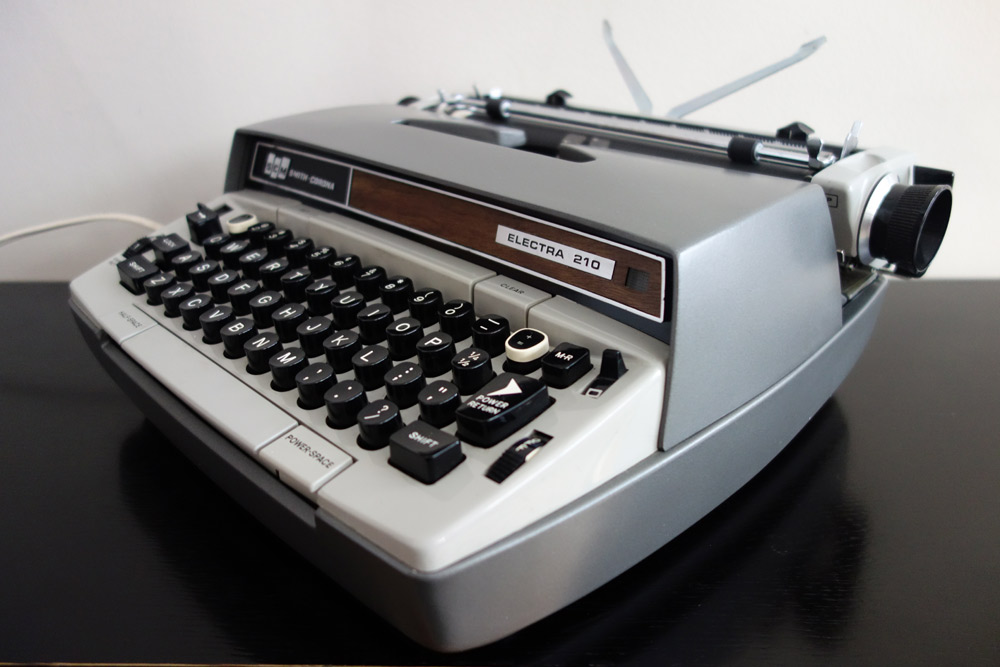
I was leaving on vacation a couple weeks ago, but I couldn’t resist the siren call of a broken electric typewriter at Moe’s shop. While I supposed to be packing, I was instead fooling around with this misbehaving Smith-Corona Electra 210:
When the power was turned on, the typewriter mysteriously typed all by itself, hitting “5” repeatedly. “555” is not exactly the mark of the beast, but the typewriter was seemingly possessed:

I took off the bottom of the typewriter and blew out dust and etc from inside the machine:

You can see that the lever for “5” is partially engaged and I found the lever connections very gummy. I cleaned carefully with mineral spirits:

I flipped the machine over, plugged it back in, and turned the power on. No automatic “5” typing! I did some tentative pecking and all seemed well until I hit the “h” key and the typewriter went bananas with a repeating “h” key. I ended up turning it off, unplugging it, flipping it over, and cleaning it a few times as random keys would get stuck. Eventually everything was freed up and the typewriter was working like a charm.
This is such a pleasant machine to use, fairly quiet for an electric.

Joe Van Cleave recently posted a really good video comparing a Smith-Corona Galaxy 12 with the electric Smith-Corona Coronet Automatic 12:
I have enjoyed Joe’s typewriter video series very much.
I may end up buying the Electra 210 from Moe and donating it to The Shop at Flywheel Press. It could replace a wonderful but rather delicate electric Penncrest. That poor dear has sprung clevises (AKA “link springs”) that have sprung so many times that they can’t withstand the onslaught of kid fingers after re-attachment. The little kids have a tendency to push several keys all at once and *POP* goes the clevises.
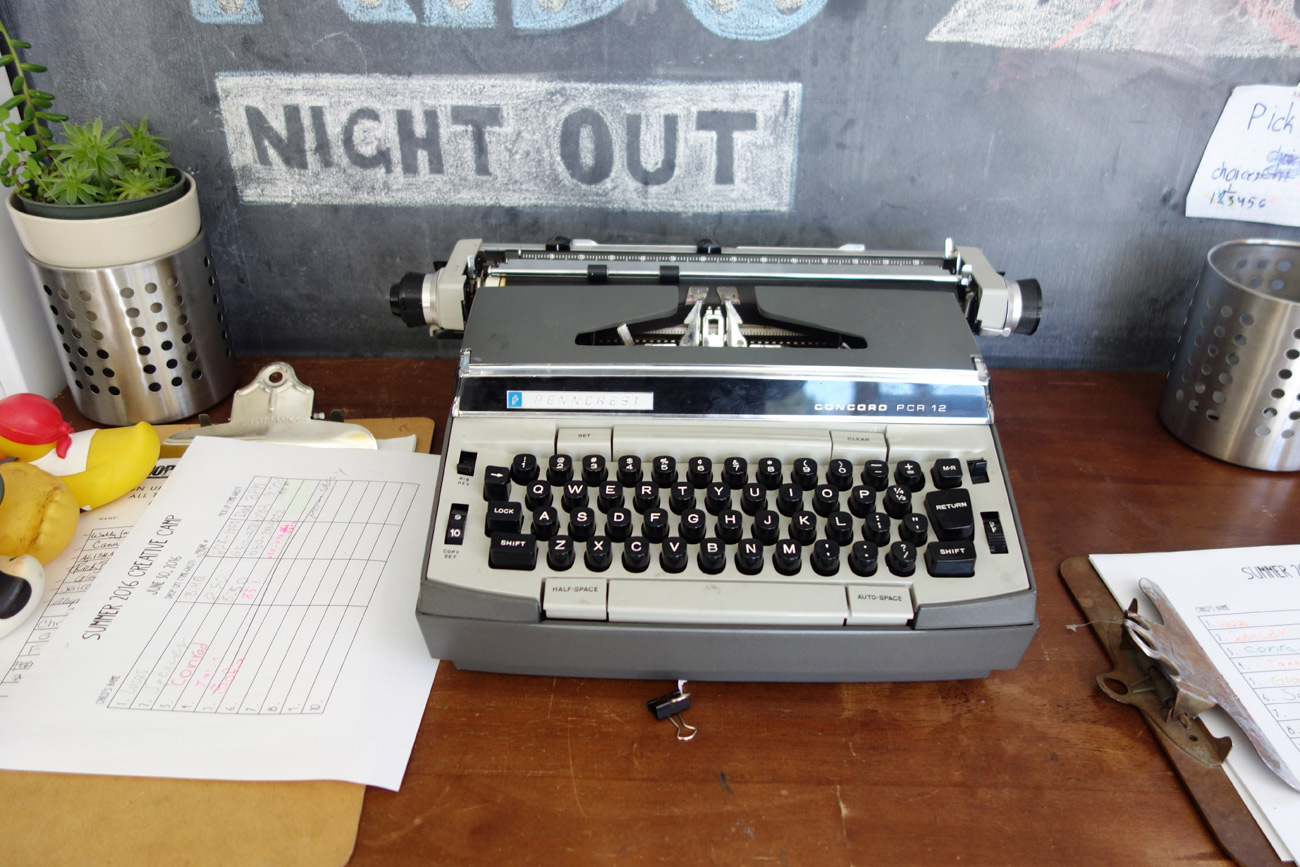
This Penncrest should probably be an adult-only typewriter.
After I returned from vacation last week, I swung by The Shop at Flywheel Press to do typewriter tune-up. The typewriters there had been through several summer kids camps and had a few events in front of them.

I brought my tub of cleaning and repair materials and got most of the typewriters back on their feet. Minor ribbon issues and engaged carriage locks seem to be the most common problems.
That wide carriage Olympia SM3 came home with me since the space bar was unresponsive and the vertical text alignment very off.
I am amazed that repairs such as this duct-tape clevis repair on a SCM Galaxie have withstood the slings and arrows of kid camps.

Yay, duct tape!
Recalled to Life
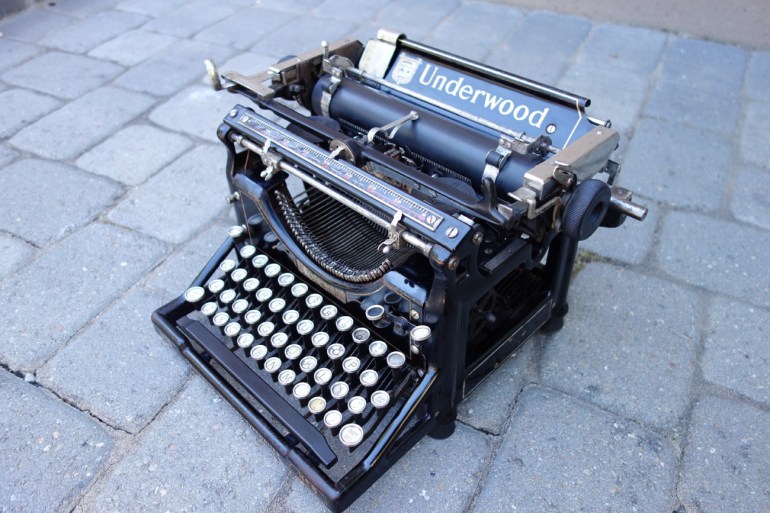
As I prepared Quin’s Underwood 5 for its return to Modesto, I finished the last items on my to do list. I used a lot of penetrating oil on this typewriter, so I needed to flush out the sticky oil before it started attracting dirt. I flushed everything with liberal amounts of mineral spirits and then gave the typewriter a final blast of air to clear out the steel wool fragments and rusty grit.


